Event submissions
Published
This submission belongs to the session S2. Hydrogels, Organogels, Xerogels, and Aerogels of the event The 1st International Online Conference on Gels
Published date
28 Nov, 2025
Academic Editor
'%3e%3cpath%20d='M12.6657%2010.9104C12.4185%2010.325%2012.0599%209.79327%2011.6097%209.34482C11.1609%208.89508%2010.6293%208.5365%2010.0442%208.28888C10.0389%208.28626%2010.0337%208.28495%2010.0285%208.28233C10.8446%207.69279%2011.3752%206.73249%2011.3752%205.64904C11.3752%203.8542%209.92103%202.39999%208.1262%202.39999C6.33136%202.39999%204.87715%203.8542%204.87715%205.64904C4.87715%206.73249%205.40774%207.69279%206.22393%208.28364C6.21869%208.28626%206.21345%208.28757%206.20821%208.29019C5.62129%208.5378%205.09463%208.89284%204.64265%209.34613C4.1929%209.79493%203.83432%2010.3266%203.58671%2010.9117C3.34345%2011.4845%203.21226%2012.0987%203.20023%2012.7209C3.19988%2012.7349%203.20233%2012.7488%203.20744%2012.7619C3.21255%2012.7749%203.22022%2012.7867%203.22998%2012.7968C3.23975%2012.8068%203.25142%2012.8147%203.26431%2012.8202C3.2772%2012.8256%203.29105%2012.8284%203.30504%2012.8284H4.09109C4.14874%2012.8284%204.19459%2012.7825%204.1959%2012.7262C4.2221%2011.7148%204.62823%2010.7676%205.34617%2010.0497C6.08899%209.30683%207.0755%208.89808%208.1262%208.89808C9.17689%208.89808%2010.1634%209.30683%2010.9062%2010.0497C11.6242%2010.7676%2012.0303%2011.7148%2012.0565%2012.7262C12.0578%2012.7838%2012.1037%2012.8284%2012.1613%2012.8284H12.9474C12.9613%2012.8284%2012.9752%2012.8256%2012.9881%2012.8202C13.001%2012.8147%2013.0126%2012.8068%2013.0224%2012.7968C13.0322%2012.7867%2013.0398%2012.7749%2013.0449%2012.7619C13.0501%2012.7488%2013.0525%2012.7349%2013.0522%2012.7209C13.0391%2012.0947%2012.9094%2011.4855%2012.6657%2010.9104ZM8.1262%207.9024C7.52486%207.9024%206.9589%207.6679%206.53312%207.24211C6.10733%206.81633%205.87283%206.25037%205.87283%205.64904C5.87283%205.0477%206.10733%204.48174%206.53312%204.05596C6.9589%203.63018%207.52486%203.39567%208.1262%203.39567C8.72753%203.39567%209.29349%203.63018%209.71927%204.05596C10.1451%204.48174%2010.3796%205.0477%2010.3796%205.64904C10.3796%206.25037%2010.1451%206.81633%209.71927%207.24211C9.29349%207.6679%208.72753%207.9024%208.1262%207.9024Z'%20fill='%235D1EE1'/%3e%3c/g%3e%3c/svg%3e) SIDI A. BENCHERIF
SIDI A. BENCHERIFCitation
Bambang Riyanto, Rusty Rosalina Simatupang, Wini Trilaksani, Wahyu Ramadhan, Structurally Stable Aerogel from Marine Biopolymers for the Functional Delivery of Virgin Fish Oil, in Proceedings of The 1st International Online Conference on Gels, 3 December–5 December 2025, MDPI: Basel, Switzerland
Share
Email
Facebook
Twitter
LinkedIn
Structurally Stable Aerogel from Marine Biopolymers for the Functional Delivery of Virgin Fish Oil
'%3e%3cpath%20d='M12.6647%2010.9104C12.4176%2010.325%2012.0589%209.7933%2011.6088%209.34485C11.16%208.89511%2010.6283%208.53653%2010.0432%208.28891C10.038%208.28629%2010.0327%208.28498%2010.0275%208.28236C10.8437%207.69282%2011.3743%206.73252%2011.3743%205.64907C11.3743%203.85423%209.92005%202.40002%208.12522%202.40002C6.33038%202.40002%204.87618%203.85423%204.87618%205.64907C4.87618%206.73252%205.40677%207.69282%206.22296%208.28367C6.21772%208.28629%206.21248%208.2876%206.20724%208.29022C5.62031%208.53783%205.09365%208.89287%204.64167%209.34616C4.19192%209.79496%203.83334%2010.3266%203.58573%2010.9117C3.34247%2011.4846%203.21128%2012.0987%203.19925%2012.721C3.1989%2012.735%203.20135%2012.7489%203.20646%2012.7619C3.21157%2012.7749%203.21924%2012.7868%203.22901%2012.7968C3.23877%2012.8068%203.25045%2012.8148%203.26334%2012.8202C3.27623%2012.8256%203.29007%2012.8284%203.30406%2012.8284H4.09012C4.14776%2012.8284%204.19362%2012.7825%204.19493%2012.7262C4.22113%2011.7148%204.62726%2010.7676%205.34519%2010.0497C6.08802%209.30686%207.07452%208.89811%208.12522%208.89811C9.17592%208.89811%2010.1624%209.30686%2010.9052%2010.0497C11.6232%2010.7676%2012.0293%2011.7148%2012.0555%2012.7262C12.0568%2012.7839%2012.1027%2012.8284%2012.1603%2012.8284H12.9464C12.9604%2012.8284%2012.9742%2012.8256%2012.9871%2012.8202C13%2012.8148%2013.0117%2012.8068%2013.0214%2012.7968C13.0312%2012.7868%2013.0389%2012.7749%2013.044%2012.7619C13.0491%2012.7489%2013.0515%2012.735%2013.0512%2012.721C13.0381%2012.0947%2012.9084%2011.4856%2012.6647%2010.9104ZM8.12522%207.90243C7.52388%207.90243%206.95792%207.66793%206.53214%207.24215C6.10636%206.81636%205.87185%206.2504%205.87185%205.64907C5.87185%205.04773%206.10636%204.48177%206.53214%204.05599C6.95792%203.63021%207.52388%203.3957%208.12522%203.3957C8.72655%203.3957%209.29252%203.63021%209.7183%204.05599C10.1441%204.48177%2010.3786%205.04773%2010.3786%205.64907C10.3786%206.2504%2010.1441%206.81636%209.7183%207.24215C9.29252%207.66793%208.72655%207.90243%208.12522%207.90243Z'%20fill='%235D1EE1'/%3e%3c/g%3e%3c/svg%3e)
Bambang Riyanto 1
Rusty Rosalina Simatupang 1
Wini Trilaksani 1

Wahyu Ramadhan 1
1. Department of Aquatic Product Technology, Faculty of Fisheries and Marine Science, IPB University, Bogor 16680, Indonesia
Abstract
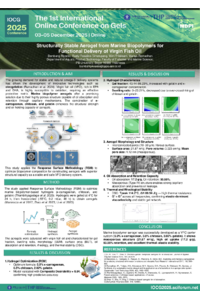
Virgin fish oil (VFO) is a high-quality source of omega-3 polyunsaturated fatty acids, particularly EPA and DHA, which offer significant health benefits. However, its application remains limited due to poor oxidative stability and undesirable sensory characteristics. Aerogel-based oleogelation presents an innovative non-thermal approach to address these challenges by forming a semi-solid structure that protects bioactive compounds while enhancing formulation flexibility. This study aimed to develop and optimize a marine biopolymer-based aerogel with superior structural capacity for VFO delivery using the Response Surface Methodology (RSM). Optimization was performed using a Box–Behnken experimental design. Three marine biopolymers—κ-carrageenan (0.5–3.0% w/v), chitosan (0.5–4.0% w/v), and gelatin (2–15% w/v)—were evaluated based on two key responses: gel fraction and swelling ratio. The optimized hydrogel was then freeze-dried to produce aerogel. Characterization was conducted using Scanning Electron Microscopy (SEM) for pore morphology, Brunauer–Emmett–Teller (BET) analysis for surface area, Differential Scanning Calorimetry (DSC) for thermal stability, and rheological analysis (frequency sweep) to evaluate oil absorption capacity and viscoelastic behavior. The optimal formula consisted of 0.90% κ-carrageenan, 0.5% chitosan, and 2.02% gelatin, resulting in a gel fraction of 54.50% and a swelling ratio of 23.07%. The resulting aerogel exhibited a mesoporous structure (3–7 nm), a specific surface area of 21.87 m²/g, and an oil absorption capacity of 17.2 g/g. DSC analysis revealed a thermal phase transition peak at 114.2°C and an enthalpy of 80.54 J/g. Rheological testing showed dominant elastic behavior (G’ > G”, tan δ < 1), indicating strong mechanical stability. The formulated marine biopolymer-based aerogel proved effective as a structurally and thermally stable VFO delivery system. This innovation shows strong potential for application in functional food products and supports the use of sustainable, clean-label marine-derived materials.
Keywords
chitosan
functional food
gel fraction
omega-3 delivery
virgin fish oil
Poster
Poster IOCG 2025_IPB University_Rusty Rosalina Simatupang.pdf
Design of a novel biodegradable hydrogel scaffold for cultured meat production
Foxy5-Loaded Thermosensitive Hydrogel Incorporating Hyaluronic Acid for Bone defect Applications