Event submissions
Published
This submission belongs to the session S2. Hydrogels, Organogels, Xerogels, and Aerogels of the event The 1st International Online Conference on Gels
Published date
28 Nov, 2025
Academic Editor
'%3e%3cpath%20d='M12.6657%2010.9104C12.4185%2010.325%2012.0599%209.79327%2011.6097%209.34482C11.1609%208.89508%2010.6293%208.5365%2010.0442%208.28888C10.0389%208.28626%2010.0337%208.28495%2010.0285%208.28233C10.8446%207.69279%2011.3752%206.73249%2011.3752%205.64904C11.3752%203.8542%209.92103%202.39999%208.1262%202.39999C6.33136%202.39999%204.87715%203.8542%204.87715%205.64904C4.87715%206.73249%205.40774%207.69279%206.22393%208.28364C6.21869%208.28626%206.21345%208.28757%206.20821%208.29019C5.62129%208.5378%205.09463%208.89284%204.64265%209.34613C4.1929%209.79493%203.83432%2010.3266%203.58671%2010.9117C3.34345%2011.4845%203.21226%2012.0987%203.20023%2012.7209C3.19988%2012.7349%203.20233%2012.7488%203.20744%2012.7619C3.21255%2012.7749%203.22022%2012.7867%203.22998%2012.7968C3.23975%2012.8068%203.25142%2012.8147%203.26431%2012.8202C3.2772%2012.8256%203.29105%2012.8284%203.30504%2012.8284H4.09109C4.14874%2012.8284%204.19459%2012.7825%204.1959%2012.7262C4.2221%2011.7148%204.62823%2010.7676%205.34617%2010.0497C6.08899%209.30683%207.0755%208.89808%208.1262%208.89808C9.17689%208.89808%2010.1634%209.30683%2010.9062%2010.0497C11.6242%2010.7676%2012.0303%2011.7148%2012.0565%2012.7262C12.0578%2012.7838%2012.1037%2012.8284%2012.1613%2012.8284H12.9474C12.9613%2012.8284%2012.9752%2012.8256%2012.9881%2012.8202C13.001%2012.8147%2013.0126%2012.8068%2013.0224%2012.7968C13.0322%2012.7867%2013.0398%2012.7749%2013.0449%2012.7619C13.0501%2012.7488%2013.0525%2012.7349%2013.0522%2012.7209C13.0391%2012.0947%2012.9094%2011.4855%2012.6657%2010.9104ZM8.1262%207.9024C7.52486%207.9024%206.9589%207.6679%206.53312%207.24211C6.10733%206.81633%205.87283%206.25037%205.87283%205.64904C5.87283%205.0477%206.10733%204.48174%206.53312%204.05596C6.9589%203.63018%207.52486%203.39567%208.1262%203.39567C8.72753%203.39567%209.29349%203.63018%209.71927%204.05596C10.1451%204.48174%2010.3796%205.0477%2010.3796%205.64904C10.3796%206.25037%2010.1451%206.81633%209.71927%207.24211C9.29349%207.6679%208.72753%207.9024%208.1262%207.9024Z'%20fill='%235D1EE1'/%3e%3c/g%3e%3c/svg%3e) SIDI A. BENCHERIF
SIDI A. BENCHERIFCitation
Carla Serri, Hansheng Deng, Tianfeng Zhu, Gianfilippo Caggiari, Giovanna Rassu, Paolo Giunchedi, Carlo Doria, Elisabetta Gavini, Foxy5-Loaded Thermosensitive Hydrogel Incorporating Hyaluronic Acid for Bone defect Applications, in Proceedings of The 1st International Online Conference on Gels, 3 December–5 December 2025, MDPI: Basel, Switzerland
Share
Email
Facebook
Twitter
LinkedIn
Foxy5-Loaded Thermosensitive Hydrogel Incorporating Hyaluronic Acid for Bone defect Applications

Carla Serri 1
'%3e%3cpath%20d='M12.6647%2010.9104C12.4176%2010.325%2012.0589%209.7933%2011.6088%209.34485C11.16%208.89511%2010.6283%208.53653%2010.0432%208.28891C10.038%208.28629%2010.0327%208.28498%2010.0275%208.28236C10.8437%207.69282%2011.3743%206.73252%2011.3743%205.64907C11.3743%203.85423%209.92005%202.40002%208.12522%202.40002C6.33038%202.40002%204.87618%203.85423%204.87618%205.64907C4.87618%206.73252%205.40677%207.69282%206.22296%208.28367C6.21772%208.28629%206.21248%208.2876%206.20724%208.29022C5.62031%208.53783%205.09365%208.89287%204.64167%209.34616C4.19192%209.79496%203.83334%2010.3266%203.58573%2010.9117C3.34247%2011.4846%203.21128%2012.0987%203.19925%2012.721C3.1989%2012.735%203.20135%2012.7489%203.20646%2012.7619C3.21157%2012.7749%203.21924%2012.7868%203.22901%2012.7968C3.23877%2012.8068%203.25045%2012.8148%203.26334%2012.8202C3.27623%2012.8256%203.29007%2012.8284%203.30406%2012.8284H4.09012C4.14776%2012.8284%204.19362%2012.7825%204.19493%2012.7262C4.22113%2011.7148%204.62726%2010.7676%205.34519%2010.0497C6.08802%209.30686%207.07452%208.89811%208.12522%208.89811C9.17592%208.89811%2010.1624%209.30686%2010.9052%2010.0497C11.6232%2010.7676%2012.0293%2011.7148%2012.0555%2012.7262C12.0568%2012.7839%2012.1027%2012.8284%2012.1603%2012.8284H12.9464C12.9604%2012.8284%2012.9742%2012.8256%2012.9871%2012.8202C13%2012.8148%2013.0117%2012.8068%2013.0214%2012.7968C13.0312%2012.7868%2013.0389%2012.7749%2013.044%2012.7619C13.0491%2012.7489%2013.0515%2012.735%2013.0512%2012.721C13.0381%2012.0947%2012.9084%2011.4856%2012.6647%2010.9104ZM8.12522%207.90243C7.52388%207.90243%206.95792%207.66793%206.53214%207.24215C6.10636%206.81636%205.87185%206.2504%205.87185%205.64907C5.87185%205.04773%206.10636%204.48177%206.53214%204.05599C6.95792%203.63021%207.52388%203.3957%208.12522%203.3957C8.72655%203.3957%209.29252%203.63021%209.7183%204.05599C10.1441%204.48177%2010.3786%205.04773%2010.3786%205.64907C10.3786%206.2504%2010.1441%206.81636%209.7183%207.24215C9.29252%207.66793%208.72655%207.90243%208.12522%207.90243Z'%20fill='%235D1EE1'/%3e%3c/g%3e%3c/svg%3e)
Hansheng Deng 2
Tianfeng Zhu 2
Gianfilippo Caggiari 1

Giovanna Rassu 1
Paolo Giunchedi 1
Carlo Doria 1

Elisabetta Gavini 1
1. Department of Medicine, Surgery and Pharmacy, University of Sassari, Sassari, Italy
2. Department of Biomedical Sciences, University of Sassari, Sassari, Italy
Abstract
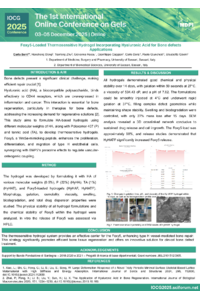
Introduction: Bone defects present a significant clinical challenge, making efficient repair crucial [1]. Hyaluronic acid (HA), a biocompatible polysaccharide, binds effectively to CD44 receptors, which are overexpressed in inflammation and cancer. This interaction is essential for bone regeneration, particularly in therapies for bone defects, addressing the increasing demand for regenerative solutions [2]. This study aims to formulate HA-based hydrogels using different molecular weights of HA, along with Poloxamer 407 (P) and tannic acid (TA), to develop thermosensitive hydrogels. Foxy5, a Wnt5a-mimicking peptide, enhances the proliferation, differentiation, and migration of type H endothelial cells, synergizing with BMP2’s paracrine effects to regulate vascular–osteogenic coupling.
Method: The hydrogel was developed by formulating it with HA of various molecular weights (0.5%), P (22%) (HyHA), TA (1%) (HyHAT), and Foxy5-loaded hydrogels (HyHAF, HyHATF). Morphology, gelation, osmolality, viscosity, swelling, biodegradation, and total drug dispersion properties were studied. The physical stability of all hydrogel formulations and the chemical stability of Foxy5 within the hydrogel were analyzed. In vitro, the release of Foxy5 was assessed via HPLC.
Results: All hydrogels demonstrated good chemical and physical stability over 14 days, with gelation within 50 seconds at 27°C, a viscosity of 534.43 cP, and a pH of 7.62. The formulations could be smoothly injected at 4°C and underwent rapid gelation at 37°C, filling complex defect geometries while maintaining shape stability. Swelling and biodegradation were controlled, with only 27% mass loss after 15 days. SEM analysis revealed a 3D crosslinked network conducive to sustained drug release and cell ingrowth. The Foxy5 load was approximately 90%, and release studies demonstrated that HyHATF significantly increased Foxy5 release.
Conclusion: The thermosensitive hydrogel system provides an effective carrier for the Foxy5, enhancing type H vessel-mediated bone repair. This strategy significantly promotes efficient bone tissue regeneration and offers an innovative solution for clinical bone defect treatment.
Keywords
Thermosensitive hydrogels
Hyaluronic acid
drug delivery
Foxy5
Poster
Foxy5-Loaded Thermosensitive Hydrogel Incorporating Hyaluronic Acid for Bone defects.pdf
Structurally Stable Aerogel from Marine Biopolymers for the Functional Delivery of Virgin Fish Oil
Development of a Janus Nanocomposite Hydrogel Based on Lignin and Polyelectrolyte sIPN for Enhanced Wastewater Treatment via Interfacial Solar Steam Generation