Event submissions
Published
This submission belongs to the session S4. Gels in Medicine, Regenerative Medicine, Pharmacy, and Personal Care Products of the event The 1st International Online Conference on Gels
Published date
28 Nov, 2025
Academic Editor
'%3e%3cpath%20d='M12.6657%2010.9104C12.4185%2010.325%2012.0599%209.79327%2011.6097%209.34482C11.1609%208.89508%2010.6293%208.5365%2010.0442%208.28888C10.0389%208.28626%2010.0337%208.28495%2010.0285%208.28233C10.8446%207.69279%2011.3752%206.73249%2011.3752%205.64904C11.3752%203.8542%209.92103%202.39999%208.1262%202.39999C6.33136%202.39999%204.87715%203.8542%204.87715%205.64904C4.87715%206.73249%205.40774%207.69279%206.22393%208.28364C6.21869%208.28626%206.21345%208.28757%206.20821%208.29019C5.62129%208.5378%205.09463%208.89284%204.64265%209.34613C4.1929%209.79493%203.83432%2010.3266%203.58671%2010.9117C3.34345%2011.4845%203.21226%2012.0987%203.20023%2012.7209C3.19988%2012.7349%203.20233%2012.7488%203.20744%2012.7619C3.21255%2012.7749%203.22022%2012.7867%203.22998%2012.7968C3.23975%2012.8068%203.25142%2012.8147%203.26431%2012.8202C3.2772%2012.8256%203.29105%2012.8284%203.30504%2012.8284H4.09109C4.14874%2012.8284%204.19459%2012.7825%204.1959%2012.7262C4.2221%2011.7148%204.62823%2010.7676%205.34617%2010.0497C6.08899%209.30683%207.0755%208.89808%208.1262%208.89808C9.17689%208.89808%2010.1634%209.30683%2010.9062%2010.0497C11.6242%2010.7676%2012.0303%2011.7148%2012.0565%2012.7262C12.0578%2012.7838%2012.1037%2012.8284%2012.1613%2012.8284H12.9474C12.9613%2012.8284%2012.9752%2012.8256%2012.9881%2012.8202C13.001%2012.8147%2013.0126%2012.8068%2013.0224%2012.7968C13.0322%2012.7867%2013.0398%2012.7749%2013.0449%2012.7619C13.0501%2012.7488%2013.0525%2012.7349%2013.0522%2012.7209C13.0391%2012.0947%2012.9094%2011.4855%2012.6657%2010.9104ZM8.1262%207.9024C7.52486%207.9024%206.9589%207.6679%206.53312%207.24211C6.10733%206.81633%205.87283%206.25037%205.87283%205.64904C5.87283%205.0477%206.10733%204.48174%206.53312%204.05596C6.9589%203.63018%207.52486%203.39567%208.1262%203.39567C8.72753%203.39567%209.29349%203.63018%209.71927%204.05596C10.1451%204.48174%2010.3796%205.0477%2010.3796%205.64904C10.3796%206.25037%2010.1451%206.81633%209.71927%207.24211C9.29349%207.6679%208.72753%207.9024%208.1262%207.9024Z'%20fill='%235D1EE1'/%3e%3c/g%3e%3c/svg%3e) Dirk Kuckling
Dirk KucklingCitation
Joachim Emeka Arikibe, Roselyn Lata, David Rohindra, Harnessing Nature: Hydrogels Derived from Bacterial Cellulose and Chitosan for Biomedical Applications, in Proceedings of The 1st International Online Conference on Gels, 3 December–5 December 2025, MDPI: Basel, Switzerland
Share
Email
Facebook
Twitter
LinkedIn
Harnessing Nature: Hydrogels Derived from Bacterial Cellulose and Chitosan for Biomedical Applications
'%3e%3cpath%20d='M12.6647%2010.9104C12.4176%2010.325%2012.0589%209.7933%2011.6088%209.34485C11.16%208.89511%2010.6283%208.53653%2010.0432%208.28891C10.038%208.28629%2010.0327%208.28498%2010.0275%208.28236C10.8437%207.69282%2011.3743%206.73252%2011.3743%205.64907C11.3743%203.85423%209.92005%202.40002%208.12522%202.40002C6.33038%202.40002%204.87618%203.85423%204.87618%205.64907C4.87618%206.73252%205.40677%207.69282%206.22296%208.28367C6.21772%208.28629%206.21248%208.2876%206.20724%208.29022C5.62031%208.53783%205.09365%208.89287%204.64167%209.34616C4.19192%209.79496%203.83334%2010.3266%203.58573%2010.9117C3.34247%2011.4846%203.21128%2012.0987%203.19925%2012.721C3.1989%2012.735%203.20135%2012.7489%203.20646%2012.7619C3.21157%2012.7749%203.21924%2012.7868%203.22901%2012.7968C3.23877%2012.8068%203.25045%2012.8148%203.26334%2012.8202C3.27623%2012.8256%203.29007%2012.8284%203.30406%2012.8284H4.09012C4.14776%2012.8284%204.19362%2012.7825%204.19493%2012.7262C4.22113%2011.7148%204.62726%2010.7676%205.34519%2010.0497C6.08802%209.30686%207.07452%208.89811%208.12522%208.89811C9.17592%208.89811%2010.1624%209.30686%2010.9052%2010.0497C11.6232%2010.7676%2012.0293%2011.7148%2012.0555%2012.7262C12.0568%2012.7839%2012.1027%2012.8284%2012.1603%2012.8284H12.9464C12.9604%2012.8284%2012.9742%2012.8256%2012.9871%2012.8202C13%2012.8148%2013.0117%2012.8068%2013.0214%2012.7968C13.0312%2012.7868%2013.0389%2012.7749%2013.044%2012.7619C13.0491%2012.7489%2013.0515%2012.735%2013.0512%2012.721C13.0381%2012.0947%2012.9084%2011.4856%2012.6647%2010.9104ZM8.12522%207.90243C7.52388%207.90243%206.95792%207.66793%206.53214%207.24215C6.10636%206.81636%205.87185%206.2504%205.87185%205.64907C5.87185%205.04773%206.10636%204.48177%206.53214%204.05599C6.95792%203.63021%207.52388%203.3957%208.12522%203.3957C8.72655%203.3957%209.29252%203.63021%209.7183%204.05599C10.1441%204.48177%2010.3786%205.04773%2010.3786%205.64907C10.3786%206.2504%2010.1441%206.81636%209.7183%207.24215C9.29252%207.66793%208.72655%207.90243%208.12522%207.90243Z'%20fill='%235D1EE1'/%3e%3c/g%3e%3c/svg%3e)
Joachim Emeka Arikibe 1,2,3
Roselyn Lata 3

David Rohindra 3
1. Department of Chemical Sciences, University of Padova, Via F. Marzolo, 1, 35131 Padova, Italy
2. Department of Drug Delivery Across Biological Barriers, Helmholtz Institute for Pharmaceutical Research Saarland (HIPS), Helmholtz Centre for Infection Research (HZI), Campus E8 1, 66123 Saarbrücken, Germany
3. School of Agriculture, Geography, Environment, Oceans and Natural Sciences, The University of the South Pacific, Private Mail Bag, Suva, Fiji
Abstract
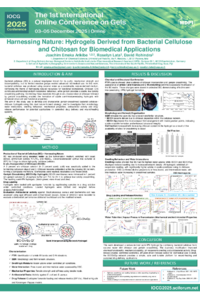
Bacterial cellulose (BC) is a biopolymer with excellent mechanical strength and purity. However, its utilization in biomedical applications is hampered due to its limitations in reactive functional groups. This work presents the development of semi-interpenetrating hydrogels (semi-IPNs) by combining BC with chitosan (Ch) and crosslinking with genipin (Gp), using a straightforward two-step strategy. First, an in situ method was employed to incorporate chitosan directly into the BC matrix during the Gluconacetobacter xylinus fermentation process. This was followed by an ex situ crosslinking step, where BC-Ch was immersed in a genipin solution to enhance network stability and biocompatibility. The FTIR study revealed new amide I and II bands and C–N stretching vibrations, confirming the successful modification of BC with Ch. SEM analysis demonstrated that crosslinked BC-Ch-Gp hydrogels exhibited a compact, highly interconnected fibril network with improved porosity. Differential Scanning Calorimetry indicated the presence of free, bound, and intermediate water types, contributing to the good water retention capacity of the hydrogels. Swelling studies revealed pH-responsive behaviors, with higher swelling at low pH for crosslinked samples and an increased chitosan ratio further enhancing this response. Mechanical testing showed improved stiffness and reduced moisture content in crosslinked hydrogels, making them more suitable for biomedical environments. Antibacterial evaluation confirmed effective inhibition of Escherichia coli and Staphylococcus aureus. In vitro drug release studies using quetiapine fumarate showed sustained release profiles following the Higuchi model and a combination of non-Fickian and super case II transport, indicating controlled diffusion and matrix relaxation. Using non-pathogenic bacteria and coconut-derived media, this simple dual-method strategy produced safe and functional hydrogels suitable for applications in controlled drug delivery, wound healing, and advanced biomedical dressings
Keywords
Bacterial cellulose
Chitosan
Genipin
Semi-IPN hydrogel
In-situ synthesis
Ex-situ crosslinking
pH responsiveness
Controlled drug release
Antimicrobial
Poster
IOCG2025_sciforum-130946_Poster_Arikibe et al.pdf
Soft, Stretchable, and Smart: Alginate/Gelatin Organohydrogels for Wearable Electronics
Ultrasound-Enhanced Gelation and Functional Properties of Faba Bean Protein for Clean-Label Food Applications