Event submissions
Published
This submission belongs to the session S3. Gels in Agriculture and Food of the event The 1st International Online Conference on Gels
Published date
28 Nov, 2025
Academic Editor
'%3e%3cpath%20d='M12.6657%2010.9104C12.4185%2010.325%2012.0599%209.79327%2011.6097%209.34482C11.1609%208.89508%2010.6293%208.5365%2010.0442%208.28888C10.0389%208.28626%2010.0337%208.28495%2010.0285%208.28233C10.8446%207.69279%2011.3752%206.73249%2011.3752%205.64904C11.3752%203.8542%209.92103%202.39999%208.1262%202.39999C6.33136%202.39999%204.87715%203.8542%204.87715%205.64904C4.87715%206.73249%205.40774%207.69279%206.22393%208.28364C6.21869%208.28626%206.21345%208.28757%206.20821%208.29019C5.62129%208.5378%205.09463%208.89284%204.64265%209.34613C4.1929%209.79493%203.83432%2010.3266%203.58671%2010.9117C3.34345%2011.4845%203.21226%2012.0987%203.20023%2012.7209C3.19988%2012.7349%203.20233%2012.7488%203.20744%2012.7619C3.21255%2012.7749%203.22022%2012.7867%203.22998%2012.7968C3.23975%2012.8068%203.25142%2012.8147%203.26431%2012.8202C3.2772%2012.8256%203.29105%2012.8284%203.30504%2012.8284H4.09109C4.14874%2012.8284%204.19459%2012.7825%204.1959%2012.7262C4.2221%2011.7148%204.62823%2010.7676%205.34617%2010.0497C6.08899%209.30683%207.0755%208.89808%208.1262%208.89808C9.17689%208.89808%2010.1634%209.30683%2010.9062%2010.0497C11.6242%2010.7676%2012.0303%2011.7148%2012.0565%2012.7262C12.0578%2012.7838%2012.1037%2012.8284%2012.1613%2012.8284H12.9474C12.9613%2012.8284%2012.9752%2012.8256%2012.9881%2012.8202C13.001%2012.8147%2013.0126%2012.8068%2013.0224%2012.7968C13.0322%2012.7867%2013.0398%2012.7749%2013.0449%2012.7619C13.0501%2012.7488%2013.0525%2012.7349%2013.0522%2012.7209C13.0391%2012.0947%2012.9094%2011.4855%2012.6657%2010.9104ZM8.1262%207.9024C7.52486%207.9024%206.9589%207.6679%206.53312%207.24211C6.10733%206.81633%205.87283%206.25037%205.87283%205.64904C5.87283%205.0477%206.10733%204.48174%206.53312%204.05596C6.9589%203.63018%207.52486%203.39567%208.1262%203.39567C8.72753%203.39567%209.29349%203.63018%209.71927%204.05596C10.1451%204.48174%2010.3796%205.0477%2010.3796%205.64904C10.3796%206.25037%2010.1451%206.81633%209.71927%207.24211C9.29349%207.6679%208.72753%207.9024%208.1262%207.9024Z'%20fill='%235D1EE1'/%3e%3c/g%3e%3c/svg%3e) Luis Alfonso Trujillo-Cayado
Luis Alfonso Trujillo-CayadoCitation
Ana Valeria Torres-Figueroa, Teresa del Castillo-Castro, Andres Ochoa-Meza, Jhovanna Pérez-Martínez, Humic Acid-Enriched Biopolymer Hydrogels: Water Retention, Biodegradation, and Sorghum Growth, in Proceedings of The 1st International Online Conference on Gels, 3 December–5 December 2025, MDPI: Basel, Switzerland
Share
Email
Facebook
Twitter
LinkedIn
Humic Acid-Enriched Biopolymer Hydrogels: Water Retention, Biodegradation, and Sorghum Growth
'%3e%3cpath%20d='M12.6647%2010.9104C12.4176%2010.325%2012.0589%209.7933%2011.6088%209.34485C11.16%208.89511%2010.6283%208.53653%2010.0432%208.28891C10.038%208.28629%2010.0327%208.28498%2010.0275%208.28236C10.8437%207.69282%2011.3743%206.73252%2011.3743%205.64907C11.3743%203.85423%209.92005%202.40002%208.12522%202.40002C6.33038%202.40002%204.87618%203.85423%204.87618%205.64907C4.87618%206.73252%205.40677%207.69282%206.22296%208.28367C6.21772%208.28629%206.21248%208.2876%206.20724%208.29022C5.62031%208.53783%205.09365%208.89287%204.64167%209.34616C4.19192%209.79496%203.83334%2010.3266%203.58573%2010.9117C3.34247%2011.4846%203.21128%2012.0987%203.19925%2012.721C3.1989%2012.735%203.20135%2012.7489%203.20646%2012.7619C3.21157%2012.7749%203.21924%2012.7868%203.22901%2012.7968C3.23877%2012.8068%203.25045%2012.8148%203.26334%2012.8202C3.27623%2012.8256%203.29007%2012.8284%203.30406%2012.8284H4.09012C4.14776%2012.8284%204.19362%2012.7825%204.19493%2012.7262C4.22113%2011.7148%204.62726%2010.7676%205.34519%2010.0497C6.08802%209.30686%207.07452%208.89811%208.12522%208.89811C9.17592%208.89811%2010.1624%209.30686%2010.9052%2010.0497C11.6232%2010.7676%2012.0293%2011.7148%2012.0555%2012.7262C12.0568%2012.7839%2012.1027%2012.8284%2012.1603%2012.8284H12.9464C12.9604%2012.8284%2012.9742%2012.8256%2012.9871%2012.8202C13%2012.8148%2013.0117%2012.8068%2013.0214%2012.7968C13.0312%2012.7868%2013.0389%2012.7749%2013.044%2012.7619C13.0491%2012.7489%2013.0515%2012.735%2013.0512%2012.721C13.0381%2012.0947%2012.9084%2011.4856%2012.6647%2010.9104ZM8.12522%207.90243C7.52388%207.90243%206.95792%207.66793%206.53214%207.24215C6.10636%206.81636%205.87185%206.2504%205.87185%205.64907C5.87185%205.04773%206.10636%204.48177%206.53214%204.05599C6.95792%203.63021%207.52388%203.3957%208.12522%203.3957C8.72655%203.3957%209.29252%203.63021%209.7183%204.05599C10.1441%204.48177%2010.3786%205.04773%2010.3786%205.64907C10.3786%206.2504%2010.1441%206.81636%209.7183%207.24215C9.29252%207.66793%208.72655%207.90243%208.12522%207.90243Z'%20fill='%235D1EE1'/%3e%3c/g%3e%3c/svg%3e)
Ana Valeria Torres-Figueroa 1
Teresa del Castillo-Castro 2
Andres Ochoa-Meza 3
Jhovanna Pérez-Martínez 1
1. Departamento de Ciencias Químico Biológicas, Universidad de Sonora, Hermosillo 83000, Mexico
2. Departamento de Investigación en Polímeros y Materiales, Universidad de Sonora, Hermosillo 83000, Mexico
3. Departamento de Agricultura y Ganadería, Universidad de Sonora, Carretera a Bahía de Kino Km. 21, Hermosillo 83000, Mexico
Abstract
Water scarcity is one of the most limiting factors for agricultural productivity in arid and semi-arid regions. Hydrogels, as three-dimensional polymeric networks, have emerged as promising soil conditioners due to their ability to retain water and act as carriers for nutrients or plant growth-promoting agents. However, most commercial hydrogels are based on synthetic polymers such as polyacrylates, which exhibit limited biodegradability and raise environmental concerns. This has stimulated interest in the development of biobased and biodegradable hydrogels for sustainable agriculture.
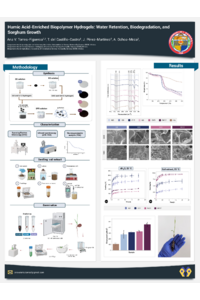
In this study, we designed and developed superabsorbent hydrogels based on gellan gum (GG), karaya gum (KG), and humic acid (HA) as eco-friendly alternatives for agricultural applications. The hydrogels were characterized by FTIR, TGA, SEM, mechanical assays, and swelling kinetics. Water retention tests indicated that both GG/HA and GG/KG/HA hydrogels preserved higher soil moisture compared to a commercial polyacrylate hydrogel. Soil biodegradation assays demonstrated that the biopolymer hydrogels lost more than one-third of their weight after 30 days, confirming their degradability under natural conditions.
Biological assays were carried out using sorghum (Sorghum sp.) seedlings germinated in a growth chamber at 27±1 °C with a 12 h photoperiod. Both GG/HA and GG/KG/HA hydrogels exhibited no phytotoxicity, while the GG/KG/HA formulation promoted higher growth and chlorophyll accumulation compared to GG/HA.
Overall, GG/KG/HA hydrogels proved to be biodegradable, biocompatible, and effective soil conditioners, positioning them as promising candidates to improve soil quality and crop productivity in sustainable agriculture.
Keywords
biodegradable hydrogel
soil biodegradation
sorghum
Poster
sciforum25-1.pdf
Exploring the potential of self-healing hydrogels for breast cancer management
OPTIMIZATION OF CROSS-LINKED PVA FUNCTIONALIZED WITH PANI: IN SITU STRATEGIES TO DESIGN ELECTRO-CONDUCTIVE FIBROUS PLATFORMS FOR BRAIN APPLICATIONS