Event submissions
Published
This submission belongs to the session S3. Gels in Agriculture and Food of the event The 1st International Online Conference on Gels
Published date
28 Nov, 2025
Academic Editor
'%3e%3cpath%20d='M12.6657%2010.9104C12.4185%2010.325%2012.0599%209.79327%2011.6097%209.34482C11.1609%208.89508%2010.6293%208.5365%2010.0442%208.28888C10.0389%208.28626%2010.0337%208.28495%2010.0285%208.28233C10.8446%207.69279%2011.3752%206.73249%2011.3752%205.64904C11.3752%203.8542%209.92103%202.39999%208.1262%202.39999C6.33136%202.39999%204.87715%203.8542%204.87715%205.64904C4.87715%206.73249%205.40774%207.69279%206.22393%208.28364C6.21869%208.28626%206.21345%208.28757%206.20821%208.29019C5.62129%208.5378%205.09463%208.89284%204.64265%209.34613C4.1929%209.79493%203.83432%2010.3266%203.58671%2010.9117C3.34345%2011.4845%203.21226%2012.0987%203.20023%2012.7209C3.19988%2012.7349%203.20233%2012.7488%203.20744%2012.7619C3.21255%2012.7749%203.22022%2012.7867%203.22998%2012.7968C3.23975%2012.8068%203.25142%2012.8147%203.26431%2012.8202C3.2772%2012.8256%203.29105%2012.8284%203.30504%2012.8284H4.09109C4.14874%2012.8284%204.19459%2012.7825%204.1959%2012.7262C4.2221%2011.7148%204.62823%2010.7676%205.34617%2010.0497C6.08899%209.30683%207.0755%208.89808%208.1262%208.89808C9.17689%208.89808%2010.1634%209.30683%2010.9062%2010.0497C11.6242%2010.7676%2012.0303%2011.7148%2012.0565%2012.7262C12.0578%2012.7838%2012.1037%2012.8284%2012.1613%2012.8284H12.9474C12.9613%2012.8284%2012.9752%2012.8256%2012.9881%2012.8202C13.001%2012.8147%2013.0126%2012.8068%2013.0224%2012.7968C13.0322%2012.7867%2013.0398%2012.7749%2013.0449%2012.7619C13.0501%2012.7488%2013.0525%2012.7349%2013.0522%2012.7209C13.0391%2012.0947%2012.9094%2011.4855%2012.6657%2010.9104ZM8.1262%207.9024C7.52486%207.9024%206.9589%207.6679%206.53312%207.24211C6.10733%206.81633%205.87283%206.25037%205.87283%205.64904C5.87283%205.0477%206.10733%204.48174%206.53312%204.05596C6.9589%203.63018%207.52486%203.39567%208.1262%203.39567C8.72753%203.39567%209.29349%203.63018%209.71927%204.05596C10.1451%204.48174%2010.3796%205.0477%2010.3796%205.64904C10.3796%206.25037%2010.1451%206.81633%209.71927%207.24211C9.29349%207.6679%208.72753%207.9024%208.1262%207.9024Z'%20fill='%235D1EE1'/%3e%3c/g%3e%3c/svg%3e) Luis Alfonso Trujillo-Cayado
Luis Alfonso Trujillo-CayadoCitation
Domenico Mammolenti, Patrizia Formoso, Francesca Romana Lupi, Noemi Baldino, Domenico Gabriele, Emulgel structured with citrus fiber as potential delivery system of curcumin (Curcuma longa) for food application: viscoelasticity modelling, morphology and in vitro diffusion study, in Proceedings of The 1st International Online Conference on Gels, 3 December–5 December 2025, MDPI: Basel, Switzerland
Share
Email
Facebook
Twitter
LinkedIn
Emulgel structured with citrus fiber as potential delivery system of curcumin (Curcuma longa) for food application: viscoelasticity modelling, morphology and in vitro diffusion study
'%3e%3cpath%20d='M12.6647%2010.9104C12.4176%2010.325%2012.0589%209.7933%2011.6088%209.34485C11.16%208.89511%2010.6283%208.53653%2010.0432%208.28891C10.038%208.28629%2010.0327%208.28498%2010.0275%208.28236C10.8437%207.69282%2011.3743%206.73252%2011.3743%205.64907C11.3743%203.85423%209.92005%202.40002%208.12522%202.40002C6.33038%202.40002%204.87618%203.85423%204.87618%205.64907C4.87618%206.73252%205.40677%207.69282%206.22296%208.28367C6.21772%208.28629%206.21248%208.2876%206.20724%208.29022C5.62031%208.53783%205.09365%208.89287%204.64167%209.34616C4.19192%209.79496%203.83334%2010.3266%203.58573%2010.9117C3.34247%2011.4846%203.21128%2012.0987%203.19925%2012.721C3.1989%2012.735%203.20135%2012.7489%203.20646%2012.7619C3.21157%2012.7749%203.21924%2012.7868%203.22901%2012.7968C3.23877%2012.8068%203.25045%2012.8148%203.26334%2012.8202C3.27623%2012.8256%203.29007%2012.8284%203.30406%2012.8284H4.09012C4.14776%2012.8284%204.19362%2012.7825%204.19493%2012.7262C4.22113%2011.7148%204.62726%2010.7676%205.34519%2010.0497C6.08802%209.30686%207.07452%208.89811%208.12522%208.89811C9.17592%208.89811%2010.1624%209.30686%2010.9052%2010.0497C11.6232%2010.7676%2012.0293%2011.7148%2012.0555%2012.7262C12.0568%2012.7839%2012.1027%2012.8284%2012.1603%2012.8284H12.9464C12.9604%2012.8284%2012.9742%2012.8256%2012.9871%2012.8202C13%2012.8148%2013.0117%2012.8068%2013.0214%2012.7968C13.0312%2012.7868%2013.0389%2012.7749%2013.044%2012.7619C13.0491%2012.7489%2013.0515%2012.735%2013.0512%2012.721C13.0381%2012.0947%2012.9084%2011.4856%2012.6647%2010.9104ZM8.12522%207.90243C7.52388%207.90243%206.95792%207.66793%206.53214%207.24215C6.10636%206.81636%205.87185%206.2504%205.87185%205.64907C5.87185%205.04773%206.10636%204.48177%206.53214%204.05599C6.95792%203.63021%207.52388%203.3957%208.12522%203.3957C8.72655%203.3957%209.29252%203.63021%209.7183%204.05599C10.1441%204.48177%2010.3786%205.04773%2010.3786%205.64907C10.3786%206.2504%2010.1441%206.81636%209.7183%207.24215C9.29252%207.66793%208.72655%207.90243%208.12522%207.90243Z'%20fill='%235D1EE1'/%3e%3c/g%3e%3c/svg%3e)
Domenico Mammolenti 1

Patrizia Formoso 2

Francesca Romana Lupi 1
Noemi Baldino 1
Domenico Gabriele 1
1. Department of Information, Modeling, Electronics and Systems, (D.I.M.E.S.) University of Calabria, Via P. Bucci, Cubo 39C, 87036 Rende, Italy
2. Department of Pharmacy, Health and Nutritional Sciences, University of Calabria, via A. Savino, Polyfunctional Building, 87036 Rende, Italy
Abstract
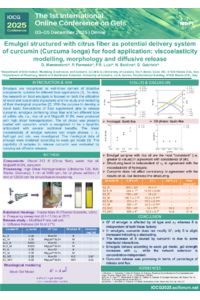
Citrus fiber is recognized to be a structuring ingredient that can form particle hydrogels (in water) or emulgels (oil droplets entrapped in the water phase). Emulgels are used in a wide range of food applications, such as low-fat and low-calorie foods or food supplements, since they are particularly suitable for the delivery of bioactive molecules. In the present work, emulgels containing citrus fiber that are potentially suitable as a food supplement of curcumin were produced by high-speed homogenization and using two different edible oils: Miglyol® 812N and rice oil (both at 0.4 w/w). The viscoelasticity of the emulgels and single phases (hydrogels and oil phases) was investigated by frequency sweep test in the linear region, and was previously determined by a stress sweep test. The consistency, in terms of complex shear modulus (G*), of both the hydrogel and emulgels increased more than linearly with increasing fiber fractions (from 0.020 w/w to 0.030 w/w), whereas the structuring degree, in terms of phase angle (δ), was almost independent of the fiber fraction. The addition of curcumin does not affect the viscoelasticity of oil phases based on either oil. The emulgel with rice oil showed higher G* than that containing Miglyol® 812N, but they showed similar δ values. Rheological results for the emulgels were modelled using the weak gel model. The gel strength increases with increasing fiber fraction; network extension seems independent from fiber concentration. Curcumin does not change the consistency of emulgels, but it slightly decreases teir structure extension (δ moves from 5.5° to approximately 7.0°), According to in vitro diffusion studies, the diffused curcumin percentage (Cur%) at 24 h was 14.6% for the emulgel with Miglyol® 812N, whereas for the emulgel with rice oil, it was 18.3%. These results can be considered promising for making future investigations attractive for the development of edible emulsions for food supplementation of curumin.
Keywords
Emulgel
dietary fiber
antioxidant
food supplement
weak gel
Poster
Poster GELS_MammolentiDomenico.pdf
Characterization of mozzarella cheese analogue with reduced saturated fats using soybean oil and beeswax oleogels
Polysaccharide-based decontamination gels for the radioactive decontamination of metal parts within radioactive waste management.