Event submissions
Published
This submission belongs to the session S6. Gels in Chemical Processing, Energy, and Environment of the event The 1st International Online Conference on Gels
Published date
28 Nov, 2025
Academic Editor
'%3e%3cpath%20d='M12.6657%2010.9104C12.4185%2010.325%2012.0599%209.79327%2011.6097%209.34482C11.1609%208.89508%2010.6293%208.5365%2010.0442%208.28888C10.0389%208.28626%2010.0337%208.28495%2010.0285%208.28233C10.8446%207.69279%2011.3752%206.73249%2011.3752%205.64904C11.3752%203.8542%209.92103%202.39999%208.1262%202.39999C6.33136%202.39999%204.87715%203.8542%204.87715%205.64904C4.87715%206.73249%205.40774%207.69279%206.22393%208.28364C6.21869%208.28626%206.21345%208.28757%206.20821%208.29019C5.62129%208.5378%205.09463%208.89284%204.64265%209.34613C4.1929%209.79493%203.83432%2010.3266%203.58671%2010.9117C3.34345%2011.4845%203.21226%2012.0987%203.20023%2012.7209C3.19988%2012.7349%203.20233%2012.7488%203.20744%2012.7619C3.21255%2012.7749%203.22022%2012.7867%203.22998%2012.7968C3.23975%2012.8068%203.25142%2012.8147%203.26431%2012.8202C3.2772%2012.8256%203.29105%2012.8284%203.30504%2012.8284H4.09109C4.14874%2012.8284%204.19459%2012.7825%204.1959%2012.7262C4.2221%2011.7148%204.62823%2010.7676%205.34617%2010.0497C6.08899%209.30683%207.0755%208.89808%208.1262%208.89808C9.17689%208.89808%2010.1634%209.30683%2010.9062%2010.0497C11.6242%2010.7676%2012.0303%2011.7148%2012.0565%2012.7262C12.0578%2012.7838%2012.1037%2012.8284%2012.1613%2012.8284H12.9474C12.9613%2012.8284%2012.9752%2012.8256%2012.9881%2012.8202C13.001%2012.8147%2013.0126%2012.8068%2013.0224%2012.7968C13.0322%2012.7867%2013.0398%2012.7749%2013.0449%2012.7619C13.0501%2012.7488%2013.0525%2012.7349%2013.0522%2012.7209C13.0391%2012.0947%2012.9094%2011.4855%2012.6657%2010.9104ZM8.1262%207.9024C7.52486%207.9024%206.9589%207.6679%206.53312%207.24211C6.10733%206.81633%205.87283%206.25037%205.87283%205.64904C5.87283%205.0477%206.10733%204.48174%206.53312%204.05596C6.9589%203.63018%207.52486%203.39567%208.1262%203.39567C8.72753%203.39567%209.29349%203.63018%209.71927%204.05596C10.1451%204.48174%2010.3796%205.0477%2010.3796%205.64904C10.3796%206.25037%2010.1451%206.81633%209.71927%207.24211C9.29349%207.6679%208.72753%207.9024%208.1262%207.9024Z'%20fill='%235D1EE1'/%3e%3c/g%3e%3c/svg%3e) Annarosa Gugliuzza
Annarosa GugliuzzaCitation
Abhishek Tyagi, Akhil Agrawal, Synthesis of advanced Biopolymers through Chemo-selective Approach for Enhanced Oil Recovery from Non-producing Reservoirs, in Proceedings of The 1st International Online Conference on Gels, 3 December–5 December 2025, MDPI: Basel, Switzerland
Share
Email
Facebook
Twitter
LinkedIn
Synthesis of advanced Biopolymers through Chemo-selective Approach for Enhanced Oil Recovery from Non-producing Reservoirs
'%3e%3cpath%20d='M12.6647%2010.9104C12.4176%2010.325%2012.0589%209.7933%2011.6088%209.34485C11.16%208.89511%2010.6283%208.53653%2010.0432%208.28891C10.038%208.28629%2010.0327%208.28498%2010.0275%208.28236C10.8437%207.69282%2011.3743%206.73252%2011.3743%205.64907C11.3743%203.85423%209.92005%202.40002%208.12522%202.40002C6.33038%202.40002%204.87618%203.85423%204.87618%205.64907C4.87618%206.73252%205.40677%207.69282%206.22296%208.28367C6.21772%208.28629%206.21248%208.2876%206.20724%208.29022C5.62031%208.53783%205.09365%208.89287%204.64167%209.34616C4.19192%209.79496%203.83334%2010.3266%203.58573%2010.9117C3.34247%2011.4846%203.21128%2012.0987%203.19925%2012.721C3.1989%2012.735%203.20135%2012.7489%203.20646%2012.7619C3.21157%2012.7749%203.21924%2012.7868%203.22901%2012.7968C3.23877%2012.8068%203.25045%2012.8148%203.26334%2012.8202C3.27623%2012.8256%203.29007%2012.8284%203.30406%2012.8284H4.09012C4.14776%2012.8284%204.19362%2012.7825%204.19493%2012.7262C4.22113%2011.7148%204.62726%2010.7676%205.34519%2010.0497C6.08802%209.30686%207.07452%208.89811%208.12522%208.89811C9.17592%208.89811%2010.1624%209.30686%2010.9052%2010.0497C11.6232%2010.7676%2012.0293%2011.7148%2012.0555%2012.7262C12.0568%2012.7839%2012.1027%2012.8284%2012.1603%2012.8284H12.9464C12.9604%2012.8284%2012.9742%2012.8256%2012.9871%2012.8202C13%2012.8148%2013.0117%2012.8068%2013.0214%2012.7968C13.0312%2012.7868%2013.0389%2012.7749%2013.044%2012.7619C13.0491%2012.7489%2013.0515%2012.735%2013.0512%2012.721C13.0381%2012.0947%2012.9084%2011.4856%2012.6647%2010.9104ZM8.12522%207.90243C7.52388%207.90243%206.95792%207.66793%206.53214%207.24215C6.10636%206.81636%205.87185%206.2504%205.87185%205.64907C5.87185%205.04773%206.10636%204.48177%206.53214%204.05599C6.95792%203.63021%207.52388%203.3957%208.12522%203.3957C8.72655%203.3957%209.29252%203.63021%209.7183%204.05599C10.1441%204.48177%2010.3786%205.04773%2010.3786%205.64907C10.3786%206.2504%2010.1441%206.81636%209.7183%207.24215C9.29252%207.66793%208.72655%207.90243%208.12522%207.90243Z'%20fill='%235D1EE1'/%3e%3c/g%3e%3c/svg%3e)
Abhishek Tyagi 1
Akhil Agrawal 1
1. Department of Microbiology, School of Life Sciences, Central University of Rajasthan, 305817, Ajmer, India
Abstract
The production of crude oil must be increased to meet the growing global energy demand. As crude oil will remain a dominant energy source for the next ~30 years, enhanced oil recovery (EOR) has become essential to maximize output from existing reservoirs, which is more economical than drilling new wells. Conventional recovery methods are inefficient, leaving behind nearly 50% of the original oil. Within EOR, biopolymers are emerging as sustainable alternatives due to their accessibility, cost-effectiveness, viscoelastic behaviour, and biodegradability. Natural polymers such as guar gum, xanthan gum, welan gum, scleroglucan, schizophyllan, and gum tragacanth are increasingly being investigated to replace synthetic polymers. However, microbial deterioration, shear-stress instability, and sensitivity to reservoir conditions (temperature, salinity, concentration, and functional groups) restrict their widespread application. This study introduces a novel chemically tailored biopolymer for EOR from non-producing reservoirs. While conventional polymers like polyacrylamide and xanthan gum typically achieve only 4-5% incremental recovery, our preliminary results demonstrate up to 10% additional recovery. The polymer is structurally modified through graft copolymerization, gel modification, esterification, crosslinking, and nanocomposite functionalization, ensuring higher viscosity, stability, and reservoir compatibility. The formulations will be developed using single or modified polymers along with oilfield adjuvants after validation under simulated reservoir conditions. Even a 1-2% incremental recovery can translate into millions of additional barrels of oil, highlighting the scalability and economic relevance of this approach. Recently, chemo-selectively modified and thermo-viscosifying polymers further support enhanced sweep efficiency under harsh conditions through viscosity increment, wettability alteration, and emulsification. These polymers have been successfully investigated in both laboratory experiments and field trials, highlighting their strong potential for large-scale EOR applications.
“Towards Sustainable Oil Recovery: Biopolymer Solutions for Energy Efficiency”
Keywords
Enhanced Oil Recovery
Chemical Modification
Polymer Flooding
Interfacial Tension
Wettability Alteration
Poster
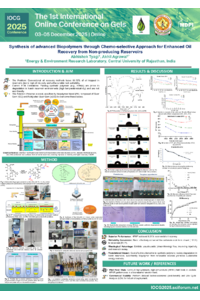
Gels poster_ABHISHEK_Central University of Rajasthan.pdf
Structuring Niger Seed Oil with Beeswax: Physicochemical, Structural, and Oxidative Stability Insights into Oleogel Formation
Synergistic Stabilization and Rheology of Sodium Alginate Gel Foams for Subsurface Carbon Storage and Enhanced Oil Recovery