Event submissions
Published
This submission belongs to the session B. Development and Optimization of Animal Vaccines of the event The 1st International Online Conference on Veterinary Sciences
Published date
28 Nov, 2025
Academic Editor
'%3e%3cpath%20d='M12.6657%2010.9104C12.4185%2010.325%2012.0599%209.79327%2011.6097%209.34482C11.1609%208.89508%2010.6293%208.5365%2010.0442%208.28888C10.0389%208.28626%2010.0337%208.28495%2010.0285%208.28233C10.8446%207.69279%2011.3752%206.73249%2011.3752%205.64904C11.3752%203.8542%209.92103%202.39999%208.1262%202.39999C6.33136%202.39999%204.87715%203.8542%204.87715%205.64904C4.87715%206.73249%205.40774%207.69279%206.22393%208.28364C6.21869%208.28626%206.21345%208.28757%206.20821%208.29019C5.62129%208.5378%205.09463%208.89284%204.64265%209.34613C4.1929%209.79493%203.83432%2010.3266%203.58671%2010.9117C3.34345%2011.4845%203.21226%2012.0987%203.20023%2012.7209C3.19988%2012.7349%203.20233%2012.7488%203.20744%2012.7619C3.21255%2012.7749%203.22022%2012.7867%203.22998%2012.7968C3.23975%2012.8068%203.25142%2012.8147%203.26431%2012.8202C3.2772%2012.8256%203.29105%2012.8284%203.30504%2012.8284H4.09109C4.14874%2012.8284%204.19459%2012.7825%204.1959%2012.7262C4.2221%2011.7148%204.62823%2010.7676%205.34617%2010.0497C6.08899%209.30683%207.0755%208.89808%208.1262%208.89808C9.17689%208.89808%2010.1634%209.30683%2010.9062%2010.0497C11.6242%2010.7676%2012.0303%2011.7148%2012.0565%2012.7262C12.0578%2012.7838%2012.1037%2012.8284%2012.1613%2012.8284H12.9474C12.9613%2012.8284%2012.9752%2012.8256%2012.9881%2012.8202C13.001%2012.8147%2013.0126%2012.8068%2013.0224%2012.7968C13.0322%2012.7867%2013.0398%2012.7749%2013.0449%2012.7619C13.0501%2012.7488%2013.0525%2012.7349%2013.0522%2012.7209C13.0391%2012.0947%2012.9094%2011.4855%2012.6657%2010.9104ZM8.1262%207.9024C7.52486%207.9024%206.9589%207.6679%206.53312%207.24211C6.10733%206.81633%205.87283%206.25037%205.87283%205.64904C5.87283%205.0477%206.10733%204.48174%206.53312%204.05596C6.9589%203.63018%207.52486%203.39567%208.1262%203.39567C8.72753%203.39567%209.29349%203.63018%209.71927%204.05596C10.1451%204.48174%2010.3796%205.0477%2010.3796%205.64904C10.3796%206.25037%2010.1451%206.81633%209.71927%207.24211C9.29349%207.6679%208.72753%207.9024%208.1262%207.9024Z'%20fill='%235D1EE1'/%3e%3c/g%3e%3c/svg%3e) Francis O. Eko
Francis O. EkoCitation
Luis Jiménez-Cabello, Juana Sánchez-Puig, Eva Calvo-Pinilla, Sergio Utrilla-Trigo, Julio Benavides, Rafael Blasco, Aitor Nogales, Javier Ortego, Bivalent protection against BTV in sheep by combination of MVA viral vectors expressing proteins VP2 of BTV-4 and BTV-8., in Proceedings of The 1st International Online Conference on Veterinary Sciences, 3 December–5 December 2025, MDPI: Basel, Switzerland
Share
Email
Facebook
Twitter
LinkedIn
Bivalent protection against BTV in sheep by combination of MVA viral vectors expressing proteins VP2 of BTV-4 and BTV-8.
'%3e%3cpath%20d='M12.6647%2010.9104C12.4176%2010.325%2012.0589%209.7933%2011.6088%209.34485C11.16%208.89511%2010.6283%208.53653%2010.0432%208.28891C10.038%208.28629%2010.0327%208.28498%2010.0275%208.28236C10.8437%207.69282%2011.3743%206.73252%2011.3743%205.64907C11.3743%203.85423%209.92005%202.40002%208.12522%202.40002C6.33038%202.40002%204.87618%203.85423%204.87618%205.64907C4.87618%206.73252%205.40677%207.69282%206.22296%208.28367C6.21772%208.28629%206.21248%208.2876%206.20724%208.29022C5.62031%208.53783%205.09365%208.89287%204.64167%209.34616C4.19192%209.79496%203.83334%2010.3266%203.58573%2010.9117C3.34247%2011.4846%203.21128%2012.0987%203.19925%2012.721C3.1989%2012.735%203.20135%2012.7489%203.20646%2012.7619C3.21157%2012.7749%203.21924%2012.7868%203.22901%2012.7968C3.23877%2012.8068%203.25045%2012.8148%203.26334%2012.8202C3.27623%2012.8256%203.29007%2012.8284%203.30406%2012.8284H4.09012C4.14776%2012.8284%204.19362%2012.7825%204.19493%2012.7262C4.22113%2011.7148%204.62726%2010.7676%205.34519%2010.0497C6.08802%209.30686%207.07452%208.89811%208.12522%208.89811C9.17592%208.89811%2010.1624%209.30686%2010.9052%2010.0497C11.6232%2010.7676%2012.0293%2011.7148%2012.0555%2012.7262C12.0568%2012.7839%2012.1027%2012.8284%2012.1603%2012.8284H12.9464C12.9604%2012.8284%2012.9742%2012.8256%2012.9871%2012.8202C13%2012.8148%2013.0117%2012.8068%2013.0214%2012.7968C13.0312%2012.7868%2013.0389%2012.7749%2013.044%2012.7619C13.0491%2012.7489%2013.0515%2012.735%2013.0512%2012.721C13.0381%2012.0947%2012.9084%2011.4856%2012.6647%2010.9104ZM8.12522%207.90243C7.52388%207.90243%206.95792%207.66793%206.53214%207.24215C6.10636%206.81636%205.87185%206.2504%205.87185%205.64907C5.87185%205.04773%206.10636%204.48177%206.53214%204.05599C6.95792%203.63021%207.52388%203.3957%208.12522%203.3957C8.72655%203.3957%209.29252%203.63021%209.7183%204.05599C10.1441%204.48177%2010.3786%205.04773%2010.3786%205.64907C10.3786%206.2504%2010.1441%206.81636%209.7183%207.24215C9.29252%207.66793%208.72655%207.90243%208.12522%207.90243Z'%20fill='%235D1EE1'/%3e%3c/g%3e%3c/svg%3e)
Luis Jiménez-Cabello 1
Juana Sánchez-Puig 2
Eva Calvo-Pinilla 1
Sergio Utrilla-Trigo 1
Julio Benavides 3
Rafael Blasco 2
Aitor Nogales 1
Javier Ortego 1
1. Department of Inmunoprofilaxis de enfermedades transmitidas por arbovirus y virus respiratorios, Centro de Investigación en Sanidad Animal, Consejo Superior de Investigaciones Científicas (CISA-INIA/CSIC), Valdeolmos, Madrid, 28130, Spain
2. Department of Biotechnology, Instituto Nacional de Investigación y Tecnología Agraria y Alimentaria Consejo Superior de Investigaciones Científicas (INIA-CSIC), Madrid, 28040, Spain
3. Department of Enfermedades parasitarias e infecciosas en especies de interés ganadero, Instituto de Ganadería de Montaña (IGM), León, 24346, Spain
Abstract
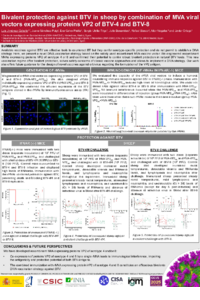
Bluetongue virus (BTV) is an important viral pathogen listed as a notifiable disease by the World Organization for Animal Health (WOAH). BTV, which is transmitted by biting midges of the genus Culicoides, affects a wide range of wild and domestic ruminants, causing a significant impact on the local, regional and global primary sector. To date, more than 29 different BTV serotypes exist, hindering control and prevention of Bluetongue (BT) disease. Currently, vaccination with live attenuated vaccines and inactivated vaccines is the main countermeasure for control of these pathogens. However, classical vaccination approaches against BTV have several drawbacks related to vaccine safety and efficacy but also to their inability to confer multiserotype protection and to differentiate between vaccinated and infected animals (DIVA strategy). Here, we developed recombinant MVA viral vectors expressing the BTV VP2 proteins of serotypes 4 and 8. After characterizing this recombinant MVAs, we evaluated their immunogenicity and protective efficacy in BTV-susceptible IFNAR(-/-) mice and sheep. Immunization of IFNAR(-/-) mice with both rMVA expressing either BTV-4 VP2 or BTV-8 VP2 elicited a strong neutralizing immune response that conferred complete protection against lethal challenge with BTV-4 and BTV-8. In sheep, combinatorial prime-boost immunization with both rMVAs induced high titers of neutralizing antibodies against both homologous BTV serotypes. Importantly, immunized sheep were fully protected against BTV-4, as no fever, viraemia or RNAemia could be observed after challenge. Similarly, sheep immunized with both recombinant MVAs displayed a high degree of protection against BTV-8 although detectable but mild RNAemia and slight increase in rectal temperatures were observed after challenge. Overall, we present a DIVA vaccination strategy that confers a high degree of protection against BTV-4 and BTV-8 in natural hosts of the disease. Further experiments will explore the unlikely protective capacity against heterologous serotypes.
Keywords
Bluetongue
MVA
sheep
VP2.
Poster
Poster Sciforum-128727 Cabello.pdf
A M. bovis-BoHV-1 Combined Vaccine Confers Protection Against Diverse Bovine
Herpesvirus Type 1 Strains
Herpesvirus Type 1 Strains
Assessment of a Live Attenuated African Swine Fever Vaccine Produced in a Stable Cell Line: Immunogenicity and Protective Potential in Wild Boar