Event submissions
Published
This submission belongs to the session C. Veterinary Epidemiology of the event The 1st International Online Conference on Veterinary Sciences
Published date
28 Nov, 2025
Academic Editor
'%3e%3cpath%20d='M12.6657%2010.9104C12.4185%2010.325%2012.0599%209.79327%2011.6097%209.34482C11.1609%208.89508%2010.6293%208.5365%2010.0442%208.28888C10.0389%208.28626%2010.0337%208.28495%2010.0285%208.28233C10.8446%207.69279%2011.3752%206.73249%2011.3752%205.64904C11.3752%203.8542%209.92103%202.39999%208.1262%202.39999C6.33136%202.39999%204.87715%203.8542%204.87715%205.64904C4.87715%206.73249%205.40774%207.69279%206.22393%208.28364C6.21869%208.28626%206.21345%208.28757%206.20821%208.29019C5.62129%208.5378%205.09463%208.89284%204.64265%209.34613C4.1929%209.79493%203.83432%2010.3266%203.58671%2010.9117C3.34345%2011.4845%203.21226%2012.0987%203.20023%2012.7209C3.19988%2012.7349%203.20233%2012.7488%203.20744%2012.7619C3.21255%2012.7749%203.22022%2012.7867%203.22998%2012.7968C3.23975%2012.8068%203.25142%2012.8147%203.26431%2012.8202C3.2772%2012.8256%203.29105%2012.8284%203.30504%2012.8284H4.09109C4.14874%2012.8284%204.19459%2012.7825%204.1959%2012.7262C4.2221%2011.7148%204.62823%2010.7676%205.34617%2010.0497C6.08899%209.30683%207.0755%208.89808%208.1262%208.89808C9.17689%208.89808%2010.1634%209.30683%2010.9062%2010.0497C11.6242%2010.7676%2012.0303%2011.7148%2012.0565%2012.7262C12.0578%2012.7838%2012.1037%2012.8284%2012.1613%2012.8284H12.9474C12.9613%2012.8284%2012.9752%2012.8256%2012.9881%2012.8202C13.001%2012.8147%2013.0126%2012.8068%2013.0224%2012.7968C13.0322%2012.7867%2013.0398%2012.7749%2013.0449%2012.7619C13.0501%2012.7488%2013.0525%2012.7349%2013.0522%2012.7209C13.0391%2012.0947%2012.9094%2011.4855%2012.6657%2010.9104ZM8.1262%207.9024C7.52486%207.9024%206.9589%207.6679%206.53312%207.24211C6.10733%206.81633%205.87283%206.25037%205.87283%205.64904C5.87283%205.0477%206.10733%204.48174%206.53312%204.05596C6.9589%203.63018%207.52486%203.39567%208.1262%203.39567C8.72753%203.39567%209.29349%203.63018%209.71927%204.05596C10.1451%204.48174%2010.3796%205.0477%2010.3796%205.64904C10.3796%206.25037%2010.1451%206.81633%209.71927%207.24211C9.29349%207.6679%208.72753%207.9024%208.1262%207.9024Z'%20fill='%235D1EE1'/%3e%3c/g%3e%3c/svg%3e) Yingyu Chen
Yingyu ChenCitation
Antonia Charalampos Mataragka, The Role of Cats in MRSA Transmission: Investigating Staphylococcus aureus in Feline Stomatitis and its Public Health Implications, in Proceedings of The 1st International Online Conference on Veterinary Sciences, 3 December–5 December 2025, MDPI: Basel, Switzerland
Share
Email
Facebook
Twitter
LinkedIn
The Role of Cats in MRSA Transmission: Investigating Staphylococcus aureus in Feline Stomatitis and its Public Health Implications

Antonia Charalampos Mataragka 1
1. Laboratory of Anatomy and Physiology of Farm Animals, Department of Animal Science, School of Animal Biosciences, Agricultural University of Athens, 11855 Athens, Greece
Abstract
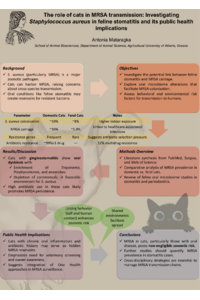
Staphylococcus spp. commonly colonize the skin, mucosal surfaces, and gastrointestinal tracts of humans and animals, among which Staphylococcus aureus, especially methicillin-resistant S. aureus (MRSA), represents a pathogen of concern. Although MRSA is traditionally associated with healthcare settings, its increasing prevalence in the community has raised concerns about its transmission from animals to humans. Studies comparing domestic and feral cats demonstrate that indoor pet cats exhibit higher colonization rates of S. aureus, approximately 19% vs. 8% among feral cats, and MRSA carriage reaches about 10% in domestic cats, compared to only 1.4% in feral populations. In healthy indoor cats, MRSA prevalence averages 6.6%, with risk factors including households where owners work in healthcare, co‑resident dogs, and antibiotic treatment in the past year. Although feline stomatitis has not been directly studied for MRSA prevalence, existing data show that oropharyngeal staphylococci from cats often demonstrate high resistance rates ~99% to at least one antibiotic, ~12% multidrug resistance, and frequent carriage of resistance genes including mecA. Microbiome research in cats with gingivostomatitis, periodontitis, and chronic stomatitis reveals significant oral dysbiosis characterized by enrichment of anaerobic periodontal pathogens (Treponema, Porphyromonas) and reduced commensal taxa, thereby creating conditions favorable to opportunistic staphylococcal colonization. Behavioral patterns, such as self‑licking and human face/hand licking, further increase the opportunity for the bidirectional transmission of MRSA between cats and owners. Moreover, while MRSA prevalence in cats with stomatitis is yet to be directly quantified, the convergence of high antibiotic exposure, documented indoor MRSA carriage, and oral microbial disruption strongly suggests that cats suffering from chronic oral inflammatory diseases and undergoing repeated or prolonged antibiotic therapy may act as overlooked reservoirs of MRSA. Understanding the role of feline S. aureus in MRSA epidemiology is crucial for assessing potential risks to human cohabitants and improving public health strategies.
Keywords
MRSA
Staphylococcus aureus
cats
stomatitis
Poster
Poster - The Role of Cats in MRSA Transmission.pdf
One Health and non-communicable diseases: animal interconnection to human non-communicable diseases
Development and Characterization of Novel Swine Influenza Virus-Like Particles (VLPs)