Event submissions
Published
This submission belongs to the session C. Veterinary Epidemiology of the event The 1st International Online Conference on Veterinary Sciences
Published date
28 Nov, 2025
Academic Editor
'%3e%3cpath%20d='M12.6657%2010.9104C12.4185%2010.325%2012.0599%209.79327%2011.6097%209.34482C11.1609%208.89508%2010.6293%208.5365%2010.0442%208.28888C10.0389%208.28626%2010.0337%208.28495%2010.0285%208.28233C10.8446%207.69279%2011.3752%206.73249%2011.3752%205.64904C11.3752%203.8542%209.92103%202.39999%208.1262%202.39999C6.33136%202.39999%204.87715%203.8542%204.87715%205.64904C4.87715%206.73249%205.40774%207.69279%206.22393%208.28364C6.21869%208.28626%206.21345%208.28757%206.20821%208.29019C5.62129%208.5378%205.09463%208.89284%204.64265%209.34613C4.1929%209.79493%203.83432%2010.3266%203.58671%2010.9117C3.34345%2011.4845%203.21226%2012.0987%203.20023%2012.7209C3.19988%2012.7349%203.20233%2012.7488%203.20744%2012.7619C3.21255%2012.7749%203.22022%2012.7867%203.22998%2012.7968C3.23975%2012.8068%203.25142%2012.8147%203.26431%2012.8202C3.2772%2012.8256%203.29105%2012.8284%203.30504%2012.8284H4.09109C4.14874%2012.8284%204.19459%2012.7825%204.1959%2012.7262C4.2221%2011.7148%204.62823%2010.7676%205.34617%2010.0497C6.08899%209.30683%207.0755%208.89808%208.1262%208.89808C9.17689%208.89808%2010.1634%209.30683%2010.9062%2010.0497C11.6242%2010.7676%2012.0303%2011.7148%2012.0565%2012.7262C12.0578%2012.7838%2012.1037%2012.8284%2012.1613%2012.8284H12.9474C12.9613%2012.8284%2012.9752%2012.8256%2012.9881%2012.8202C13.001%2012.8147%2013.0126%2012.8068%2013.0224%2012.7968C13.0322%2012.7867%2013.0398%2012.7749%2013.0449%2012.7619C13.0501%2012.7488%2013.0525%2012.7349%2013.0522%2012.7209C13.0391%2012.0947%2012.9094%2011.4855%2012.6657%2010.9104ZM8.1262%207.9024C7.52486%207.9024%206.9589%207.6679%206.53312%207.24211C6.10733%206.81633%205.87283%206.25037%205.87283%205.64904C5.87283%205.0477%206.10733%204.48174%206.53312%204.05596C6.9589%203.63018%207.52486%203.39567%208.1262%203.39567C8.72753%203.39567%209.29349%203.63018%209.71927%204.05596C10.1451%204.48174%2010.3796%205.0477%2010.3796%205.64904C10.3796%206.25037%2010.1451%206.81633%209.71927%207.24211C9.29349%207.6679%208.72753%207.9024%208.1262%207.9024Z'%20fill='%235D1EE1'/%3e%3c/g%3e%3c/svg%3e) Yingyu Chen
Yingyu ChenCitation
Vijay Subbiah Kumar, Md. Safiul Alam Bhuiyan, Novaldi Noer, Dexter Miller Robben, Molecular Characterisation of Fowl Adenoviruses Associated with Inclusion Body Hepatitis and Gizzard Erosion in Broiler Chickens in Sabah, Malaysia, in Proceedings of The 1st International Online Conference on Veterinary Sciences, 3 December–5 December 2025, MDPI: Basel, Switzerland
Share
Email
Facebook
Twitter
LinkedIn
Molecular Characterisation of Fowl Adenoviruses Associated with Inclusion Body Hepatitis and Gizzard Erosion in Broiler Chickens in Sabah, Malaysia
'%3e%3cpath%20d='M12.6647%2010.9104C12.4176%2010.325%2012.0589%209.7933%2011.6088%209.34485C11.16%208.89511%2010.6283%208.53653%2010.0432%208.28891C10.038%208.28629%2010.0327%208.28498%2010.0275%208.28236C10.8437%207.69282%2011.3743%206.73252%2011.3743%205.64907C11.3743%203.85423%209.92005%202.40002%208.12522%202.40002C6.33038%202.40002%204.87618%203.85423%204.87618%205.64907C4.87618%206.73252%205.40677%207.69282%206.22296%208.28367C6.21772%208.28629%206.21248%208.2876%206.20724%208.29022C5.62031%208.53783%205.09365%208.89287%204.64167%209.34616C4.19192%209.79496%203.83334%2010.3266%203.58573%2010.9117C3.34247%2011.4846%203.21128%2012.0987%203.19925%2012.721C3.1989%2012.735%203.20135%2012.7489%203.20646%2012.7619C3.21157%2012.7749%203.21924%2012.7868%203.22901%2012.7968C3.23877%2012.8068%203.25045%2012.8148%203.26334%2012.8202C3.27623%2012.8256%203.29007%2012.8284%203.30406%2012.8284H4.09012C4.14776%2012.8284%204.19362%2012.7825%204.19493%2012.7262C4.22113%2011.7148%204.62726%2010.7676%205.34519%2010.0497C6.08802%209.30686%207.07452%208.89811%208.12522%208.89811C9.17592%208.89811%2010.1624%209.30686%2010.9052%2010.0497C11.6232%2010.7676%2012.0293%2011.7148%2012.0555%2012.7262C12.0568%2012.7839%2012.1027%2012.8284%2012.1603%2012.8284H12.9464C12.9604%2012.8284%2012.9742%2012.8256%2012.9871%2012.8202C13%2012.8148%2013.0117%2012.8068%2013.0214%2012.7968C13.0312%2012.7868%2013.0389%2012.7749%2013.044%2012.7619C13.0491%2012.7489%2013.0515%2012.735%2013.0512%2012.721C13.0381%2012.0947%2012.9084%2011.4856%2012.6647%2010.9104ZM8.12522%207.90243C7.52388%207.90243%206.95792%207.66793%206.53214%207.24215C6.10636%206.81636%205.87185%206.2504%205.87185%205.64907C5.87185%205.04773%206.10636%204.48177%206.53214%204.05599C6.95792%203.63021%207.52388%203.3957%208.12522%203.3957C8.72655%203.3957%209.29252%203.63021%209.7183%204.05599C10.1441%204.48177%2010.3786%205.04773%2010.3786%205.64907C10.3786%206.2504%2010.1441%206.81636%209.7183%207.24215C9.29252%207.66793%208.72655%207.90243%208.12522%207.90243Z'%20fill='%235D1EE1'/%3e%3c/g%3e%3c/svg%3e)
Vijay Subbiah Kumar 1
Md. Safiul Alam Bhuiyan 2
Novaldi Noer 3
Dexter Miller Robben 1
1. Biotechnology Research Institute, Universiti Malaysia Sabah, 88400 Kota Kinabalu, Sabah, Malaysia
2. Faculty of Sustainable Agriculture, Universiti Malaysia Sabah, 90509 Sandakan, Sabah, Malaysia
3. Poultry Veterinarian, Kota Bekasi, 17136 West Java, Indonesia
Abstract
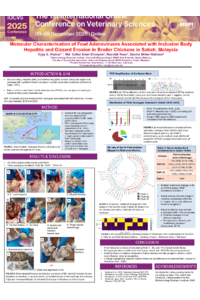
Inclusion Body Hepatitis (IBH) and adenoviral gizzard erosion (AGE), which are caused by fowl adenoviruses (FAdVs), have emerged as significant health concerns in poultry production in Sabah, Malaysia. Here, we present molecular surveillance data collected from 2019 to 2023 to characterise the FAdV serotypes associated with these diseases in broiler chickens. A total of 66 liver and gizzard samples were collected from birds exhibiting gross lesions consistent with IBH or AGE. Of these, 49 samples tested positive for FAdV by means of Polymerase Chain Reaction (PCR), and all 49 underwent partial sequencing of the hexon gene, a major capsid protein used for FAdV serotyping. We identified three FAdV serotypes over the five-year period, namely, FAdV-1 (species A), FAdV-8b (species E) and FAdV-11 (species D). We found that FAdV-8b was the most prevalent and was detected in 69.4% (34/49) of the positive samples and was present in all five years. Meanwhile, FAdV-11 (4/49) was limited to 2019 and 2020, and FAdV-1 (12/49) was detected only in 2023. We observed a notable increase in IBH cases in 2023, coinciding with a sharp rise in FAdV-8b detection. We also identified FAdV-1 only in 2023 and observed gizzard erosion during necropsy, suggesting the presence of AGE. From the sequence analysis of the Hexon gene, we identified several single-nucleotide variants (SNVs) within samples of the same serotype, which indicates intra-serotype genetic variation reflecting viral adaptation or local evolution. Our study provides the first molecular evidence of FAdV-1, -8b, and -11 associated with IBH and AGE cases in Sabah and demonstrates shifting patterns in FAdV serotype prevalence over time. Our findings highlight the importance of molecular surveillance and targeted farm-level biosecurity measures to control the spread and impact of FAdV infections in Sabah poultry flocks.
Keywords
Fowl adenovirus (FAdV)
Inclusion body hepatitis (IBH)
Adenoviral gizzard erosion (AGE)
Poultry Diseases
Biosurveillance.
Poster
IOCVS_sciforum-142712Vijay.pdf
Feasibility of on-farm somatic cell count screening for subclinical mastitis: Prevalence and risk factors in a commercial dairy herd in Bangladesh
EPIDEMIOLOGY AND MOLECULAR IDENTIFICATION OF INTESTINAL PARASITES inSLAUGHTERED SHEEP AND GOATS IN AMOSUN ABATTOIR, IBADAN, SOUTHWEST NIGERIA