Event submissions
Published
This submission belongs to the session C. Veterinary Epidemiology of the event The 1st International Online Conference on Veterinary Sciences
Published date
28 Nov, 2025
Academic Editor
'%3e%3cpath%20d='M12.6657%2010.9104C12.4185%2010.325%2012.0599%209.79327%2011.6097%209.34482C11.1609%208.89508%2010.6293%208.5365%2010.0442%208.28888C10.0389%208.28626%2010.0337%208.28495%2010.0285%208.28233C10.8446%207.69279%2011.3752%206.73249%2011.3752%205.64904C11.3752%203.8542%209.92103%202.39999%208.1262%202.39999C6.33136%202.39999%204.87715%203.8542%204.87715%205.64904C4.87715%206.73249%205.40774%207.69279%206.22393%208.28364C6.21869%208.28626%206.21345%208.28757%206.20821%208.29019C5.62129%208.5378%205.09463%208.89284%204.64265%209.34613C4.1929%209.79493%203.83432%2010.3266%203.58671%2010.9117C3.34345%2011.4845%203.21226%2012.0987%203.20023%2012.7209C3.19988%2012.7349%203.20233%2012.7488%203.20744%2012.7619C3.21255%2012.7749%203.22022%2012.7867%203.22998%2012.7968C3.23975%2012.8068%203.25142%2012.8147%203.26431%2012.8202C3.2772%2012.8256%203.29105%2012.8284%203.30504%2012.8284H4.09109C4.14874%2012.8284%204.19459%2012.7825%204.1959%2012.7262C4.2221%2011.7148%204.62823%2010.7676%205.34617%2010.0497C6.08899%209.30683%207.0755%208.89808%208.1262%208.89808C9.17689%208.89808%2010.1634%209.30683%2010.9062%2010.0497C11.6242%2010.7676%2012.0303%2011.7148%2012.0565%2012.7262C12.0578%2012.7838%2012.1037%2012.8284%2012.1613%2012.8284H12.9474C12.9613%2012.8284%2012.9752%2012.8256%2012.9881%2012.8202C13.001%2012.8147%2013.0126%2012.8068%2013.0224%2012.7968C13.0322%2012.7867%2013.0398%2012.7749%2013.0449%2012.7619C13.0501%2012.7488%2013.0525%2012.7349%2013.0522%2012.7209C13.0391%2012.0947%2012.9094%2011.4855%2012.6657%2010.9104ZM8.1262%207.9024C7.52486%207.9024%206.9589%207.6679%206.53312%207.24211C6.10733%206.81633%205.87283%206.25037%205.87283%205.64904C5.87283%205.0477%206.10733%204.48174%206.53312%204.05596C6.9589%203.63018%207.52486%203.39567%208.1262%203.39567C8.72753%203.39567%209.29349%203.63018%209.71927%204.05596C10.1451%204.48174%2010.3796%205.0477%2010.3796%205.64904C10.3796%206.25037%2010.1451%206.81633%209.71927%207.24211C9.29349%207.6679%208.72753%207.9024%208.1262%207.9024Z'%20fill='%235D1EE1'/%3e%3c/g%3e%3c/svg%3e) Yingyu Chen
Yingyu ChenCitation
Francesca Gucciardi, Giovanni Savini, Francesco La Russa, Maria Liliana di Pasquale, Antonina Princiotta, Maria teresa todaro, Annalisa Guercio, Giuseppa Purpari, Identification of co-infections of Bluetongue virus serotypes 3, 4, and 8 through animal and entomological surveillance in Sicily, Italy, in Proceedings of The 1st International Online Conference on Veterinary Sciences, 3 December–5 December 2025, MDPI: Basel, Switzerland
Share
Email
Facebook
Twitter
LinkedIn
Identification of co-infections of Bluetongue virus serotypes 3, 4, and 8 through animal and entomological surveillance in Sicily, Italy
'%3e%3cpath%20d='M12.6647%2010.9104C12.4176%2010.325%2012.0589%209.7933%2011.6088%209.34485C11.16%208.89511%2010.6283%208.53653%2010.0432%208.28891C10.038%208.28629%2010.0327%208.28498%2010.0275%208.28236C10.8437%207.69282%2011.3743%206.73252%2011.3743%205.64907C11.3743%203.85423%209.92005%202.40002%208.12522%202.40002C6.33038%202.40002%204.87618%203.85423%204.87618%205.64907C4.87618%206.73252%205.40677%207.69282%206.22296%208.28367C6.21772%208.28629%206.21248%208.2876%206.20724%208.29022C5.62031%208.53783%205.09365%208.89287%204.64167%209.34616C4.19192%209.79496%203.83334%2010.3266%203.58573%2010.9117C3.34247%2011.4846%203.21128%2012.0987%203.19925%2012.721C3.1989%2012.735%203.20135%2012.7489%203.20646%2012.7619C3.21157%2012.7749%203.21924%2012.7868%203.22901%2012.7968C3.23877%2012.8068%203.25045%2012.8148%203.26334%2012.8202C3.27623%2012.8256%203.29007%2012.8284%203.30406%2012.8284H4.09012C4.14776%2012.8284%204.19362%2012.7825%204.19493%2012.7262C4.22113%2011.7148%204.62726%2010.7676%205.34519%2010.0497C6.08802%209.30686%207.07452%208.89811%208.12522%208.89811C9.17592%208.89811%2010.1624%209.30686%2010.9052%2010.0497C11.6232%2010.7676%2012.0293%2011.7148%2012.0555%2012.7262C12.0568%2012.7839%2012.1027%2012.8284%2012.1603%2012.8284H12.9464C12.9604%2012.8284%2012.9742%2012.8256%2012.9871%2012.8202C13%2012.8148%2013.0117%2012.8068%2013.0214%2012.7968C13.0312%2012.7868%2013.0389%2012.7749%2013.044%2012.7619C13.0491%2012.7489%2013.0515%2012.735%2013.0512%2012.721C13.0381%2012.0947%2012.9084%2011.4856%2012.6647%2010.9104ZM8.12522%207.90243C7.52388%207.90243%206.95792%207.66793%206.53214%207.24215C6.10636%206.81636%205.87185%206.2504%205.87185%205.64907C5.87185%205.04773%206.10636%204.48177%206.53214%204.05599C6.95792%203.63021%207.52388%203.3957%208.12522%203.3957C8.72655%203.3957%209.29252%203.63021%209.7183%204.05599C10.1441%204.48177%2010.3786%205.04773%2010.3786%205.64907C10.3786%206.2504%2010.1441%206.81636%209.7183%207.24215C9.29252%207.66793%208.72655%207.90243%208.12522%207.90243Z'%20fill='%235D1EE1'/%3e%3c/g%3e%3c/svg%3e)
Francesca Gucciardi 1

Giovanni Savini 2
Francesco La Russa 1
Maria Liliana di Pasquale 1
Antonina Princiotta 1
Maria teresa todaro 1
Annalisa Guercio 1
Giuseppa Purpari 1
1. Istituto Zooprofilattico Sperimentale della Sicilia “A. Mirri”, Via Marinuzzi, Palermo, Italy
2. Department of Virology, OIE Reference Center for West Nile Disease, Istituto Zooprofilattico Sperimentale “G. Caporale”, 64100 Teramo, Italy
Abstract
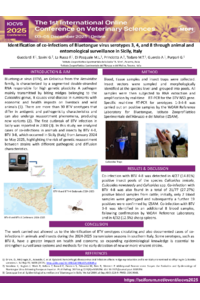
Introduction: Bluetongue virus (BTV), an Orbivirus from the Reoviridae family, is characterized by a segmented double-stranded RNA responsible for high genetic plasticity. A pathogen mainly transmitted by biting midges belonging to the Culicoides genus, it causes viral disease in ruminants with economic and health impacts on livestock and wild animals. There are more than 30 BTV serotypes that differ in antigenic and pathogenicity characteristics and can also undergo reassortment phenomena, producing new variants. The first outbreak of BTV infection in Sicily was reported in 2000 (2). In this study, we analyzed cases of co-infections in animals and insects by BTV 4-8, BTV 3-8, which occurred in Sicily (Italy) from January 2024 to May 2025, highlighting the risk of genetic reassortment between strains with different pathogenic and diffusion characteristics.
Methods: Blood, tissue samples, and insect traps were collected. Insect vectors were sampled and morphologically identified at the species and aggregate levels. Insects and blood samples were then subjected to RNA extraction and amplification by real-time RT-PCR for the BTV NS3 gene. Specific real-time RT-PCR for serotypes 1-3-4-8 was carried out on positive samples.
Results: Coinfection with BTV 4-8 was detected in 4/27 (14.81%) positive insects of the species Culicoides imicola, Culicoides new steady, and Culicoides spp., and in 2/77 (2.6%) positive blood samples from cattle. Coinfection with BTV 3-8 was identified in 2 additional blood samples and 4/32 (12.5%) sheep spleens.
Conclusions: The work carried out allowed us to the identification of BTV serotypes circulating and also documented cases of co-infections in animals and insects during the 2024-2025 transmission seasons in southern Italy. Some serotypes, such as BTV-8, have a greater impact on health and economy, so expanding epidemiological knowledge is essential to strengthen surveillance systems and methods for the early detection of new or more virulent strains.
Keywords
Bluetongue virus
Culicoides
Coinfection
Poster
Poster sciforum-142894 Francesca.pdf
Serological Survey of Rickettsia, Anaplasma, Ehrlichia, Babesia, and Flaviviruses in Dogs from Western Sicily (Italy)
Molecular Epidemiology of Mycobacterium bovis in Sicily: Insights from Spoligotyping for Targeted bTB Control