Event submissions
Published
This submission belongs to the session C. Veterinary Epidemiology of the event The 1st International Online Conference on Veterinary Sciences
Published date
28 Nov, 2025
Academic Editor
'%3e%3cpath%20d='M12.6657%2010.9104C12.4185%2010.325%2012.0599%209.79327%2011.6097%209.34482C11.1609%208.89508%2010.6293%208.5365%2010.0442%208.28888C10.0389%208.28626%2010.0337%208.28495%2010.0285%208.28233C10.8446%207.69279%2011.3752%206.73249%2011.3752%205.64904C11.3752%203.8542%209.92103%202.39999%208.1262%202.39999C6.33136%202.39999%204.87715%203.8542%204.87715%205.64904C4.87715%206.73249%205.40774%207.69279%206.22393%208.28364C6.21869%208.28626%206.21345%208.28757%206.20821%208.29019C5.62129%208.5378%205.09463%208.89284%204.64265%209.34613C4.1929%209.79493%203.83432%2010.3266%203.58671%2010.9117C3.34345%2011.4845%203.21226%2012.0987%203.20023%2012.7209C3.19988%2012.7349%203.20233%2012.7488%203.20744%2012.7619C3.21255%2012.7749%203.22022%2012.7867%203.22998%2012.7968C3.23975%2012.8068%203.25142%2012.8147%203.26431%2012.8202C3.2772%2012.8256%203.29105%2012.8284%203.30504%2012.8284H4.09109C4.14874%2012.8284%204.19459%2012.7825%204.1959%2012.7262C4.2221%2011.7148%204.62823%2010.7676%205.34617%2010.0497C6.08899%209.30683%207.0755%208.89808%208.1262%208.89808C9.17689%208.89808%2010.1634%209.30683%2010.9062%2010.0497C11.6242%2010.7676%2012.0303%2011.7148%2012.0565%2012.7262C12.0578%2012.7838%2012.1037%2012.8284%2012.1613%2012.8284H12.9474C12.9613%2012.8284%2012.9752%2012.8256%2012.9881%2012.8202C13.001%2012.8147%2013.0126%2012.8068%2013.0224%2012.7968C13.0322%2012.7867%2013.0398%2012.7749%2013.0449%2012.7619C13.0501%2012.7488%2013.0525%2012.7349%2013.0522%2012.7209C13.0391%2012.0947%2012.9094%2011.4855%2012.6657%2010.9104ZM8.1262%207.9024C7.52486%207.9024%206.9589%207.6679%206.53312%207.24211C6.10733%206.81633%205.87283%206.25037%205.87283%205.64904C5.87283%205.0477%206.10733%204.48174%206.53312%204.05596C6.9589%203.63018%207.52486%203.39567%208.1262%203.39567C8.72753%203.39567%209.29349%203.63018%209.71927%204.05596C10.1451%204.48174%2010.3796%205.0477%2010.3796%205.64904C10.3796%206.25037%2010.1451%206.81633%209.71927%207.24211C9.29349%207.6679%208.72753%207.9024%208.1262%207.9024Z'%20fill='%235D1EE1'/%3e%3c/g%3e%3c/svg%3e) Yingyu Chen
Yingyu ChenCitation
Iván Belinchón-Esteban, Sergio Utrilla-Trigo, Alejandro Carra-Valenzuela, Iván Mazuecos, Luis Jiménez-Cabello, Eva Calvo-Pinilla, Javier Ortego, Generation and characterization of replication-competent rBTV-3 expressing fluorescent and luminescent reporter genes using a reverse genetics system, in Proceedings of The 1st International Online Conference on Veterinary Sciences, 3 December–5 December 2025, MDPI: Basel, Switzerland
Share
Email
Facebook
Twitter
LinkedIn
Generation and characterization of replication-competent rBTV-3 expressing fluorescent and luminescent reporter genes using a reverse genetics system
'%3e%3cpath%20d='M12.6647%2010.9104C12.4176%2010.325%2012.0589%209.7933%2011.6088%209.34485C11.16%208.89511%2010.6283%208.53653%2010.0432%208.28891C10.038%208.28629%2010.0327%208.28498%2010.0275%208.28236C10.8437%207.69282%2011.3743%206.73252%2011.3743%205.64907C11.3743%203.85423%209.92005%202.40002%208.12522%202.40002C6.33038%202.40002%204.87618%203.85423%204.87618%205.64907C4.87618%206.73252%205.40677%207.69282%206.22296%208.28367C6.21772%208.28629%206.21248%208.2876%206.20724%208.29022C5.62031%208.53783%205.09365%208.89287%204.64167%209.34616C4.19192%209.79496%203.83334%2010.3266%203.58573%2010.9117C3.34247%2011.4846%203.21128%2012.0987%203.19925%2012.721C3.1989%2012.735%203.20135%2012.7489%203.20646%2012.7619C3.21157%2012.7749%203.21924%2012.7868%203.22901%2012.7968C3.23877%2012.8068%203.25045%2012.8148%203.26334%2012.8202C3.27623%2012.8256%203.29007%2012.8284%203.30406%2012.8284H4.09012C4.14776%2012.8284%204.19362%2012.7825%204.19493%2012.7262C4.22113%2011.7148%204.62726%2010.7676%205.34519%2010.0497C6.08802%209.30686%207.07452%208.89811%208.12522%208.89811C9.17592%208.89811%2010.1624%209.30686%2010.9052%2010.0497C11.6232%2010.7676%2012.0293%2011.7148%2012.0555%2012.7262C12.0568%2012.7839%2012.1027%2012.8284%2012.1603%2012.8284H12.9464C12.9604%2012.8284%2012.9742%2012.8256%2012.9871%2012.8202C13%2012.8148%2013.0117%2012.8068%2013.0214%2012.7968C13.0312%2012.7868%2013.0389%2012.7749%2013.044%2012.7619C13.0491%2012.7489%2013.0515%2012.735%2013.0512%2012.721C13.0381%2012.0947%2012.9084%2011.4856%2012.6647%2010.9104ZM8.12522%207.90243C7.52388%207.90243%206.95792%207.66793%206.53214%207.24215C6.10636%206.81636%205.87185%206.2504%205.87185%205.64907C5.87185%205.04773%206.10636%204.48177%206.53214%204.05599C6.95792%203.63021%207.52388%203.3957%208.12522%203.3957C8.72655%203.3957%209.29252%203.63021%209.7183%204.05599C10.1441%204.48177%2010.3786%205.04773%2010.3786%205.64907C10.3786%206.2504%2010.1441%206.81636%209.7183%207.24215C9.29252%207.66793%208.72655%207.90243%208.12522%207.90243Z'%20fill='%235D1EE1'/%3e%3c/g%3e%3c/svg%3e)
Iván Belinchón-Esteban 1
Sergio Utrilla-Trigo 1
Alejandro Carra-Valenzuela 1
Iván Mazuecos 1
Luis Jiménez-Cabello 1
Eva Calvo-Pinilla 1
Javier Ortego 1
1. Centro de Investigación en Sanidad Animal, INIA-CSIC, Valdeolmos, 28130 Madrid, Spain
Abstract
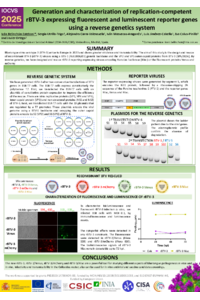
Bluetongue virus (BTV) is a widespread vector-borne pathogen of major concern for animal health, mainly affecting both wild and domestic ruminants. This virus stands out for its ability to cause significant disease and its impact on livestock production. In 2023, BTV serotype 3 was detected in the Netherlands and spread rapidly to neighbouring countries. Compared to other serotypes circulating in Europe, BTV-3 shows greater virulence and transmissibility. The aim of this study is the design and rescue of reporter-expressing BTV-3 viruses using a BTV-1 (ALG2006/01) genetic backbone and the VP2 and VP5 outer capsid proteins from BTV-3 (SPA/2024). Using a plasmid-based reverse genetic system, we have designed and rescued rBTV-3 reporter-expressing viruses encoding NanoLuc luciferase (Nluc) or the fluorescent proteins Venus and mCherry. Rescue was achieved by transfecting BSR-T7 cells with plasmids encoding BTV genome segments. The reporter-expressing viruses were generated by chaining segment 5, which encodes the NS1 protein, with a Porcine teschovirus-1 (PTV-1) 2A autoproteolytic cleavage site, followed by the reporter genes. Consequently, fluorescence and luminescence signals are only detected following viral replication and expression of non-structural proteins. BSR cells were mock-infected or infected (MOI 0.1) with rBTV-3, rBTV-3/Venus, rBTV-3/mCherry or rBTV-3/Nluc. Fluorescence was detected in the cytoplasm of the cells infected with rBTV-3/Venus or rBTV-3/mCherry but not in those infected with rBTV-3 or rBTV-3/Nluc. Moreover, Nluc activity was only detected in rBTV-3/Nluc infected cells. The use of replication-competent viruses that encode a traceable fluorescent or luciferase reporter protein may be promising tools for studying BTV infectivity, transmissibility, pathogenesis, diagnostics, and vector competence.
Keywords
BTV
reverse genetics
transmissibility
diagnostics
infectivity
Poster
POSTER MDPI IBE 2025.pdf
Prevalence and Management of Foot-and-Mouth Disease in Cattle in Iraq: A Short Review
Development of a Quantitative Structure–Retention Relationship (QSRR) Model for Predicting Veterinary Drug Retention Time in Food Matrices