Event submissions
Published
This submission belongs to the session C. Veterinary Epidemiology of the event The 1st International Online Conference on Veterinary Sciences
Published date
28 Nov, 2025
Academic Editor
'%3e%3cpath%20d='M12.6657%2010.9104C12.4185%2010.325%2012.0599%209.79327%2011.6097%209.34482C11.1609%208.89508%2010.6293%208.5365%2010.0442%208.28888C10.0389%208.28626%2010.0337%208.28495%2010.0285%208.28233C10.8446%207.69279%2011.3752%206.73249%2011.3752%205.64904C11.3752%203.8542%209.92103%202.39999%208.1262%202.39999C6.33136%202.39999%204.87715%203.8542%204.87715%205.64904C4.87715%206.73249%205.40774%207.69279%206.22393%208.28364C6.21869%208.28626%206.21345%208.28757%206.20821%208.29019C5.62129%208.5378%205.09463%208.89284%204.64265%209.34613C4.1929%209.79493%203.83432%2010.3266%203.58671%2010.9117C3.34345%2011.4845%203.21226%2012.0987%203.20023%2012.7209C3.19988%2012.7349%203.20233%2012.7488%203.20744%2012.7619C3.21255%2012.7749%203.22022%2012.7867%203.22998%2012.7968C3.23975%2012.8068%203.25142%2012.8147%203.26431%2012.8202C3.2772%2012.8256%203.29105%2012.8284%203.30504%2012.8284H4.09109C4.14874%2012.8284%204.19459%2012.7825%204.1959%2012.7262C4.2221%2011.7148%204.62823%2010.7676%205.34617%2010.0497C6.08899%209.30683%207.0755%208.89808%208.1262%208.89808C9.17689%208.89808%2010.1634%209.30683%2010.9062%2010.0497C11.6242%2010.7676%2012.0303%2011.7148%2012.0565%2012.7262C12.0578%2012.7838%2012.1037%2012.8284%2012.1613%2012.8284H12.9474C12.9613%2012.8284%2012.9752%2012.8256%2012.9881%2012.8202C13.001%2012.8147%2013.0126%2012.8068%2013.0224%2012.7968C13.0322%2012.7867%2013.0398%2012.7749%2013.0449%2012.7619C13.0501%2012.7488%2013.0525%2012.7349%2013.0522%2012.7209C13.0391%2012.0947%2012.9094%2011.4855%2012.6657%2010.9104ZM8.1262%207.9024C7.52486%207.9024%206.9589%207.6679%206.53312%207.24211C6.10733%206.81633%205.87283%206.25037%205.87283%205.64904C5.87283%205.0477%206.10733%204.48174%206.53312%204.05596C6.9589%203.63018%207.52486%203.39567%208.1262%203.39567C8.72753%203.39567%209.29349%203.63018%209.71927%204.05596C10.1451%204.48174%2010.3796%205.0477%2010.3796%205.64904C10.3796%206.25037%2010.1451%206.81633%209.71927%207.24211C9.29349%207.6679%208.72753%207.9024%208.1262%207.9024Z'%20fill='%235D1EE1'/%3e%3c/g%3e%3c/svg%3e) Yingyu Chen
Yingyu ChenCitation
Hamada Abdelfattah Ali Noreldeen, Abdel-Rahman Mustafa Hamed, Yassein Abdel-Maksoud Ahmed Osman, Development of a Quantitative Structure–Retention Relationship (QSRR) Model for Predicting Veterinary Drug Retention Time in Food Matrices, in Proceedings of The 1st International Online Conference on Veterinary Sciences, 3 December–5 December 2025, MDPI: Basel, Switzerland
Share
Email
Facebook
Twitter
LinkedIn
Development of a Quantitative Structure–Retention Relationship (QSRR) Model for Predicting Veterinary Drug Retention Time in Food Matrices

Hamada Abdelfattah Ali Noreldeen 1,2
'%3e%3cpath%20d='M12.6647%2010.9104C12.4176%2010.325%2012.0589%209.7933%2011.6088%209.34485C11.16%208.89511%2010.6283%208.53653%2010.0432%208.28891C10.038%208.28629%2010.0327%208.28498%2010.0275%208.28236C10.8437%207.69282%2011.3743%206.73252%2011.3743%205.64907C11.3743%203.85423%209.92005%202.40002%208.12522%202.40002C6.33038%202.40002%204.87618%203.85423%204.87618%205.64907C4.87618%206.73252%205.40677%207.69282%206.22296%208.28367C6.21772%208.28629%206.21248%208.2876%206.20724%208.29022C5.62031%208.53783%205.09365%208.89287%204.64167%209.34616C4.19192%209.79496%203.83334%2010.3266%203.58573%2010.9117C3.34247%2011.4846%203.21128%2012.0987%203.19925%2012.721C3.1989%2012.735%203.20135%2012.7489%203.20646%2012.7619C3.21157%2012.7749%203.21924%2012.7868%203.22901%2012.7968C3.23877%2012.8068%203.25045%2012.8148%203.26334%2012.8202C3.27623%2012.8256%203.29007%2012.8284%203.30406%2012.8284H4.09012C4.14776%2012.8284%204.19362%2012.7825%204.19493%2012.7262C4.22113%2011.7148%204.62726%2010.7676%205.34519%2010.0497C6.08802%209.30686%207.07452%208.89811%208.12522%208.89811C9.17592%208.89811%2010.1624%209.30686%2010.9052%2010.0497C11.6232%2010.7676%2012.0293%2011.7148%2012.0555%2012.7262C12.0568%2012.7839%2012.1027%2012.8284%2012.1603%2012.8284H12.9464C12.9604%2012.8284%2012.9742%2012.8256%2012.9871%2012.8202C13%2012.8148%2013.0117%2012.8068%2013.0214%2012.7968C13.0312%2012.7868%2013.0389%2012.7749%2013.044%2012.7619C13.0491%2012.7489%2013.0515%2012.735%2013.0512%2012.721C13.0381%2012.0947%2012.9084%2011.4856%2012.6647%2010.9104ZM8.12522%207.90243C7.52388%207.90243%206.95792%207.66793%206.53214%207.24215C6.10636%206.81636%205.87185%206.2504%205.87185%205.64907C5.87185%205.04773%206.10636%204.48177%206.53214%204.05599C6.95792%203.63021%207.52388%203.3957%208.12522%203.3957C8.72655%203.3957%209.29252%203.63021%209.7183%204.05599C10.1441%204.48177%2010.3786%205.04773%2010.3786%205.64907C10.3786%206.2504%2010.1441%206.81636%209.7183%207.24215C9.29252%207.66793%208.72655%207.90243%208.12522%207.90243Z'%20fill='%235D1EE1'/%3e%3c/g%3e%3c/svg%3e)
Abdel-Rahman Mustafa Hamed 3
Yassein Abdel-Maksoud Ahmed Osman 2
1. Pathogen-Host Interaction Program, Texas Biomedical Research Institute, San Antonio, TX, 78227, USA
2. National Institute of Oceanography and Fisheries, NIOF, Cairo, 4262110, Egypt
3. Faculty of Science, Chemistry, Faculty of Science, Al-Azhar University, Assuit, 71111, Egypt
Abstract
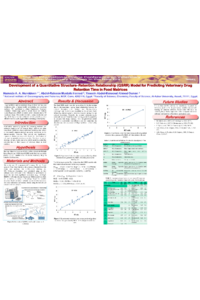
Quantitative structure–retention relationships (QSRR) offer a powerful approach to predict chromatographic retention times of compounds based on their molecular structures. In this study, we developed a practical and user-friendly QSRR model using multiple linear regression (MLR) to forecast the retention behavior of three classes of illicit veterinary drug additives in food matrices. A total of 95 drugs were analyzed, divided into a training set (62 compounds), a test set (30 compounds), and a real-sample validation set (3 compounds). Molecular descriptors were generated using freely available software tools, including Advanced Chemistry Development (ACD) and the Toxicity Estimation Software Tool (TEST).
The final MLR-QSRR model demonstrated excellent predictive performance, with a strong correlation between observed retention times and selected molecular descriptors (R² = 0.966). Key descriptors influencing retention time included ACDlogP, ALOGP, ALOGP2, Hy, Ui, ib, BEHp1, BEHp2, GATS1m, and GATS2m. Validation through four independent approaches—leave-one-out, k-fold cross-validation, external test set, and real-sample application—confirmed the robustness and reliability of the model.
These findings highlight the potential of QSRR modeling as a valuable analytical tool in food safety, particularly for detecting and monitoring illegal veterinary drug residues. By enabling accurate retention time prediction, this approach supports enhanced screening efficiency in chromatographic workflows and contributes to safeguarding public health.
Keywords
Quantitative structure–retention relationships (QSRR)
Veterinary drug residues
Food safety
Liquid chromatography–mass spectrometry (LC–MS)
Illegal additives
Poster
Poster sciforum-145990 Hamada.pdf
Generation and characterization of replication-competent rBTV-3 expressing fluorescent and luminescent reporter genes using a reverse genetics system
Study of antibiotic resistance of Escherichia coli and Staphylococcus aureus isolated from biomaterial from chickens that died from avian influenza A (H5N1)