Event submissions
Published
This submission belongs to the session C. Veterinary Epidemiology of the event The 1st International Online Conference on Veterinary Sciences
Published date
28 Nov, 2025
Academic Editor
'%3e%3cpath%20d='M12.6657%2010.9104C12.4185%2010.325%2012.0599%209.79327%2011.6097%209.34482C11.1609%208.89508%2010.6293%208.5365%2010.0442%208.28888C10.0389%208.28626%2010.0337%208.28495%2010.0285%208.28233C10.8446%207.69279%2011.3752%206.73249%2011.3752%205.64904C11.3752%203.8542%209.92103%202.39999%208.1262%202.39999C6.33136%202.39999%204.87715%203.8542%204.87715%205.64904C4.87715%206.73249%205.40774%207.69279%206.22393%208.28364C6.21869%208.28626%206.21345%208.28757%206.20821%208.29019C5.62129%208.5378%205.09463%208.89284%204.64265%209.34613C4.1929%209.79493%203.83432%2010.3266%203.58671%2010.9117C3.34345%2011.4845%203.21226%2012.0987%203.20023%2012.7209C3.19988%2012.7349%203.20233%2012.7488%203.20744%2012.7619C3.21255%2012.7749%203.22022%2012.7867%203.22998%2012.7968C3.23975%2012.8068%203.25142%2012.8147%203.26431%2012.8202C3.2772%2012.8256%203.29105%2012.8284%203.30504%2012.8284H4.09109C4.14874%2012.8284%204.19459%2012.7825%204.1959%2012.7262C4.2221%2011.7148%204.62823%2010.7676%205.34617%2010.0497C6.08899%209.30683%207.0755%208.89808%208.1262%208.89808C9.17689%208.89808%2010.1634%209.30683%2010.9062%2010.0497C11.6242%2010.7676%2012.0303%2011.7148%2012.0565%2012.7262C12.0578%2012.7838%2012.1037%2012.8284%2012.1613%2012.8284H12.9474C12.9613%2012.8284%2012.9752%2012.8256%2012.9881%2012.8202C13.001%2012.8147%2013.0126%2012.8068%2013.0224%2012.7968C13.0322%2012.7867%2013.0398%2012.7749%2013.0449%2012.7619C13.0501%2012.7488%2013.0525%2012.7349%2013.0522%2012.7209C13.0391%2012.0947%2012.9094%2011.4855%2012.6657%2010.9104ZM8.1262%207.9024C7.52486%207.9024%206.9589%207.6679%206.53312%207.24211C6.10733%206.81633%205.87283%206.25037%205.87283%205.64904C5.87283%205.0477%206.10733%204.48174%206.53312%204.05596C6.9589%203.63018%207.52486%203.39567%208.1262%203.39567C8.72753%203.39567%209.29349%203.63018%209.71927%204.05596C10.1451%204.48174%2010.3796%205.0477%2010.3796%205.64904C10.3796%206.25037%2010.1451%206.81633%209.71927%207.24211C9.29349%207.6679%208.72753%207.9024%208.1262%207.9024Z'%20fill='%235D1EE1'/%3e%3c/g%3e%3c/svg%3e) Yingyu Chen
Yingyu ChenCitation
Valeria Blanda, Virginia Talarico, Dario Bonomo, Rosalia D'Agostino, Valeria Vaglica, Elisa Maria Petta, Vincenza Cannella, Davide Pepe, Francesca Grippi, Annalisa Guercio, Santina Di Bella, Molecular and Serological Investigation of Tick-Borne Pathogens in Equines in Sicily, Italy, in Proceedings of The 1st International Online Conference on Veterinary Sciences, 3 December–5 December 2025, MDPI: Basel, Switzerland
Share
Email
Facebook
Twitter
LinkedIn
Molecular and Serological Investigation of Tick-Borne Pathogens in Equines in Sicily, Italy
'%3e%3cpath%20d='M12.6647%2010.9104C12.4176%2010.325%2012.0589%209.7933%2011.6088%209.34485C11.16%208.89511%2010.6283%208.53653%2010.0432%208.28891C10.038%208.28629%2010.0327%208.28498%2010.0275%208.28236C10.8437%207.69282%2011.3743%206.73252%2011.3743%205.64907C11.3743%203.85423%209.92005%202.40002%208.12522%202.40002C6.33038%202.40002%204.87618%203.85423%204.87618%205.64907C4.87618%206.73252%205.40677%207.69282%206.22296%208.28367C6.21772%208.28629%206.21248%208.2876%206.20724%208.29022C5.62031%208.53783%205.09365%208.89287%204.64167%209.34616C4.19192%209.79496%203.83334%2010.3266%203.58573%2010.9117C3.34247%2011.4846%203.21128%2012.0987%203.19925%2012.721C3.1989%2012.735%203.20135%2012.7489%203.20646%2012.7619C3.21157%2012.7749%203.21924%2012.7868%203.22901%2012.7968C3.23877%2012.8068%203.25045%2012.8148%203.26334%2012.8202C3.27623%2012.8256%203.29007%2012.8284%203.30406%2012.8284H4.09012C4.14776%2012.8284%204.19362%2012.7825%204.19493%2012.7262C4.22113%2011.7148%204.62726%2010.7676%205.34519%2010.0497C6.08802%209.30686%207.07452%208.89811%208.12522%208.89811C9.17592%208.89811%2010.1624%209.30686%2010.9052%2010.0497C11.6232%2010.7676%2012.0293%2011.7148%2012.0555%2012.7262C12.0568%2012.7839%2012.1027%2012.8284%2012.1603%2012.8284H12.9464C12.9604%2012.8284%2012.9742%2012.8256%2012.9871%2012.8202C13%2012.8148%2013.0117%2012.8068%2013.0214%2012.7968C13.0312%2012.7868%2013.0389%2012.7749%2013.044%2012.7619C13.0491%2012.7489%2013.0515%2012.735%2013.0512%2012.721C13.0381%2012.0947%2012.9084%2011.4856%2012.6647%2010.9104ZM8.12522%207.90243C7.52388%207.90243%206.95792%207.66793%206.53214%207.24215C6.10636%206.81636%205.87185%206.2504%205.87185%205.64907C5.87185%205.04773%206.10636%204.48177%206.53214%204.05599C6.95792%203.63021%207.52388%203.3957%208.12522%203.3957C8.72655%203.3957%209.29252%203.63021%209.7183%204.05599C10.1441%204.48177%2010.3786%205.04773%2010.3786%205.64907C10.3786%206.2504%2010.1441%206.81636%209.7183%207.24215C9.29252%207.66793%208.72655%207.90243%208.12522%207.90243Z'%20fill='%235D1EE1'/%3e%3c/g%3e%3c/svg%3e)
Valeria Blanda 1
Virginia Talarico 1
Dario Bonomo 1
Rosalia D'Agostino 1
Valeria Vaglica 1
Elisa Maria Petta 1
Vincenza Cannella 1
Davide Pepe 1
Francesca Grippi 1
Annalisa Guercio 1
Santina Di Bella 1
1. Istituto Zooprofilattico Sperimentale della Sicilia "A.Mirri", Palermo, Italy
Abstract
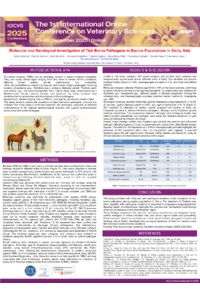
Tick-borne diseases (TBDs) are significant health concerns affecting equines worldwide, causing a range of clinical syndromes and negatively impacting animal welfare and productivity. These diseases are caused by a broad spectrum of tick-transmitted pathogens, including bacteria (e.g., Anaplasma spp., Rickettsia spp.), protozoa (e.g., Babesia caballi, Theileria equi), and viruses such as tick-borne encephalitis virus. Sicily, Italy, with its Mediterranean climate and widespread ticks, represents a potentially high-risk area for equine TBDs. This study aimed to investigate the circulation of major tick-borne pathogens in equines (horses and donkeys) to improve understanding of their epidemiological status and to support targeted control strategies.
Between 2024 and 2025, blood, serum, and ticks were collected from equines. DNA was extracted from whole blood and ticks and subjected to PCR assays targeting genes of key pathogens, including Rickettsia spp. (ompB, ompA, gltA), Anaplasma spp. (16S rRNA), Borrelia burgdorferi (OspA), Babesia caballi (48 kDa rhoptry protein), and Theileria equi (EMA-1). Serum samples were analyzed by indirect immunofluorescence assay (IFA) for antibodies against Anaplasma spp. and B. caballi, and by ELISA for flavivirus antibodies.
Of the 163 blood samples tested, 16% were positive for T. equi, while no other pathogens were detected. A total of 29 ticks were collected: 20 Ixodes ricinus, 6 Haemaphysalis punctata, and 3 nymphs. One Haemaphysalis tick tested positive for Anaplasma spp. Among 196 equine serum samples, 12.2% were seropositive for Anaplasma phagocytophilum, 3.8% for B. caballi, and 6% for flaviviruses.
The molecular detection of tick-borne pathogens in equines from Sicily confirms the circulation of multiple TBD agents in the region. These findings highlight the need for improved surveillance and implementation of tick control measures to manage equine TBDs. Further studies are warranted to evaluate clinical relevance and local vector ecology.
This research was funded by the Italian Ministry of Health: IZSSI 03/23 RC.
Keywords
Rickettsia spp.
Anaplasma spp
Theileria equi
Babesia caballi
Borrelia burgdorferi
flavivirus
equines
tick-borne pathogens
ticks
Poster
Blanda-Talarico et al., 2025.pdf
Seroprevalence and Lesion Profiles of Mycoplasma synoviae in Broiler Chickens: Evidence from District Karak, Pakistan
Serological and Molecular Investigation of Rickettsia spp. and Anaplasma spp. in Domestic Cats from Sicily, Italy