Event submissions
Published
This submission belongs to the session C. Veterinary Epidemiology of the event The 1st International Online Conference on Veterinary Sciences
Published date
28 Nov, 2025
Academic Editor
'%3e%3cpath%20d='M12.6657%2010.9104C12.4185%2010.325%2012.0599%209.79327%2011.6097%209.34482C11.1609%208.89508%2010.6293%208.5365%2010.0442%208.28888C10.0389%208.28626%2010.0337%208.28495%2010.0285%208.28233C10.8446%207.69279%2011.3752%206.73249%2011.3752%205.64904C11.3752%203.8542%209.92103%202.39999%208.1262%202.39999C6.33136%202.39999%204.87715%203.8542%204.87715%205.64904C4.87715%206.73249%205.40774%207.69279%206.22393%208.28364C6.21869%208.28626%206.21345%208.28757%206.20821%208.29019C5.62129%208.5378%205.09463%208.89284%204.64265%209.34613C4.1929%209.79493%203.83432%2010.3266%203.58671%2010.9117C3.34345%2011.4845%203.21226%2012.0987%203.20023%2012.7209C3.19988%2012.7349%203.20233%2012.7488%203.20744%2012.7619C3.21255%2012.7749%203.22022%2012.7867%203.22998%2012.7968C3.23975%2012.8068%203.25142%2012.8147%203.26431%2012.8202C3.2772%2012.8256%203.29105%2012.8284%203.30504%2012.8284H4.09109C4.14874%2012.8284%204.19459%2012.7825%204.1959%2012.7262C4.2221%2011.7148%204.62823%2010.7676%205.34617%2010.0497C6.08899%209.30683%207.0755%208.89808%208.1262%208.89808C9.17689%208.89808%2010.1634%209.30683%2010.9062%2010.0497C11.6242%2010.7676%2012.0303%2011.7148%2012.0565%2012.7262C12.0578%2012.7838%2012.1037%2012.8284%2012.1613%2012.8284H12.9474C12.9613%2012.8284%2012.9752%2012.8256%2012.9881%2012.8202C13.001%2012.8147%2013.0126%2012.8068%2013.0224%2012.7968C13.0322%2012.7867%2013.0398%2012.7749%2013.0449%2012.7619C13.0501%2012.7488%2013.0525%2012.7349%2013.0522%2012.7209C13.0391%2012.0947%2012.9094%2011.4855%2012.6657%2010.9104ZM8.1262%207.9024C7.52486%207.9024%206.9589%207.6679%206.53312%207.24211C6.10733%206.81633%205.87283%206.25037%205.87283%205.64904C5.87283%205.0477%206.10733%204.48174%206.53312%204.05596C6.9589%203.63018%207.52486%203.39567%208.1262%203.39567C8.72753%203.39567%209.29349%203.63018%209.71927%204.05596C10.1451%204.48174%2010.3796%205.0477%2010.3796%205.64904C10.3796%206.25037%2010.1451%206.81633%209.71927%207.24211C9.29349%207.6679%208.72753%207.9024%208.1262%207.9024Z'%20fill='%235D1EE1'/%3e%3c/g%3e%3c/svg%3e) Yingyu Chen
Yingyu ChenCitation
Santina Di Bella, Dario Bonomo, Virginia Talarico, Valeria Blanda, Francesco Santangelo, Davide Pepe, Vincenza Cannella, Annalisa Guercio, Serological and Molecular Investigation of Rickettsia spp. and Anaplasma spp. in Domestic Cats from Sicily, Italy, in Proceedings of The 1st International Online Conference on Veterinary Sciences, 3 December–5 December 2025, MDPI: Basel, Switzerland
Share
Email
Facebook
Twitter
LinkedIn
Serological and Molecular Investigation of Rickettsia spp. and Anaplasma spp. in Domestic Cats from Sicily, Italy
'%3e%3cpath%20d='M12.6647%2010.9104C12.4176%2010.325%2012.0589%209.7933%2011.6088%209.34485C11.16%208.89511%2010.6283%208.53653%2010.0432%208.28891C10.038%208.28629%2010.0327%208.28498%2010.0275%208.28236C10.8437%207.69282%2011.3743%206.73252%2011.3743%205.64907C11.3743%203.85423%209.92005%202.40002%208.12522%202.40002C6.33038%202.40002%204.87618%203.85423%204.87618%205.64907C4.87618%206.73252%205.40677%207.69282%206.22296%208.28367C6.21772%208.28629%206.21248%208.2876%206.20724%208.29022C5.62031%208.53783%205.09365%208.89287%204.64167%209.34616C4.19192%209.79496%203.83334%2010.3266%203.58573%2010.9117C3.34247%2011.4846%203.21128%2012.0987%203.19925%2012.721C3.1989%2012.735%203.20135%2012.7489%203.20646%2012.7619C3.21157%2012.7749%203.21924%2012.7868%203.22901%2012.7968C3.23877%2012.8068%203.25045%2012.8148%203.26334%2012.8202C3.27623%2012.8256%203.29007%2012.8284%203.30406%2012.8284H4.09012C4.14776%2012.8284%204.19362%2012.7825%204.19493%2012.7262C4.22113%2011.7148%204.62726%2010.7676%205.34519%2010.0497C6.08802%209.30686%207.07452%208.89811%208.12522%208.89811C9.17592%208.89811%2010.1624%209.30686%2010.9052%2010.0497C11.6232%2010.7676%2012.0293%2011.7148%2012.0555%2012.7262C12.0568%2012.7839%2012.1027%2012.8284%2012.1603%2012.8284H12.9464C12.9604%2012.8284%2012.9742%2012.8256%2012.9871%2012.8202C13%2012.8148%2013.0117%2012.8068%2013.0214%2012.7968C13.0312%2012.7868%2013.0389%2012.7749%2013.044%2012.7619C13.0491%2012.7489%2013.0515%2012.735%2013.0512%2012.721C13.0381%2012.0947%2012.9084%2011.4856%2012.6647%2010.9104ZM8.12522%207.90243C7.52388%207.90243%206.95792%207.66793%206.53214%207.24215C6.10636%206.81636%205.87185%206.2504%205.87185%205.64907C5.87185%205.04773%206.10636%204.48177%206.53214%204.05599C6.95792%203.63021%207.52388%203.3957%208.12522%203.3957C8.72655%203.3957%209.29252%203.63021%209.7183%204.05599C10.1441%204.48177%2010.3786%205.04773%2010.3786%205.64907C10.3786%206.2504%2010.1441%206.81636%209.7183%207.24215C9.29252%207.66793%208.72655%207.90243%208.12522%207.90243Z'%20fill='%235D1EE1'/%3e%3c/g%3e%3c/svg%3e)
Santina Di Bella 1
Dario Bonomo 1
Virginia Talarico 1
Valeria Blanda 1
Francesco Santangelo 2
Davide Pepe 1
Vincenza Cannella 1
Annalisa Guercio 1
1. Istituto Zooprofilattico Sperimentale della Sicilia "A.Mirri", Palermo, Italy
2. Department of Veterinary Prevention, UOS Veterinary Urban Hygiene Units (Kennel), Provincial Health Authority of Palermo, Palermo, Italy
Abstract
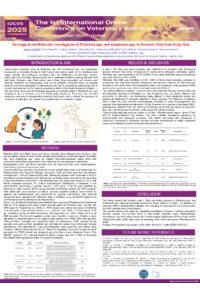
Vector-borne pathogens such as Rickettsia spp. and Anaplasma spp. are increasingly recognized as emerging threats to human and animal health. Domestic cats (Felis catus) may act as sentinels, reservoirs, or incidental hosts, especially in Mediterranean areas where arthropod vectors are widespread. This study aimed to investigate exposure and infection rates of Rickettsia spp. and Anaplasma spp. in cats from Sicily (Italy), including molecular screenings of their ectoparasites.
Serum samples were tested for antibodies against Rickettsia spp. and Anaplasma spp. using indirect immunofluorescence assay (IFA). DNA extracted from EDTA blood and ectoparasites (ticks and fleas) was subjected to PCR for Rickettsia spp. and Anaplasma spp. Positive PCR products were sequenced to confirm species identity.
Between 2024 and 2025, samples were collected from 80 cats. Serological testing revealed high exposure rates, with 56.3% of cats positive for Rickettsia spp. antibodies and 12.7% for Anaplasma spp. In contrast, molecular analyses detected Rickettsia felis DNA in only 3.8% of feline blood samples, while no Anaplasma spp. DNA was identified. Among ectoparasites, R. felis DNA was detected in one of two fleas (Ctenocephalides felis), and Anaplasma phagocytophilum DNA in one (Ixodes ricinus) of eight ticks.
The marked discrepancy between seroprevalence and molecular detection suggests that while cats are frequently exposed to these pathogens, active infections detectable by PCR are uncommon, likely due to a transient bacteremia that limits the window of molecular detectability. The identification of pathogen DNA in ectoparasites supports their circulation in the environment, although this alone does not confirm a reservoir role for cats. These findings highlight the importance of the integrated surveillance of companion animals and their ectoparasites within a One Health framework to better understand and mitigate zoonotic risks.
This research was funded by the Italian Ministry of Health (IZSSI 03/23 RC).
Keywords
Rickettsia
Anaplasma
Cats
vector-borne pathogens
ticks
fleas
Poster
Bonomo et al., 2025.pdf
Molecular and Serological Investigation of Tick-Borne Pathogens in Equines in Sicily, Italy
Prevalence and Resistance profiling of Methicillin Resistance Staphylococcus aureus in crustacean seafood in Lagos, Nigeria