Event submissions
Published
This submission belongs to the session S3. Animal Taxonomy of the event The 1st International Online Conference on Taxonomy
Published date
01 Dec, 2025
Academic Editor
'%3e%3cpath%20d='M12.6657%2010.9104C12.4185%2010.325%2012.0599%209.79327%2011.6097%209.34482C11.1609%208.89508%2010.6293%208.5365%2010.0442%208.28888C10.0389%208.28626%2010.0337%208.28495%2010.0285%208.28233C10.8446%207.69279%2011.3752%206.73249%2011.3752%205.64904C11.3752%203.8542%209.92103%202.39999%208.1262%202.39999C6.33136%202.39999%204.87715%203.8542%204.87715%205.64904C4.87715%206.73249%205.40774%207.69279%206.22393%208.28364C6.21869%208.28626%206.21345%208.28757%206.20821%208.29019C5.62129%208.5378%205.09463%208.89284%204.64265%209.34613C4.1929%209.79493%203.83432%2010.3266%203.58671%2010.9117C3.34345%2011.4845%203.21226%2012.0987%203.20023%2012.7209C3.19988%2012.7349%203.20233%2012.7488%203.20744%2012.7619C3.21255%2012.7749%203.22022%2012.7867%203.22998%2012.7968C3.23975%2012.8068%203.25142%2012.8147%203.26431%2012.8202C3.2772%2012.8256%203.29105%2012.8284%203.30504%2012.8284H4.09109C4.14874%2012.8284%204.19459%2012.7825%204.1959%2012.7262C4.2221%2011.7148%204.62823%2010.7676%205.34617%2010.0497C6.08899%209.30683%207.0755%208.89808%208.1262%208.89808C9.17689%208.89808%2010.1634%209.30683%2010.9062%2010.0497C11.6242%2010.7676%2012.0303%2011.7148%2012.0565%2012.7262C12.0578%2012.7838%2012.1037%2012.8284%2012.1613%2012.8284H12.9474C12.9613%2012.8284%2012.9752%2012.8256%2012.9881%2012.8202C13.001%2012.8147%2013.0126%2012.8068%2013.0224%2012.7968C13.0322%2012.7867%2013.0398%2012.7749%2013.0449%2012.7619C13.0501%2012.7488%2013.0525%2012.7349%2013.0522%2012.7209C13.0391%2012.0947%2012.9094%2011.4855%2012.6657%2010.9104ZM8.1262%207.9024C7.52486%207.9024%206.9589%207.6679%206.53312%207.24211C6.10733%206.81633%205.87283%206.25037%205.87283%205.64904C5.87283%205.0477%206.10733%204.48174%206.53312%204.05596C6.9589%203.63018%207.52486%203.39567%208.1262%203.39567C8.72753%203.39567%209.29349%203.63018%209.71927%204.05596C10.1451%204.48174%2010.3796%205.0477%2010.3796%205.64904C10.3796%206.25037%2010.1451%206.81633%209.71927%207.24211C9.29349%207.6679%208.72753%207.9024%208.1262%207.9024Z'%20fill='%235D1EE1'/%3e%3c/g%3e%3c/svg%3e) Mathias Harzhauser
Mathias HarzhauserCitation
Laura Vanstraelen, Vincent Cuypers, Tom Artois, Yander L. Diez, Philippe Jouk, Nathalie Revis, Marlies Monnens, A taxonomic revision of Gyratrix hermaphroditus Ehrenberg, 1831 (Platyhelminthes) using integrative taxonomy, in Proceedings of The 1st International Online Conference on Taxonomy, 3 December–4 December 2025, MDPI: Basel, Switzerland
Share
Email
Facebook
Twitter
LinkedIn
A taxonomic revision of Gyratrix hermaphroditus Ehrenberg, 1831 (Platyhelminthes) using integrative taxonomy
'%3e%3cpath%20d='M12.6647%2010.9104C12.4176%2010.325%2012.0589%209.7933%2011.6088%209.34485C11.16%208.89511%2010.6283%208.53653%2010.0432%208.28891C10.038%208.28629%2010.0327%208.28498%2010.0275%208.28236C10.8437%207.69282%2011.3743%206.73252%2011.3743%205.64907C11.3743%203.85423%209.92005%202.40002%208.12522%202.40002C6.33038%202.40002%204.87618%203.85423%204.87618%205.64907C4.87618%206.73252%205.40677%207.69282%206.22296%208.28367C6.21772%208.28629%206.21248%208.2876%206.20724%208.29022C5.62031%208.53783%205.09365%208.89287%204.64167%209.34616C4.19192%209.79496%203.83334%2010.3266%203.58573%2010.9117C3.34247%2011.4846%203.21128%2012.0987%203.19925%2012.721C3.1989%2012.735%203.20135%2012.7489%203.20646%2012.7619C3.21157%2012.7749%203.21924%2012.7868%203.22901%2012.7968C3.23877%2012.8068%203.25045%2012.8148%203.26334%2012.8202C3.27623%2012.8256%203.29007%2012.8284%203.30406%2012.8284H4.09012C4.14776%2012.8284%204.19362%2012.7825%204.19493%2012.7262C4.22113%2011.7148%204.62726%2010.7676%205.34519%2010.0497C6.08802%209.30686%207.07452%208.89811%208.12522%208.89811C9.17592%208.89811%2010.1624%209.30686%2010.9052%2010.0497C11.6232%2010.7676%2012.0293%2011.7148%2012.0555%2012.7262C12.0568%2012.7839%2012.1027%2012.8284%2012.1603%2012.8284H12.9464C12.9604%2012.8284%2012.9742%2012.8256%2012.9871%2012.8202C13%2012.8148%2013.0117%2012.8068%2013.0214%2012.7968C13.0312%2012.7868%2013.0389%2012.7749%2013.044%2012.7619C13.0491%2012.7489%2013.0515%2012.735%2013.0512%2012.721C13.0381%2012.0947%2012.9084%2011.4856%2012.6647%2010.9104ZM8.12522%207.90243C7.52388%207.90243%206.95792%207.66793%206.53214%207.24215C6.10636%206.81636%205.87185%206.2504%205.87185%205.64907C5.87185%205.04773%206.10636%204.48177%206.53214%204.05599C6.95792%203.63021%207.52388%203.3957%208.12522%203.3957C8.72655%203.3957%209.29252%203.63021%209.7183%204.05599C10.1441%204.48177%2010.3786%205.04773%2010.3786%205.64907C10.3786%206.2504%2010.1441%206.81636%209.7183%207.24215C9.29252%207.66793%208.72655%207.90243%208.12522%207.90243Z'%20fill='%235D1EE1'/%3e%3c/g%3e%3c/svg%3e)
Laura Vanstraelen 1
Vincent Cuypers 1,2
Tom Artois 1
Yander L. Diez 1,3
Philippe Jouk 1,4
Nathalie Revis 1
Marlies Monnens 1,5
1. Research Group ‘Zoology: Biodiversity and Toxicology’, Centre for Environmental Sciences, Hasselt University, Agoralaan Gebouw-D, 3590 Diepenbeek, Belgium
2. Institute of Philosophy, KU Leuven, Kardinaal Mercierplein 2, B-3000 Leuven, Belgium
3. Smithsonian Marine Station, 701 Seaway Drive, Fort Pierce, Florida 34949, United States
4. Centre for Research & Conservation, Royal Zoological Society of Antwerp, Koningin Astridplein 20-26, B-2018 Antwerp, Belgium
5. Royal Belgian Institute for Natural Sciences, O. D. Taxonomy and Phylogeny, Vautierstraat 29, 1000 Brussel, Belgium
Abstract
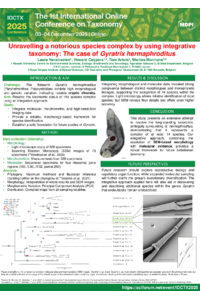
The microturbellarian flatworm Gyratrix hermaphroditus (Kalyptorhynchia: Polycystididae) has long been hypothesised to constitute a vast species complex, a view recently confirmed by molecular evidence. However, to date, the complex has not yet been formally split, as its taxonomy is complicated by multiple nested species hypotheses and by the fact that distinguishing features often consist of very subtle morphological differences in the sclerotised male copulatory organ. Here, building on the existing molecular framework, we present a large integrative effort to resolve the species complex. We add new DNA sequences from specimens collected near the type locality of G. hermaphroditus, expand the previously published morphometric dataset with additional measurements and statistical analyses, and use Scanning Electron Microscopy (SEM) to visualise and clarify morphological differences within the complex. As such, we delineate 14 species of Gyratrix, originating from freshwater, brackish, and marine habitats across the taxon’s global range. Species boundaries are primarily defined by variation in the morphology of the copulatory organ, which is especially evident in the high-resolution SEM images. These morphological differences are robustly supported by molecular and morphometric evidence. Finally, we assess the practical value of our new delineations by testing whether they enable reliable identification of both historical and newly collected specimens in the absence of molecular data.
Keywords
Cryptic species
Integrative taxonomy
Molecular phylogeny
Morphology
SEM
‘turbellaria’
Poster
Poster IOCTX25.pdf
A revision of the genus Baltoplana Karling, 1949 (Rhabdocoela: Schizorhynchia: Cheliplanidae): Phylogenetic Insights and Seven New Species