Event submissions
Published
This submission belongs to the session S3. Animal Taxonomy of the event The 1st International Online Conference on Taxonomy
Published date
01 Dec, 2025
Academic Editor
'%3e%3cpath%20d='M12.6657%2010.9104C12.4185%2010.325%2012.0599%209.79327%2011.6097%209.34482C11.1609%208.89508%2010.6293%208.5365%2010.0442%208.28888C10.0389%208.28626%2010.0337%208.28495%2010.0285%208.28233C10.8446%207.69279%2011.3752%206.73249%2011.3752%205.64904C11.3752%203.8542%209.92103%202.39999%208.1262%202.39999C6.33136%202.39999%204.87715%203.8542%204.87715%205.64904C4.87715%206.73249%205.40774%207.69279%206.22393%208.28364C6.21869%208.28626%206.21345%208.28757%206.20821%208.29019C5.62129%208.5378%205.09463%208.89284%204.64265%209.34613C4.1929%209.79493%203.83432%2010.3266%203.58671%2010.9117C3.34345%2011.4845%203.21226%2012.0987%203.20023%2012.7209C3.19988%2012.7349%203.20233%2012.7488%203.20744%2012.7619C3.21255%2012.7749%203.22022%2012.7867%203.22998%2012.7968C3.23975%2012.8068%203.25142%2012.8147%203.26431%2012.8202C3.2772%2012.8256%203.29105%2012.8284%203.30504%2012.8284H4.09109C4.14874%2012.8284%204.19459%2012.7825%204.1959%2012.7262C4.2221%2011.7148%204.62823%2010.7676%205.34617%2010.0497C6.08899%209.30683%207.0755%208.89808%208.1262%208.89808C9.17689%208.89808%2010.1634%209.30683%2010.9062%2010.0497C11.6242%2010.7676%2012.0303%2011.7148%2012.0565%2012.7262C12.0578%2012.7838%2012.1037%2012.8284%2012.1613%2012.8284H12.9474C12.9613%2012.8284%2012.9752%2012.8256%2012.9881%2012.8202C13.001%2012.8147%2013.0126%2012.8068%2013.0224%2012.7968C13.0322%2012.7867%2013.0398%2012.7749%2013.0449%2012.7619C13.0501%2012.7488%2013.0525%2012.7349%2013.0522%2012.7209C13.0391%2012.0947%2012.9094%2011.4855%2012.6657%2010.9104ZM8.1262%207.9024C7.52486%207.9024%206.9589%207.6679%206.53312%207.24211C6.10733%206.81633%205.87283%206.25037%205.87283%205.64904C5.87283%205.0477%206.10733%204.48174%206.53312%204.05596C6.9589%203.63018%207.52486%203.39567%208.1262%203.39567C8.72753%203.39567%209.29349%203.63018%209.71927%204.05596C10.1451%204.48174%2010.3796%205.0477%2010.3796%205.64904C10.3796%206.25037%2010.1451%206.81633%209.71927%207.24211C9.29349%207.6679%208.72753%207.9024%208.1262%207.9024Z'%20fill='%235D1EE1'/%3e%3c/g%3e%3c/svg%3e) Mathias Harzhauser
Mathias HarzhauserCitation
JHOE REYES, MARLIES MONNENS, LAURA VANSTRAELEN, YANDER L. DIEZ, PHILIPPE E.H. JOUK, NATHALIE J.P. REVIS, ERNEST SCHOCKAERT, TOM ARTOIS, A revision of the genus Baltoplana Karling, 1949 (Rhabdocoela: Schizorhynchia: Cheliplanidae): Phylogenetic Insights and Seven New Species, in Proceedings of The 1st International Online Conference on Taxonomy, 3 December–4 December 2025, MDPI: Basel, Switzerland
Share
Email
Facebook
Twitter
LinkedIn
A revision of the genus Baltoplana Karling, 1949 (Rhabdocoela: Schizorhynchia: Cheliplanidae): Phylogenetic Insights and Seven New Species
'%3e%3cpath%20d='M12.6647%2010.9104C12.4176%2010.325%2012.0589%209.7933%2011.6088%209.34485C11.16%208.89511%2010.6283%208.53653%2010.0432%208.28891C10.038%208.28629%2010.0327%208.28498%2010.0275%208.28236C10.8437%207.69282%2011.3743%206.73252%2011.3743%205.64907C11.3743%203.85423%209.92005%202.40002%208.12522%202.40002C6.33038%202.40002%204.87618%203.85423%204.87618%205.64907C4.87618%206.73252%205.40677%207.69282%206.22296%208.28367C6.21772%208.28629%206.21248%208.2876%206.20724%208.29022C5.62031%208.53783%205.09365%208.89287%204.64167%209.34616C4.19192%209.79496%203.83334%2010.3266%203.58573%2010.9117C3.34247%2011.4846%203.21128%2012.0987%203.19925%2012.721C3.1989%2012.735%203.20135%2012.7489%203.20646%2012.7619C3.21157%2012.7749%203.21924%2012.7868%203.22901%2012.7968C3.23877%2012.8068%203.25045%2012.8148%203.26334%2012.8202C3.27623%2012.8256%203.29007%2012.8284%203.30406%2012.8284H4.09012C4.14776%2012.8284%204.19362%2012.7825%204.19493%2012.7262C4.22113%2011.7148%204.62726%2010.7676%205.34519%2010.0497C6.08802%209.30686%207.07452%208.89811%208.12522%208.89811C9.17592%208.89811%2010.1624%209.30686%2010.9052%2010.0497C11.6232%2010.7676%2012.0293%2011.7148%2012.0555%2012.7262C12.0568%2012.7839%2012.1027%2012.8284%2012.1603%2012.8284H12.9464C12.9604%2012.8284%2012.9742%2012.8256%2012.9871%2012.8202C13%2012.8148%2013.0117%2012.8068%2013.0214%2012.7968C13.0312%2012.7868%2013.0389%2012.7749%2013.044%2012.7619C13.0491%2012.7489%2013.0515%2012.735%2013.0512%2012.721C13.0381%2012.0947%2012.9084%2011.4856%2012.6647%2010.9104ZM8.12522%207.90243C7.52388%207.90243%206.95792%207.66793%206.53214%207.24215C6.10636%206.81636%205.87185%206.2504%205.87185%205.64907C5.87185%205.04773%206.10636%204.48177%206.53214%204.05599C6.95792%203.63021%207.52388%203.3957%208.12522%203.3957C8.72655%203.3957%209.29252%203.63021%209.7183%204.05599C10.1441%204.48177%2010.3786%205.04773%2010.3786%205.64907C10.3786%206.2504%2010.1441%206.81636%209.7183%207.24215C9.29252%207.66793%208.72655%207.90243%208.12522%207.90243Z'%20fill='%235D1EE1'/%3e%3c/g%3e%3c/svg%3e)
JHOE REYES 1
MARLIES MONNENS 1,2
LAURA VANSTRAELEN 1
YANDER L. DIEZ 1,3
PHILIPPE E.H. JOUK 1,4
NATHALIE J.P. REVIS 1
ERNEST SCHOCKAERT 1
TOM ARTOIS 1
1. Research Group ‘Zoology: Biodiversity and Toxicology’, Centre for Environmental Sciences, Hasselt University, Agoralaan Gebouw-D, 3590 Diepenbeek, Belgium
2. Royal Belgian Institute for Natural Sciences, O. D. Taxonomy and Phylogeny, Vautierstraat 29, 1000 Brussel, Belgium
3. Smithsonian Marine Station, 701 Seaway Drive, Fort Pierce, Florida 34949, United States
4. Center for Research & Conservation, Royal Zoological Society of Antwerp, Koningin Astridplein 20-26, B-2018 Antwerp, Belgium
Abstract
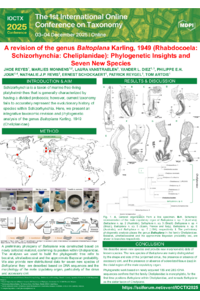
Schizorhynchia is a taxon of marine free-living platyhelminthes that is generally characterized by having a divided proboscis; however, current taxonomy fails to accurately represent the evolutionary history of species within Schizorhynchia. Here, we present an integrative taxonomic revision and phylogenetic analysis of the genus Baltoplana Karling, 1949 (Cheliplanidae). We collected specimens from various locations around the world, including Australia, Brazil, Spain, France, Italy, and the United States. The specimens were extracted from sandy substrates on beaches. After collection, the specimens were placed in 500 mL wide-mouth flasks and processed using the MgCl2 decantation method. Live specimens were observed under a microscope, and we took photographs, videos, and detailed anatomical drawings to support subsequent species identification. Each observed specimen was fixed in lactophenol and sealed for later observations under differential interference contrast (DIC) microscopy. Phylogenetic work based on newly acquired 18S and 28S rDNA sequences confirms that the family Cheliplanidae is monophyletic, for the first time positions Baltoplana within Cheliplanidae, and reveals Baltoplana as the sister taxon of Cheliplana. We describe seven new species and provide new morphometric data of known species. The new species of Baltoplana are mainly distinguished by the shape and size of the (un)armed cirrus, the presence or absence of accessory cirri, and the presence or absence of sclerotized tissue (cap) in the distal region of the male copulatory bulb.
Keywords
microturbellarians
Phylogeny
18S rDNA
28S rDNA
Platyhelminthes
identification key
meiofauna
Poster
Jhoe Reyes Poster 2025-IOCTX.pdf
A taxonomic revision of Gyratrix hermaphroditus Ehrenberg, 1831 (Platyhelminthes) using integrative taxonomy
Phylogenetic relationships of a new schizorhynch genus refute the monophyly of Schizochilus Boaden, 1963 (Platyhelminthes, Rhabdocoela)