Event submissions
Published
This submission belongs to the session S3. Animal Taxonomy of the event The 1st International Online Conference on Taxonomy
Published date
01 Dec, 2025
Academic Editor
'%3e%3cpath%20d='M12.6657%2010.9104C12.4185%2010.325%2012.0599%209.79327%2011.6097%209.34482C11.1609%208.89508%2010.6293%208.5365%2010.0442%208.28888C10.0389%208.28626%2010.0337%208.28495%2010.0285%208.28233C10.8446%207.69279%2011.3752%206.73249%2011.3752%205.64904C11.3752%203.8542%209.92103%202.39999%208.1262%202.39999C6.33136%202.39999%204.87715%203.8542%204.87715%205.64904C4.87715%206.73249%205.40774%207.69279%206.22393%208.28364C6.21869%208.28626%206.21345%208.28757%206.20821%208.29019C5.62129%208.5378%205.09463%208.89284%204.64265%209.34613C4.1929%209.79493%203.83432%2010.3266%203.58671%2010.9117C3.34345%2011.4845%203.21226%2012.0987%203.20023%2012.7209C3.19988%2012.7349%203.20233%2012.7488%203.20744%2012.7619C3.21255%2012.7749%203.22022%2012.7867%203.22998%2012.7968C3.23975%2012.8068%203.25142%2012.8147%203.26431%2012.8202C3.2772%2012.8256%203.29105%2012.8284%203.30504%2012.8284H4.09109C4.14874%2012.8284%204.19459%2012.7825%204.1959%2012.7262C4.2221%2011.7148%204.62823%2010.7676%205.34617%2010.0497C6.08899%209.30683%207.0755%208.89808%208.1262%208.89808C9.17689%208.89808%2010.1634%209.30683%2010.9062%2010.0497C11.6242%2010.7676%2012.0303%2011.7148%2012.0565%2012.7262C12.0578%2012.7838%2012.1037%2012.8284%2012.1613%2012.8284H12.9474C12.9613%2012.8284%2012.9752%2012.8256%2012.9881%2012.8202C13.001%2012.8147%2013.0126%2012.8068%2013.0224%2012.7968C13.0322%2012.7867%2013.0398%2012.7749%2013.0449%2012.7619C13.0501%2012.7488%2013.0525%2012.7349%2013.0522%2012.7209C13.0391%2012.0947%2012.9094%2011.4855%2012.6657%2010.9104ZM8.1262%207.9024C7.52486%207.9024%206.9589%207.6679%206.53312%207.24211C6.10733%206.81633%205.87283%206.25037%205.87283%205.64904C5.87283%205.0477%206.10733%204.48174%206.53312%204.05596C6.9589%203.63018%207.52486%203.39567%208.1262%203.39567C8.72753%203.39567%209.29349%203.63018%209.71927%204.05596C10.1451%204.48174%2010.3796%205.0477%2010.3796%205.64904C10.3796%206.25037%2010.1451%206.81633%209.71927%207.24211C9.29349%207.6679%208.72753%207.9024%208.1262%207.9024Z'%20fill='%235D1EE1'/%3e%3c/g%3e%3c/svg%3e) Mathias Harzhauser
Mathias HarzhauserCitation
BADARUL SIJAD, Theparambil Mohamed Najmudeen, Genetic Divergence and Phylogeographic Structuring in Lethrinus (Osteichthyes: Lethrinidae): Evidence of Species Complexes and Regional Lineages, in Proceedings of The 1st International Online Conference on Taxonomy, 3 December–4 December 2025, MDPI: Basel, Switzerland
Share
Email
Facebook
Twitter
LinkedIn
Genetic Divergence and Phylogeographic Structuring in Lethrinus (Osteichthyes: Lethrinidae): Evidence of Species Complexes and Regional Lineages
'%3e%3cpath%20d='M12.6647%2010.9104C12.4176%2010.325%2012.0589%209.7933%2011.6088%209.34485C11.16%208.89511%2010.6283%208.53653%2010.0432%208.28891C10.038%208.28629%2010.0327%208.28498%2010.0275%208.28236C10.8437%207.69282%2011.3743%206.73252%2011.3743%205.64907C11.3743%203.85423%209.92005%202.40002%208.12522%202.40002C6.33038%202.40002%204.87618%203.85423%204.87618%205.64907C4.87618%206.73252%205.40677%207.69282%206.22296%208.28367C6.21772%208.28629%206.21248%208.2876%206.20724%208.29022C5.62031%208.53783%205.09365%208.89287%204.64167%209.34616C4.19192%209.79496%203.83334%2010.3266%203.58573%2010.9117C3.34247%2011.4846%203.21128%2012.0987%203.19925%2012.721C3.1989%2012.735%203.20135%2012.7489%203.20646%2012.7619C3.21157%2012.7749%203.21924%2012.7868%203.22901%2012.7968C3.23877%2012.8068%203.25045%2012.8148%203.26334%2012.8202C3.27623%2012.8256%203.29007%2012.8284%203.30406%2012.8284H4.09012C4.14776%2012.8284%204.19362%2012.7825%204.19493%2012.7262C4.22113%2011.7148%204.62726%2010.7676%205.34519%2010.0497C6.08802%209.30686%207.07452%208.89811%208.12522%208.89811C9.17592%208.89811%2010.1624%209.30686%2010.9052%2010.0497C11.6232%2010.7676%2012.0293%2011.7148%2012.0555%2012.7262C12.0568%2012.7839%2012.1027%2012.8284%2012.1603%2012.8284H12.9464C12.9604%2012.8284%2012.9742%2012.8256%2012.9871%2012.8202C13%2012.8148%2013.0117%2012.8068%2013.0214%2012.7968C13.0312%2012.7868%2013.0389%2012.7749%2013.044%2012.7619C13.0491%2012.7489%2013.0515%2012.735%2013.0512%2012.721C13.0381%2012.0947%2012.9084%2011.4856%2012.6647%2010.9104ZM8.12522%207.90243C7.52388%207.90243%206.95792%207.66793%206.53214%207.24215C6.10636%206.81636%205.87185%206.2504%205.87185%205.64907C5.87185%205.04773%206.10636%204.48177%206.53214%204.05599C6.95792%203.63021%207.52388%203.3957%208.12522%203.3957C8.72655%203.3957%209.29252%203.63021%209.7183%204.05599C10.1441%204.48177%2010.3786%205.04773%2010.3786%205.64907C10.3786%206.2504%2010.1441%206.81636%209.7183%207.24215C9.29252%207.66793%208.72655%207.90243%208.12522%207.90243Z'%20fill='%235D1EE1'/%3e%3c/g%3e%3c/svg%3e)
BADARUL SIJAD 1
Theparambil Mohamed Najmudeen 1
1. ICAR-Central Marine Fisheries Research Institute, Kochi, Kerala, India
Abstract
Introduction:
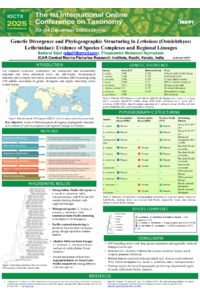
The emperors (Lethrinus, Osteichthyes: Lethrinidae) are ecologically and commercially important reef fishes distributed across the Indo-Pacific. Species delimitation remains problematic due to morphological similarity, synonymy, and broad ranges. DNA barcoding using cytochrome oxidase I (COI) offers a powerful tool for exploring genetic divergence, phylogeographic structure, and potential species complexes. This study analyses COI sequences of Lethrinus to evaluate intra- and interspecific variability and highlight taxonomic ambiguities.
Methods:
COI sequences representing multiple Lethrinus species were retrieved from GenBank, spanning the Indo-Pacific (Indonesia, Philippines, China, Malaysia, Australia, Japan, India, Mozambique, South Africa, Madagascar, Seychelles, Mauritius, Myanmar, Saudi Arabia, Israel, Pakistan, Fiji, Micronesia, and French Polynesia). Sequences were aligned in BioEdit and trimmed to a 648 bp fragment. Phylogenetic reconstruction was performed in MEGA7 using Maximum Likelihood (ML) with the best-fit substitution model and 1,000 bootstrap replicates. Pairwise genetic divergence was calculated in MEGA7 using the Kimura-2-Parameter (K2P) model.
Results:
Intraspecific distances were low across validated species (0.0–0.005), consistent with species-level cohesion. Interspecific distances ranged from 0.083 to 0.204, supporting a clear barcode gap. However, unusually low divergence occurred among L. ornatus, L. obsoletus, L. lentjan, and L. harak (0.082–0.098), indicating a potential species complex. In contrast, L. genivittatus (0.150–0.204 vs. congeners) and L. olivaceus (0.146–0.202 vs. congeners) were well differentiated. The ML tree supported these findings, showing distinct clades for Red Sea/Arabian Gulf populations of L. lentjan and L. nebulosus relative to Indo-Pacific counterparts, as well as regional structuring in L. harak, L. rubrioperculatus, and L. olivaceus.
Conclusion:
The COI-based phylogeny and distance analysis reveal both robust species separations and zones of ambiguity within Lethrinus. The ornatus–obsoletus–lentjan–harak group appears as a taxonomic complex requiring integrative revision, while deep geographic structuring in several widespread species suggests historical isolation and potential cryptic diversity. These results underscore the need for combined morphological, multilocus, and ecological approaches to refine species boundaries and better understand the evolutionary biogeography of Indo-Pacific emperors.
Keywords
Lethrinus
COI barcoding
phylogeography
Indo-Pacific
species complex
Poster
Presentation.pdf
First Molecular Records and Genetic Links among Craspedacusta sowerbii (Cnidaria; Hydrozoa) Populations in Argentina and Brazil
Exploring Machine Learning for Species Delimitation in the Trimerotropis pallidipennis Complex (Othoptera: Acrididae)