Event submissions
Published
This submission belongs to the session S2. Microbial Taxonomy of the event The 1st International Online Conference on Taxonomy
Published date
01 Dec, 2025
Academic Editor
'%3e%3cpath%20d='M12.6657%2010.9104C12.4185%2010.325%2012.0599%209.79327%2011.6097%209.34482C11.1609%208.89508%2010.6293%208.5365%2010.0442%208.28888C10.0389%208.28626%2010.0337%208.28495%2010.0285%208.28233C10.8446%207.69279%2011.3752%206.73249%2011.3752%205.64904C11.3752%203.8542%209.92103%202.39999%208.1262%202.39999C6.33136%202.39999%204.87715%203.8542%204.87715%205.64904C4.87715%206.73249%205.40774%207.69279%206.22393%208.28364C6.21869%208.28626%206.21345%208.28757%206.20821%208.29019C5.62129%208.5378%205.09463%208.89284%204.64265%209.34613C4.1929%209.79493%203.83432%2010.3266%203.58671%2010.9117C3.34345%2011.4845%203.21226%2012.0987%203.20023%2012.7209C3.19988%2012.7349%203.20233%2012.7488%203.20744%2012.7619C3.21255%2012.7749%203.22022%2012.7867%203.22998%2012.7968C3.23975%2012.8068%203.25142%2012.8147%203.26431%2012.8202C3.2772%2012.8256%203.29105%2012.8284%203.30504%2012.8284H4.09109C4.14874%2012.8284%204.19459%2012.7825%204.1959%2012.7262C4.2221%2011.7148%204.62823%2010.7676%205.34617%2010.0497C6.08899%209.30683%207.0755%208.89808%208.1262%208.89808C9.17689%208.89808%2010.1634%209.30683%2010.9062%2010.0497C11.6242%2010.7676%2012.0303%2011.7148%2012.0565%2012.7262C12.0578%2012.7838%2012.1037%2012.8284%2012.1613%2012.8284H12.9474C12.9613%2012.8284%2012.9752%2012.8256%2012.9881%2012.8202C13.001%2012.8147%2013.0126%2012.8068%2013.0224%2012.7968C13.0322%2012.7867%2013.0398%2012.7749%2013.0449%2012.7619C13.0501%2012.7488%2013.0525%2012.7349%2013.0522%2012.7209C13.0391%2012.0947%2012.9094%2011.4855%2012.6657%2010.9104ZM8.1262%207.9024C7.52486%207.9024%206.9589%207.6679%206.53312%207.24211C6.10733%206.81633%205.87283%206.25037%205.87283%205.64904C5.87283%205.0477%206.10733%204.48174%206.53312%204.05596C6.9589%203.63018%207.52486%203.39567%208.1262%203.39567C8.72753%203.39567%209.29349%203.63018%209.71927%204.05596C10.1451%204.48174%2010.3796%205.0477%2010.3796%205.64904C10.3796%206.25037%2010.1451%206.81633%209.71927%207.24211C9.29349%207.6679%208.72753%207.9024%208.1262%207.9024Z'%20fill='%235D1EE1'/%3e%3c/g%3e%3c/svg%3e) Matthias Sipiczki
Matthias SipiczkiCitation
Vanessa Vaz Leonel, Mariana Machado Fidelis Nascimento, Juliana Vitoria Messias Bittencourt, Taxonomic characterization of lineages of the genus Ganoderma with emphasis on morphological and molecular analysis, in Proceedings of The 1st International Online Conference on Taxonomy, 3 December–4 December 2025, MDPI: Basel, Switzerland
Share
Email
Facebook
Twitter
LinkedIn
Taxonomic characterization of lineages of the genus Ganoderma with emphasis on morphological and molecular analysis
'%3e%3cpath%20d='M12.6647%2010.9104C12.4176%2010.325%2012.0589%209.7933%2011.6088%209.34485C11.16%208.89511%2010.6283%208.53653%2010.0432%208.28891C10.038%208.28629%2010.0327%208.28498%2010.0275%208.28236C10.8437%207.69282%2011.3743%206.73252%2011.3743%205.64907C11.3743%203.85423%209.92005%202.40002%208.12522%202.40002C6.33038%202.40002%204.87618%203.85423%204.87618%205.64907C4.87618%206.73252%205.40677%207.69282%206.22296%208.28367C6.21772%208.28629%206.21248%208.2876%206.20724%208.29022C5.62031%208.53783%205.09365%208.89287%204.64167%209.34616C4.19192%209.79496%203.83334%2010.3266%203.58573%2010.9117C3.34247%2011.4846%203.21128%2012.0987%203.19925%2012.721C3.1989%2012.735%203.20135%2012.7489%203.20646%2012.7619C3.21157%2012.7749%203.21924%2012.7868%203.22901%2012.7968C3.23877%2012.8068%203.25045%2012.8148%203.26334%2012.8202C3.27623%2012.8256%203.29007%2012.8284%203.30406%2012.8284H4.09012C4.14776%2012.8284%204.19362%2012.7825%204.19493%2012.7262C4.22113%2011.7148%204.62726%2010.7676%205.34519%2010.0497C6.08802%209.30686%207.07452%208.89811%208.12522%208.89811C9.17592%208.89811%2010.1624%209.30686%2010.9052%2010.0497C11.6232%2010.7676%2012.0293%2011.7148%2012.0555%2012.7262C12.0568%2012.7839%2012.1027%2012.8284%2012.1603%2012.8284H12.9464C12.9604%2012.8284%2012.9742%2012.8256%2012.9871%2012.8202C13%2012.8148%2013.0117%2012.8068%2013.0214%2012.7968C13.0312%2012.7868%2013.0389%2012.7749%2013.044%2012.7619C13.0491%2012.7489%2013.0515%2012.735%2013.0512%2012.721C13.0381%2012.0947%2012.9084%2011.4856%2012.6647%2010.9104ZM8.12522%207.90243C7.52388%207.90243%206.95792%207.66793%206.53214%207.24215C6.10636%206.81636%205.87185%206.2504%205.87185%205.64907C5.87185%205.04773%206.10636%204.48177%206.53214%204.05599C6.95792%203.63021%207.52388%203.3957%208.12522%203.3957C8.72655%203.3957%209.29252%203.63021%209.7183%204.05599C10.1441%204.48177%2010.3786%205.04773%2010.3786%205.64907C10.3786%206.2504%2010.1441%206.81636%209.7183%207.24215C9.29252%207.66793%208.72655%207.90243%208.12522%207.90243Z'%20fill='%235D1EE1'/%3e%3c/g%3e%3c/svg%3e)
Vanessa Vaz Leonel 1
Mariana Machado Fidelis Nascimento 2
Juliana Vitoria Messias Bittencourt 2
1. Graduate Program in Biotechnology, Campus Ponta Grossa, Federal University of Technology – Paraná (UTFPR), Ponta Grossa, Paraná 84017-220, Brazil
2. Department of Bioprocess and Biotechnology Engineering, Campus Ponta Grossa, Graduate Program in Biotechnology, Federal University of Technology – Paraná (UTFPR), Ponta Grossa, Paraná 84017-220, Brazil
Abstract
The genus Ganoderma, belonging to the family Ganodermataceae, comprises a group of basidiomycete fungi with wide geographic distribution and scientific interest. Despite its ecological relevance and biotechnological potential, its taxonomy remains complex due to high morphological variability among species, influenced by environmental and nutritional factors that directly affect phenotypic characteristics. This study aimed to perform morphological and molecular characterization of eight fungal isolates of Ganoderma to support taxonomic identification and provide insights into their phylogenetic relationships. The eight isolates evaluated were cultured in PDA medium, morphologically characterized, and subjected to microscopic observation of hyphal structures. Mycelial growth was evaluated in different media (MEA, PDA, and SDA) and temperatures (18°C, 28°C, and 38°C) to understand the isolates physiological behavior. Subsequently, genomic DNA extraction was performed, according to the protocol by Vicente et al. (2008) and sequencing of the ITS region of ribosomal DNA, used as a marker for molecular fungi identification. Microscopically, all strains presented the trimitic hyphal system, formed by generative, skeletal, and ligative hyphae. These structures, together with colony macromorphology, confirmed generic identity. However, species-level identification was only possible through molecular analysis, which revealed four strains of G. lucidum, one of G. sessile, one of G. lingzhi, and one with ambiguous identity between G. resinaceum and G. sessile. Physiological analysis showed that medium composition directly influenced development, with some combinations promoting mycelial expansion. The temperature of 28°C favored mycelial growth in most isolates, especially G. lucidum and G. lingzhi, indicating species-specific physiological profiles. These variations reveal the specific physiological profile of each species. These data show that the traditional approach, based on morphology, is limited in delimiting Ganoderma species. The integration of microscopic characteristics, and molecular data, is essential to ensure accurate identification.
Keywords
Ganoderma
molecular identification
physiological characterization
fungal biotechnology.
Poster
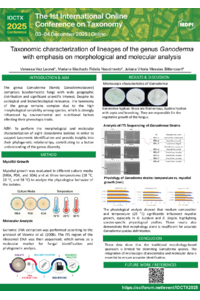
The 1st International Online Conference on Taxonomy- Vanessa.pdf
GenoScanner: Rapid Genome-Based Taxonomic Classification Using the Phylophenetic Species Concept
Unveiling Cyanobacterial Diversity from Serbian Thermal Springs: Molecular Insights