Event submissions
Published
This submission belongs to the session S3. Animal Taxonomy of the event The 1st International Online Conference on Taxonomy
Published date
01 Dec, 2025
Academic Editor
'%3e%3cpath%20d='M12.6657%2010.9104C12.4185%2010.325%2012.0599%209.79327%2011.6097%209.34482C11.1609%208.89508%2010.6293%208.5365%2010.0442%208.28888C10.0389%208.28626%2010.0337%208.28495%2010.0285%208.28233C10.8446%207.69279%2011.3752%206.73249%2011.3752%205.64904C11.3752%203.8542%209.92103%202.39999%208.1262%202.39999C6.33136%202.39999%204.87715%203.8542%204.87715%205.64904C4.87715%206.73249%205.40774%207.69279%206.22393%208.28364C6.21869%208.28626%206.21345%208.28757%206.20821%208.29019C5.62129%208.5378%205.09463%208.89284%204.64265%209.34613C4.1929%209.79493%203.83432%2010.3266%203.58671%2010.9117C3.34345%2011.4845%203.21226%2012.0987%203.20023%2012.7209C3.19988%2012.7349%203.20233%2012.7488%203.20744%2012.7619C3.21255%2012.7749%203.22022%2012.7867%203.22998%2012.7968C3.23975%2012.8068%203.25142%2012.8147%203.26431%2012.8202C3.2772%2012.8256%203.29105%2012.8284%203.30504%2012.8284H4.09109C4.14874%2012.8284%204.19459%2012.7825%204.1959%2012.7262C4.2221%2011.7148%204.62823%2010.7676%205.34617%2010.0497C6.08899%209.30683%207.0755%208.89808%208.1262%208.89808C9.17689%208.89808%2010.1634%209.30683%2010.9062%2010.0497C11.6242%2010.7676%2012.0303%2011.7148%2012.0565%2012.7262C12.0578%2012.7838%2012.1037%2012.8284%2012.1613%2012.8284H12.9474C12.9613%2012.8284%2012.9752%2012.8256%2012.9881%2012.8202C13.001%2012.8147%2013.0126%2012.8068%2013.0224%2012.7968C13.0322%2012.7867%2013.0398%2012.7749%2013.0449%2012.7619C13.0501%2012.7488%2013.0525%2012.7349%2013.0522%2012.7209C13.0391%2012.0947%2012.9094%2011.4855%2012.6657%2010.9104ZM8.1262%207.9024C7.52486%207.9024%206.9589%207.6679%206.53312%207.24211C6.10733%206.81633%205.87283%206.25037%205.87283%205.64904C5.87283%205.0477%206.10733%204.48174%206.53312%204.05596C6.9589%203.63018%207.52486%203.39567%208.1262%203.39567C8.72753%203.39567%209.29349%203.63018%209.71927%204.05596C10.1451%204.48174%2010.3796%205.0477%2010.3796%205.64904C10.3796%206.25037%2010.1451%206.81633%209.71927%207.24211C9.29349%207.6679%208.72753%207.9024%208.1262%207.9024Z'%20fill='%235D1EE1'/%3e%3c/g%3e%3c/svg%3e) Mathias Harzhauser
Mathias HarzhauserCitation
Onika Mabalabala, Melissa Kay Boonzaaeir-Davids, Courtney-Ann Puckree-Padua, Jyothi Kara, Genetic diversity, phylogenetic relationships, and systematics of the species-rich Adeonella genus from two bays along the southern coast of South Africa, in Proceedings of The 1st International Online Conference on Taxonomy, 3 December–4 December 2025, MDPI: Basel, Switzerland
Share
Email
Facebook
Twitter
LinkedIn
Genetic diversity, phylogenetic relationships, and systematics of the species-rich Adeonella genus from two bays along the southern coast of South Africa
'%3e%3cpath%20d='M12.6647%2010.9104C12.4176%2010.325%2012.0589%209.7933%2011.6088%209.34485C11.16%208.89511%2010.6283%208.53653%2010.0432%208.28891C10.038%208.28629%2010.0327%208.28498%2010.0275%208.28236C10.8437%207.69282%2011.3743%206.73252%2011.3743%205.64907C11.3743%203.85423%209.92005%202.40002%208.12522%202.40002C6.33038%202.40002%204.87618%203.85423%204.87618%205.64907C4.87618%206.73252%205.40677%207.69282%206.22296%208.28367C6.21772%208.28629%206.21248%208.2876%206.20724%208.29022C5.62031%208.53783%205.09365%208.89287%204.64167%209.34616C4.19192%209.79496%203.83334%2010.3266%203.58573%2010.9117C3.34247%2011.4846%203.21128%2012.0987%203.19925%2012.721C3.1989%2012.735%203.20135%2012.7489%203.20646%2012.7619C3.21157%2012.7749%203.21924%2012.7868%203.22901%2012.7968C3.23877%2012.8068%203.25045%2012.8148%203.26334%2012.8202C3.27623%2012.8256%203.29007%2012.8284%203.30406%2012.8284H4.09012C4.14776%2012.8284%204.19362%2012.7825%204.19493%2012.7262C4.22113%2011.7148%204.62726%2010.7676%205.34519%2010.0497C6.08802%209.30686%207.07452%208.89811%208.12522%208.89811C9.17592%208.89811%2010.1624%209.30686%2010.9052%2010.0497C11.6232%2010.7676%2012.0293%2011.7148%2012.0555%2012.7262C12.0568%2012.7839%2012.1027%2012.8284%2012.1603%2012.8284H12.9464C12.9604%2012.8284%2012.9742%2012.8256%2012.9871%2012.8202C13%2012.8148%2013.0117%2012.8068%2013.0214%2012.7968C13.0312%2012.7868%2013.0389%2012.7749%2013.044%2012.7619C13.0491%2012.7489%2013.0515%2012.735%2013.0512%2012.721C13.0381%2012.0947%2012.9084%2011.4856%2012.6647%2010.9104ZM8.12522%207.90243C7.52388%207.90243%206.95792%207.66793%206.53214%207.24215C6.10636%206.81636%205.87185%206.2504%205.87185%205.64907C5.87185%205.04773%206.10636%204.48177%206.53214%204.05599C6.95792%203.63021%207.52388%203.3957%208.12522%203.3957C8.72655%203.3957%209.29252%203.63021%209.7183%204.05599C10.1441%204.48177%2010.3786%205.04773%2010.3786%205.64907C10.3786%206.2504%2010.1441%206.81636%209.7183%207.24215C9.29252%207.66793%208.72655%207.90243%208.12522%207.90243Z'%20fill='%235D1EE1'/%3e%3c/g%3e%3c/svg%3e)
Onika Mabalabala 1
Melissa Kay Boonzaaeir-Davids 2
Courtney-Ann Puckree-Padua 1
Jyothi Kara 1
1. Department of Conservation and Marine science, Faculty of Applied Sciences, District six campus, Cape Peninsula University of Technology, Cape Town, South Africa 7925, South Africa
2. Fisheries Management Branch: Abalone Scientist Production: Inshore Resources Research, Department Forestry, Fisheries and the Environment (DFFE), Cape Town, South Africa 8001, South Africa
Abstract
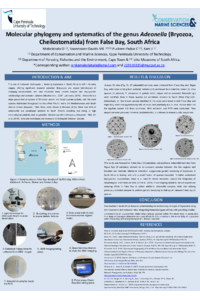
The study of bryozoans in South Africa is still in its early stages, but molecular techniques offer significant research potential. Bryozoans are crucial bioindicators of changing environments, and understanding their evolutionary history and taxonomic richness is essential. Bryozoans, like many invertebrates, serve as important bioindicators, reflecting the impact of changing environments. Globally, 45 Adeonella species are recognized, with 28 species (62%) considered endemic to South Africa. Recent studies indicate that the genera Adeonella and Laminopora require revision: Adeonella is polyphyletic, while Laminopora forms a paraphyletic clade with some Adeonella species. Both genera are predominantly found in South Africa. Due to cryptic speciation and morphological variability, validating adeonid species is needed for biodiversity research and for understanding the distribution and phylogenetic patterns. Thirty samples of South African adeonellid species collected within False Bay and Algoa were used for this study, where five species (A. pluscula, A. conspicua, A. Guttata and L. jellyae and an unnamed Adeonella sp.) were identified. Three of these species are considered endemic to South Africa. Four of the five species identified in this study were found in both False Bay and Algoa Bay, which are approximately 600 km apart. This widespread occurrence and the potential reasons for their dispersion may be attributed to the influence of the Agulhas Current, which could be responsible for pushing larvae downward along the southeast coast and facilitating their movement, as seen in other marine invertebrates like crustaceans and annelids. DNA extraction and PCR were conducted. Poor sequences were produced; however, troubleshooting is underway to ensure quality sequences.
Keywords
Bryozoa
Adeonella
Endemism
Cryptic species
Phylogenetic relationships
Poster
ONIKA MABALABALA POSTER PRESENTATION_MBD.pdf
Two new species of Hexasepalum (Spermacoceae, Rubiaceae) from the “campo rupestre” of Brazil
Taxonomic Survey of Ascidians (Tunicata: Ascidiacea) in the Parque Natural Municipal Marinho Recife de Fora Natural, Porto Seguro, Bahia, Brazil