Event submissions
Published
This submission belongs to the session S3. Animal Taxonomy of the event The 1st International Online Conference on Taxonomy
Published date
01 Dec, 2025
Academic Editor
'%3e%3cpath%20d='M12.6657%2010.9104C12.4185%2010.325%2012.0599%209.79327%2011.6097%209.34482C11.1609%208.89508%2010.6293%208.5365%2010.0442%208.28888C10.0389%208.28626%2010.0337%208.28495%2010.0285%208.28233C10.8446%207.69279%2011.3752%206.73249%2011.3752%205.64904C11.3752%203.8542%209.92103%202.39999%208.1262%202.39999C6.33136%202.39999%204.87715%203.8542%204.87715%205.64904C4.87715%206.73249%205.40774%207.69279%206.22393%208.28364C6.21869%208.28626%206.21345%208.28757%206.20821%208.29019C5.62129%208.5378%205.09463%208.89284%204.64265%209.34613C4.1929%209.79493%203.83432%2010.3266%203.58671%2010.9117C3.34345%2011.4845%203.21226%2012.0987%203.20023%2012.7209C3.19988%2012.7349%203.20233%2012.7488%203.20744%2012.7619C3.21255%2012.7749%203.22022%2012.7867%203.22998%2012.7968C3.23975%2012.8068%203.25142%2012.8147%203.26431%2012.8202C3.2772%2012.8256%203.29105%2012.8284%203.30504%2012.8284H4.09109C4.14874%2012.8284%204.19459%2012.7825%204.1959%2012.7262C4.2221%2011.7148%204.62823%2010.7676%205.34617%2010.0497C6.08899%209.30683%207.0755%208.89808%208.1262%208.89808C9.17689%208.89808%2010.1634%209.30683%2010.9062%2010.0497C11.6242%2010.7676%2012.0303%2011.7148%2012.0565%2012.7262C12.0578%2012.7838%2012.1037%2012.8284%2012.1613%2012.8284H12.9474C12.9613%2012.8284%2012.9752%2012.8256%2012.9881%2012.8202C13.001%2012.8147%2013.0126%2012.8068%2013.0224%2012.7968C13.0322%2012.7867%2013.0398%2012.7749%2013.0449%2012.7619C13.0501%2012.7488%2013.0525%2012.7349%2013.0522%2012.7209C13.0391%2012.0947%2012.9094%2011.4855%2012.6657%2010.9104ZM8.1262%207.9024C7.52486%207.9024%206.9589%207.6679%206.53312%207.24211C6.10733%206.81633%205.87283%206.25037%205.87283%205.64904C5.87283%205.0477%206.10733%204.48174%206.53312%204.05596C6.9589%203.63018%207.52486%203.39567%208.1262%203.39567C8.72753%203.39567%209.29349%203.63018%209.71927%204.05596C10.1451%204.48174%2010.3796%205.0477%2010.3796%205.64904C10.3796%206.25037%2010.1451%206.81633%209.71927%207.24211C9.29349%207.6679%208.72753%207.9024%208.1262%207.9024Z'%20fill='%235D1EE1'/%3e%3c/g%3e%3c/svg%3e) Mathias Harzhauser
Mathias HarzhauserCitation
Melissa Pessoa Osaku, Vagner Cavarzere, Morphological and vocal divergences suggest a rearrangement in thetaxonomy of eastern populations of Cnemotriccus fuscatus (Aves, Tyrannidae), in Proceedings of The 1st International Online Conference on Taxonomy, 3 December–4 December 2025, MDPI: Basel, Switzerland
Share
Email
Facebook
Twitter
LinkedIn
Morphological and vocal divergences suggest a rearrangement in the
taxonomy of eastern populations of Cnemotriccus fuscatus (Aves, Tyrannidae)
taxonomy of eastern populations of Cnemotriccus fuscatus (Aves, Tyrannidae)
'%3e%3cpath%20d='M12.6647%2010.9104C12.4176%2010.325%2012.0589%209.7933%2011.6088%209.34485C11.16%208.89511%2010.6283%208.53653%2010.0432%208.28891C10.038%208.28629%2010.0327%208.28498%2010.0275%208.28236C10.8437%207.69282%2011.3743%206.73252%2011.3743%205.64907C11.3743%203.85423%209.92005%202.40002%208.12522%202.40002C6.33038%202.40002%204.87618%203.85423%204.87618%205.64907C4.87618%206.73252%205.40677%207.69282%206.22296%208.28367C6.21772%208.28629%206.21248%208.2876%206.20724%208.29022C5.62031%208.53783%205.09365%208.89287%204.64167%209.34616C4.19192%209.79496%203.83334%2010.3266%203.58573%2010.9117C3.34247%2011.4846%203.21128%2012.0987%203.19925%2012.721C3.1989%2012.735%203.20135%2012.7489%203.20646%2012.7619C3.21157%2012.7749%203.21924%2012.7868%203.22901%2012.7968C3.23877%2012.8068%203.25045%2012.8148%203.26334%2012.8202C3.27623%2012.8256%203.29007%2012.8284%203.30406%2012.8284H4.09012C4.14776%2012.8284%204.19362%2012.7825%204.19493%2012.7262C4.22113%2011.7148%204.62726%2010.7676%205.34519%2010.0497C6.08802%209.30686%207.07452%208.89811%208.12522%208.89811C9.17592%208.89811%2010.1624%209.30686%2010.9052%2010.0497C11.6232%2010.7676%2012.0293%2011.7148%2012.0555%2012.7262C12.0568%2012.7839%2012.1027%2012.8284%2012.1603%2012.8284H12.9464C12.9604%2012.8284%2012.9742%2012.8256%2012.9871%2012.8202C13%2012.8148%2013.0117%2012.8068%2013.0214%2012.7968C13.0312%2012.7868%2013.0389%2012.7749%2013.044%2012.7619C13.0491%2012.7489%2013.0515%2012.735%2013.0512%2012.721C13.0381%2012.0947%2012.9084%2011.4856%2012.6647%2010.9104ZM8.12522%207.90243C7.52388%207.90243%206.95792%207.66793%206.53214%207.24215C6.10636%206.81636%205.87185%206.2504%205.87185%205.64907C5.87185%205.04773%206.10636%204.48177%206.53214%204.05599C6.95792%203.63021%207.52388%203.3957%208.12522%203.3957C8.72655%203.3957%209.29252%203.63021%209.7183%204.05599C10.1441%204.48177%2010.3786%205.04773%2010.3786%205.64907C10.3786%206.2504%2010.1441%206.81636%209.7183%207.24215C9.29252%207.66793%208.72655%207.90243%208.12522%207.90243Z'%20fill='%235D1EE1'/%3e%3c/g%3e%3c/svg%3e)
Melissa Pessoa Osaku 1
Vagner Cavarzere 1
1. Department of Biodiversity and Biostatistics, Institute of Biosciences, São Paulo State University, Botucatu 18618-689, Brazil
Abstract
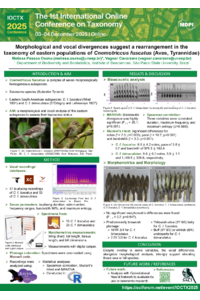
Cnemotriccus fuscatus comprises a complex of seven subspecies that have not
undergone a thorough taxonomic revision. We aimed to evaluate the morphological
and vocal characters of two eastern South American subspecies—C. f. fuscatus
and C. f. bimaculatus—to assess their taxonomic status. Specimens from the
Museu de Zoologia da Universidade de São Paulo were examined and color-coded,
while vocal recordings were obtained from the Macaulay Library and Xeno-canto
databases. Morphometric measurements—including wing chord, tail length,
tarsus length, and bill dimensions—were taken from 13 fuscatus and 23
bimaculatus specimens using a precision caliper. Additionally, 51 recordings of
the nominotypic taxon and 53 of bimaculatus were analyzed for loudsong duration,
note number, pace, maximum entropy, and frequency ranges using Raven Pro
1.6.5. Statistical analyses were conducted in R, employing a Multivariate Analysis
of Variance (MANOVA). Both populations display a predominantly brownish (10YR
3/4 for bimaculatus and 2.5Y 3/3 for fuscatus) plumage, but fuscatus exhibits a
yellowish-olive (5Y 8/6) belly, contrasting with the buff (5Y 8/3) or whitish (8/N)
underparts of bimaculatus. While no significant morphometric differences were
found (F1,1= 0.7; p = 0.547), bioacoustic divergence was highly significant (F1,7 =
26.1; p < 0.001). Three variables—duration and maximum frequency, and entropy—
were correlated. Among the remaining parameters, bimaculatus exhibited more
notes (t = 2.8; p = 0.005), faster pace (t = 10.7; p < 0.001), and broader bandwidth (t
= 3.3; p < 0.001) compared to fuscatus. On average, fuscatus produced 6.8 ± 4.2
notes per song at a pace of 3.8 ± 0.7, with a bandwidth of 975.3 ± 162.4 Hz,
whereas bimaculatus averaged 9.6 ± 6.0 notes, a pace of 5.9 ± 1.1, and a bandwidth of
1,149.5 ± 339.6 Hz. Despite overlap, the vocal differences, alongside
morphological analysis, strongly support elevating these taxa to full species.
Keywords
bioacoustics
Fuscous Flycatcher
morphology
species limits
Poster
25-11-28_cnemotriccus.pdf
Taxonomic Survey of Ascidians (Tunicata: Ascidiacea) in the Parque Natural Municipal Marinho Recife de Fora Natural, Porto Seguro, Bahia, Brazil
Morpho-anatomical taxonomic delimitation of Astragalus bruguieri and A. baba-alliar subsp. nudicarpus