Event submissions
Published
This submission belongs to the session S3. Animal Taxonomy of the event The 1st International Online Conference on Taxonomy
Published date
01 Dec, 2025
Academic Editor
'%3e%3cpath%20d='M12.6657%2010.9104C12.4185%2010.325%2012.0599%209.79327%2011.6097%209.34482C11.1609%208.89508%2010.6293%208.5365%2010.0442%208.28888C10.0389%208.28626%2010.0337%208.28495%2010.0285%208.28233C10.8446%207.69279%2011.3752%206.73249%2011.3752%205.64904C11.3752%203.8542%209.92103%202.39999%208.1262%202.39999C6.33136%202.39999%204.87715%203.8542%204.87715%205.64904C4.87715%206.73249%205.40774%207.69279%206.22393%208.28364C6.21869%208.28626%206.21345%208.28757%206.20821%208.29019C5.62129%208.5378%205.09463%208.89284%204.64265%209.34613C4.1929%209.79493%203.83432%2010.3266%203.58671%2010.9117C3.34345%2011.4845%203.21226%2012.0987%203.20023%2012.7209C3.19988%2012.7349%203.20233%2012.7488%203.20744%2012.7619C3.21255%2012.7749%203.22022%2012.7867%203.22998%2012.7968C3.23975%2012.8068%203.25142%2012.8147%203.26431%2012.8202C3.2772%2012.8256%203.29105%2012.8284%203.30504%2012.8284H4.09109C4.14874%2012.8284%204.19459%2012.7825%204.1959%2012.7262C4.2221%2011.7148%204.62823%2010.7676%205.34617%2010.0497C6.08899%209.30683%207.0755%208.89808%208.1262%208.89808C9.17689%208.89808%2010.1634%209.30683%2010.9062%2010.0497C11.6242%2010.7676%2012.0303%2011.7148%2012.0565%2012.7262C12.0578%2012.7838%2012.1037%2012.8284%2012.1613%2012.8284H12.9474C12.9613%2012.8284%2012.9752%2012.8256%2012.9881%2012.8202C13.001%2012.8147%2013.0126%2012.8068%2013.0224%2012.7968C13.0322%2012.7867%2013.0398%2012.7749%2013.0449%2012.7619C13.0501%2012.7488%2013.0525%2012.7349%2013.0522%2012.7209C13.0391%2012.0947%2012.9094%2011.4855%2012.6657%2010.9104ZM8.1262%207.9024C7.52486%207.9024%206.9589%207.6679%206.53312%207.24211C6.10733%206.81633%205.87283%206.25037%205.87283%205.64904C5.87283%205.0477%206.10733%204.48174%206.53312%204.05596C6.9589%203.63018%207.52486%203.39567%208.1262%203.39567C8.72753%203.39567%209.29349%203.63018%209.71927%204.05596C10.1451%204.48174%2010.3796%205.0477%2010.3796%205.64904C10.3796%206.25037%2010.1451%206.81633%209.71927%207.24211C9.29349%207.6679%208.72753%207.9024%208.1262%207.9024Z'%20fill='%235D1EE1'/%3e%3c/g%3e%3c/svg%3e) Mathias Harzhauser
Mathias HarzhauserCitation
Valentim Beraldo Rosolen, Vagner Cavarzere, Morphological and vocal evidence for the split of eastern Sittasomus griseicapillus (Aves, Dendrocolaptidae) subspecies, in Proceedings of The 1st International Online Conference on Taxonomy, 3 December–4 December 2025, MDPI: Basel, Switzerland
Share
Email
Facebook
Twitter
LinkedIn
Morphological and vocal evidence for the split of eastern Sittasomus griseicapillus (Aves, Dendrocolaptidae) subspecies
'%3e%3cpath%20d='M12.6647%2010.9104C12.4176%2010.325%2012.0589%209.7933%2011.6088%209.34485C11.16%208.89511%2010.6283%208.53653%2010.0432%208.28891C10.038%208.28629%2010.0327%208.28498%2010.0275%208.28236C10.8437%207.69282%2011.3743%206.73252%2011.3743%205.64907C11.3743%203.85423%209.92005%202.40002%208.12522%202.40002C6.33038%202.40002%204.87618%203.85423%204.87618%205.64907C4.87618%206.73252%205.40677%207.69282%206.22296%208.28367C6.21772%208.28629%206.21248%208.2876%206.20724%208.29022C5.62031%208.53783%205.09365%208.89287%204.64167%209.34616C4.19192%209.79496%203.83334%2010.3266%203.58573%2010.9117C3.34247%2011.4846%203.21128%2012.0987%203.19925%2012.721C3.1989%2012.735%203.20135%2012.7489%203.20646%2012.7619C3.21157%2012.7749%203.21924%2012.7868%203.22901%2012.7968C3.23877%2012.8068%203.25045%2012.8148%203.26334%2012.8202C3.27623%2012.8256%203.29007%2012.8284%203.30406%2012.8284H4.09012C4.14776%2012.8284%204.19362%2012.7825%204.19493%2012.7262C4.22113%2011.7148%204.62726%2010.7676%205.34519%2010.0497C6.08802%209.30686%207.07452%208.89811%208.12522%208.89811C9.17592%208.89811%2010.1624%209.30686%2010.9052%2010.0497C11.6232%2010.7676%2012.0293%2011.7148%2012.0555%2012.7262C12.0568%2012.7839%2012.1027%2012.8284%2012.1603%2012.8284H12.9464C12.9604%2012.8284%2012.9742%2012.8256%2012.9871%2012.8202C13%2012.8148%2013.0117%2012.8068%2013.0214%2012.7968C13.0312%2012.7868%2013.0389%2012.7749%2013.044%2012.7619C13.0491%2012.7489%2013.0515%2012.735%2013.0512%2012.721C13.0381%2012.0947%2012.9084%2011.4856%2012.6647%2010.9104ZM8.12522%207.90243C7.52388%207.90243%206.95792%207.66793%206.53214%207.24215C6.10636%206.81636%205.87185%206.2504%205.87185%205.64907C5.87185%205.04773%206.10636%204.48177%206.53214%204.05599C6.95792%203.63021%207.52388%203.3957%208.12522%203.3957C8.72655%203.3957%209.29252%203.63021%209.7183%204.05599C10.1441%204.48177%2010.3786%205.04773%2010.3786%205.64907C10.3786%206.2504%2010.1441%206.81636%209.7183%207.24215C9.29252%207.66793%208.72655%207.90243%208.12522%207.90243Z'%20fill='%235D1EE1'/%3e%3c/g%3e%3c/svg%3e)
Valentim Beraldo Rosolen 1
Vagner Cavarzere 1
1. Department of Biodiversity and Biostatistics, Institute of Biosciences, São Paulo State University, Botucatu 18618-689, Brazil
Abstract
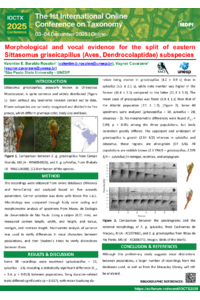
Fourteen names are assigned to the Sittasomus griseicapillus complex; yet, no taxonomic revision has been conducted. We compared the vocalization and morphology of the nominotypic population with those of southeastern South America (S. g. sylviellus and S. g. olivaceus), assessing potential divergences. Recordings were obtained from databases (WikiAves and Xeno-Canto) and analyzed based on loudsong duration, note number, pace, and minimum and maximum frequencies in Raven Pro 1.6.5. Morphology was compared through body color coding and morphometric analysis of specimens from Museu de Zoologia da Universidade de São Paulo. Using a caliper (0.01 mm), we measured culmen length, width, and height, and tarsus, remiges, and rectrices length. Multivariate analysis of variance (MANOVA) was used to test for differences in traits between populations, followed by Student’s t-test to assess distinctions within them. Some 38 recordings were examined (griseicapillus – 15; sylviellus – 23), revealing a statistically significant difference (F1,2 = 3.4; p = 0.013) between populations. Song-duration-related traits differed significantly (p = 0.017), with the mean loudsong duration being shorter in griseicapillus (4.2 ± 0.9 s) than in sylviellus (5.5 ± 2.1 s), while the note number was higher in the former (16.4 ± 5.1) compared to the latter (11.9 ± 5.9). The mean pace of griseicapillus was faster (3.9 ± 1.1) than that of the Atlantic population (2.5 ± 1.7). Some 40 specimens were analyzed (griseicapillus – 10; sylviellus – 28; olivaceus – 2). No morphometric differences were found (F1,3 = 0.98; p > 0.05) among the three populations, but body coloration greatly differed. The upperpart and underpart of griseicapillus is grayish (2.5Y 4/2), whereas in sylviellus and obsoletus, these regions are olive-green (5Y 5/6). All populations are reddish brown (2.5 YR4/6 – griseicapillus; 2.5YR 3/4 – sylviellus) in remiges, rectrices, and uropygium. The significant vocal and morphological differentiation detected suggests that griseicapillus and sylviellus should be full species.
Keywords
Bioacoustics
morphology
Olivaceous Woodcreeper
species limits
Poster
Painel p Conf de Tax.pdf
Fabaceae in the Morro do Macaco Environmental Protection Area (EPA), Iporá, Goiás, Brazil
KARYOTYPIC AND PHYLOGENETIC ASSESSMENT OF AN INDIVIDUAL OF Mazama cita sanctaemartae Allen, 1915, FROM THE COLOMBIAN CARIBBEAN.