Event submissions
Published
This submission belongs to the session S3. Animal Taxonomy of the event The 1st International Online Conference on Taxonomy
Published date
01 Dec, 2025
Academic Editor
'%3e%3cpath%20d='M12.6657%2010.9104C12.4185%2010.325%2012.0599%209.79327%2011.6097%209.34482C11.1609%208.89508%2010.6293%208.5365%2010.0442%208.28888C10.0389%208.28626%2010.0337%208.28495%2010.0285%208.28233C10.8446%207.69279%2011.3752%206.73249%2011.3752%205.64904C11.3752%203.8542%209.92103%202.39999%208.1262%202.39999C6.33136%202.39999%204.87715%203.8542%204.87715%205.64904C4.87715%206.73249%205.40774%207.69279%206.22393%208.28364C6.21869%208.28626%206.21345%208.28757%206.20821%208.29019C5.62129%208.5378%205.09463%208.89284%204.64265%209.34613C4.1929%209.79493%203.83432%2010.3266%203.58671%2010.9117C3.34345%2011.4845%203.21226%2012.0987%203.20023%2012.7209C3.19988%2012.7349%203.20233%2012.7488%203.20744%2012.7619C3.21255%2012.7749%203.22022%2012.7867%203.22998%2012.7968C3.23975%2012.8068%203.25142%2012.8147%203.26431%2012.8202C3.2772%2012.8256%203.29105%2012.8284%203.30504%2012.8284H4.09109C4.14874%2012.8284%204.19459%2012.7825%204.1959%2012.7262C4.2221%2011.7148%204.62823%2010.7676%205.34617%2010.0497C6.08899%209.30683%207.0755%208.89808%208.1262%208.89808C9.17689%208.89808%2010.1634%209.30683%2010.9062%2010.0497C11.6242%2010.7676%2012.0303%2011.7148%2012.0565%2012.7262C12.0578%2012.7838%2012.1037%2012.8284%2012.1613%2012.8284H12.9474C12.9613%2012.8284%2012.9752%2012.8256%2012.9881%2012.8202C13.001%2012.8147%2013.0126%2012.8068%2013.0224%2012.7968C13.0322%2012.7867%2013.0398%2012.7749%2013.0449%2012.7619C13.0501%2012.7488%2013.0525%2012.7349%2013.0522%2012.7209C13.0391%2012.0947%2012.9094%2011.4855%2012.6657%2010.9104ZM8.1262%207.9024C7.52486%207.9024%206.9589%207.6679%206.53312%207.24211C6.10733%206.81633%205.87283%206.25037%205.87283%205.64904C5.87283%205.0477%206.10733%204.48174%206.53312%204.05596C6.9589%203.63018%207.52486%203.39567%208.1262%203.39567C8.72753%203.39567%209.29349%203.63018%209.71927%204.05596C10.1451%204.48174%2010.3796%205.0477%2010.3796%205.64904C10.3796%206.25037%2010.1451%206.81633%209.71927%207.24211C9.29349%207.6679%208.72753%207.9024%208.1262%207.9024Z'%20fill='%235D1EE1'/%3e%3c/g%3e%3c/svg%3e) Mathias Harzhauser
Mathias HarzhauserCitation
Juan Daniel Jaramillo Hernández, Eluzai Dinai Pinto Sandoval, Pedro Peres, Héctor Ramírez Chavez, Sergio Alcides Solari Torres, José Mauricio Barbanti Duarte, KARYOTYPIC AND PHYLOGENETIC ASSESSMENT OF AN INDIVIDUAL OF Mazama cita sanctaemartae Allen, 1915, FROM THE COLOMBIAN CARIBBEAN., in Proceedings of The 1st International Online Conference on Taxonomy, 3 December–4 December 2025, MDPI: Basel, Switzerland
Share
Email
Facebook
Twitter
LinkedIn
KARYOTYPIC AND PHYLOGENETIC ASSESSMENT OF AN INDIVIDUAL OF Mazama cita sanctaemartae Allen, 1915, FROM THE COLOMBIAN CARIBBEAN.
'%3e%3cpath%20d='M12.6647%2010.9104C12.4176%2010.325%2012.0589%209.7933%2011.6088%209.34485C11.16%208.89511%2010.6283%208.53653%2010.0432%208.28891C10.038%208.28629%2010.0327%208.28498%2010.0275%208.28236C10.8437%207.69282%2011.3743%206.73252%2011.3743%205.64907C11.3743%203.85423%209.92005%202.40002%208.12522%202.40002C6.33038%202.40002%204.87618%203.85423%204.87618%205.64907C4.87618%206.73252%205.40677%207.69282%206.22296%208.28367C6.21772%208.28629%206.21248%208.2876%206.20724%208.29022C5.62031%208.53783%205.09365%208.89287%204.64167%209.34616C4.19192%209.79496%203.83334%2010.3266%203.58573%2010.9117C3.34247%2011.4846%203.21128%2012.0987%203.19925%2012.721C3.1989%2012.735%203.20135%2012.7489%203.20646%2012.7619C3.21157%2012.7749%203.21924%2012.7868%203.22901%2012.7968C3.23877%2012.8068%203.25045%2012.8148%203.26334%2012.8202C3.27623%2012.8256%203.29007%2012.8284%203.30406%2012.8284H4.09012C4.14776%2012.8284%204.19362%2012.7825%204.19493%2012.7262C4.22113%2011.7148%204.62726%2010.7676%205.34519%2010.0497C6.08802%209.30686%207.07452%208.89811%208.12522%208.89811C9.17592%208.89811%2010.1624%209.30686%2010.9052%2010.0497C11.6232%2010.7676%2012.0293%2011.7148%2012.0555%2012.7262C12.0568%2012.7839%2012.1027%2012.8284%2012.1603%2012.8284H12.9464C12.9604%2012.8284%2012.9742%2012.8256%2012.9871%2012.8202C13%2012.8148%2013.0117%2012.8068%2013.0214%2012.7968C13.0312%2012.7868%2013.0389%2012.7749%2013.044%2012.7619C13.0491%2012.7489%2013.0515%2012.735%2013.0512%2012.721C13.0381%2012.0947%2012.9084%2011.4856%2012.6647%2010.9104ZM8.12522%207.90243C7.52388%207.90243%206.95792%207.66793%206.53214%207.24215C6.10636%206.81636%205.87185%206.2504%205.87185%205.64907C5.87185%205.04773%206.10636%204.48177%206.53214%204.05599C6.95792%203.63021%207.52388%203.3957%208.12522%203.3957C8.72655%203.3957%209.29252%203.63021%209.7183%204.05599C10.1441%204.48177%2010.3786%205.04773%2010.3786%205.64907C10.3786%206.2504%2010.1441%206.81636%209.7183%207.24215C9.29252%207.66793%208.72655%207.90243%208.12522%207.90243Z'%20fill='%235D1EE1'/%3e%3c/g%3e%3c/svg%3e)
Juan Daniel Jaramillo Hernández 1
Eluzai Dinai Pinto Sandoval 1
Pedro Peres 1
Héctor Ramírez Chavez 2
Sergio Alcides Solari Torres 3
José Mauricio Barbanti Duarte 1
1. Deer Research and Conservation Center (NUPECCE), School of Agriculture and Veterinarian Sciences, São Paulo State University (UNESP), Jaboticabal, Brazil
2. Department of Biological Sciences, Faculty of Exact and Natural Sciences, University of Caldas, Manizales, Colombia
3. Mammalogy Group & Theriological Collection, Institute of Biology, University of Antioquia, Medellín, Colombia
Abstract
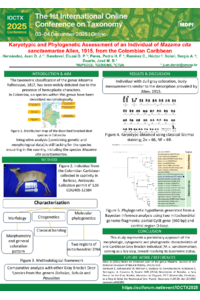
The taxonomic classification of the genus Mazama Rafinesque, 1817, has been widely debated due to homoplastic morphological characters. Although six species have been described in Colombia based on morphology, integrative analyses combining genetic and morphological data are still lacking. This study aimed to analyze the species originally described as Mazama cita sanctaemartae Allen, 1915, and to characterize its phylogenetic and cytogenetic relationships. To achieve this, fibroblast cultures were established from the skin tissue of a recently collected specimen (ID: T467) seized from illegal wildlife trafficking in Barbosa, Antioquia, which exhibited morphological traits consistent with gray brocket deers from Colombian Caribbean. Chromosomal preparations were obtained, and Giemsa-stained karyotypes were analyzed. In addition, phylogenetic analysis was performed using a 660 bp fragment of the mitochondrial Cytochrome B (CytB) gene from individual T467, in comparison with other gray brocket deer from different genera: Subulo, Passalites, and Bisbalus. Cytogenetic analysis revealed a diploid number (2n) = 66 and a fundamental number (FN) = 69, showing chromosomal similarities with the karyotype of Bisbalus citus from northwestern Venezuela. Phylogenetic reconstruction using Bayesian inference placed individual T467 within the Bisbalus clade. Thus, the karyotypic and phylogenetic analyzes of our study suggest that all Colombian individuals assessed may belong to the genus Bisbalus. The cytogenetic results may be further complemented with molecular cytogenetic techniques and chromosome painting to identify specific chromosomal rearrangements. This study provides preliminary insights into the cytogenetic and phylogenetic identity of gray brocket deer from the Colombian Caribbean, contributing to clarifying their taxonomic status and informing future conservation and management strategies.
Keywords
Cervidae
Blastocerina
Cytogenetics
Phylogenetics
Taxonomy
Poster
Poster_Juan_Jaramillo.pdf
Morphological and vocal evidence for the split of eastern Sittasomus griseicapillus (Aves, Dendrocolaptidae) subspecies
Reassessing Mexocarpus: Molecular and Morphological Evidence from Mesoamerican Palicourea (Rubiaceae)