Event submissions
Published
This submission belongs to the session S3. Animal Taxonomy of the event The 1st International Online Conference on Taxonomy
Published date
01 Dec, 2025
Academic Editor
'%3e%3cpath%20d='M12.6657%2010.9104C12.4185%2010.325%2012.0599%209.79327%2011.6097%209.34482C11.1609%208.89508%2010.6293%208.5365%2010.0442%208.28888C10.0389%208.28626%2010.0337%208.28495%2010.0285%208.28233C10.8446%207.69279%2011.3752%206.73249%2011.3752%205.64904C11.3752%203.8542%209.92103%202.39999%208.1262%202.39999C6.33136%202.39999%204.87715%203.8542%204.87715%205.64904C4.87715%206.73249%205.40774%207.69279%206.22393%208.28364C6.21869%208.28626%206.21345%208.28757%206.20821%208.29019C5.62129%208.5378%205.09463%208.89284%204.64265%209.34613C4.1929%209.79493%203.83432%2010.3266%203.58671%2010.9117C3.34345%2011.4845%203.21226%2012.0987%203.20023%2012.7209C3.19988%2012.7349%203.20233%2012.7488%203.20744%2012.7619C3.21255%2012.7749%203.22022%2012.7867%203.22998%2012.7968C3.23975%2012.8068%203.25142%2012.8147%203.26431%2012.8202C3.2772%2012.8256%203.29105%2012.8284%203.30504%2012.8284H4.09109C4.14874%2012.8284%204.19459%2012.7825%204.1959%2012.7262C4.2221%2011.7148%204.62823%2010.7676%205.34617%2010.0497C6.08899%209.30683%207.0755%208.89808%208.1262%208.89808C9.17689%208.89808%2010.1634%209.30683%2010.9062%2010.0497C11.6242%2010.7676%2012.0303%2011.7148%2012.0565%2012.7262C12.0578%2012.7838%2012.1037%2012.8284%2012.1613%2012.8284H12.9474C12.9613%2012.8284%2012.9752%2012.8256%2012.9881%2012.8202C13.001%2012.8147%2013.0126%2012.8068%2013.0224%2012.7968C13.0322%2012.7867%2013.0398%2012.7749%2013.0449%2012.7619C13.0501%2012.7488%2013.0525%2012.7349%2013.0522%2012.7209C13.0391%2012.0947%2012.9094%2011.4855%2012.6657%2010.9104ZM8.1262%207.9024C7.52486%207.9024%206.9589%207.6679%206.53312%207.24211C6.10733%206.81633%205.87283%206.25037%205.87283%205.64904C5.87283%205.0477%206.10733%204.48174%206.53312%204.05596C6.9589%203.63018%207.52486%203.39567%208.1262%203.39567C8.72753%203.39567%209.29349%203.63018%209.71927%204.05596C10.1451%204.48174%2010.3796%205.0477%2010.3796%205.64904C10.3796%206.25037%2010.1451%206.81633%209.71927%207.24211C9.29349%207.6679%208.72753%207.9024%208.1262%207.9024Z'%20fill='%235D1EE1'/%3e%3c/g%3e%3c/svg%3e) Mathias Harzhauser
Mathias HarzhauserCitation
Luísa Andrade Mendes, Paulo Brito, Thiago de Paula, Diogo Mayrinck, Taxonomic revision of the species Hoplias malabaricus Bloch, 1794 (Characiformes: Erythrinidae) from the Restinga de Jurubatiba National Park, Rio de Janeiro, Brazil, in Proceedings of The 1st International Online Conference on Taxonomy, 3 December–4 December 2025, MDPI: Basel, Switzerland
Share
Email
Facebook
Twitter
LinkedIn
Taxonomic revision of the species Hoplias malabaricus Bloch, 1794 (Characiformes: Erythrinidae) from the Restinga de Jurubatiba National Park, Rio de Janeiro, Brazil
'%3e%3cpath%20d='M12.6647%2010.9104C12.4176%2010.325%2012.0589%209.7933%2011.6088%209.34485C11.16%208.89511%2010.6283%208.53653%2010.0432%208.28891C10.038%208.28629%2010.0327%208.28498%2010.0275%208.28236C10.8437%207.69282%2011.3743%206.73252%2011.3743%205.64907C11.3743%203.85423%209.92005%202.40002%208.12522%202.40002C6.33038%202.40002%204.87618%203.85423%204.87618%205.64907C4.87618%206.73252%205.40677%207.69282%206.22296%208.28367C6.21772%208.28629%206.21248%208.2876%206.20724%208.29022C5.62031%208.53783%205.09365%208.89287%204.64167%209.34616C4.19192%209.79496%203.83334%2010.3266%203.58573%2010.9117C3.34247%2011.4846%203.21128%2012.0987%203.19925%2012.721C3.1989%2012.735%203.20135%2012.7489%203.20646%2012.7619C3.21157%2012.7749%203.21924%2012.7868%203.22901%2012.7968C3.23877%2012.8068%203.25045%2012.8148%203.26334%2012.8202C3.27623%2012.8256%203.29007%2012.8284%203.30406%2012.8284H4.09012C4.14776%2012.8284%204.19362%2012.7825%204.19493%2012.7262C4.22113%2011.7148%204.62726%2010.7676%205.34519%2010.0497C6.08802%209.30686%207.07452%208.89811%208.12522%208.89811C9.17592%208.89811%2010.1624%209.30686%2010.9052%2010.0497C11.6232%2010.7676%2012.0293%2011.7148%2012.0555%2012.7262C12.0568%2012.7839%2012.1027%2012.8284%2012.1603%2012.8284H12.9464C12.9604%2012.8284%2012.9742%2012.8256%2012.9871%2012.8202C13%2012.8148%2013.0117%2012.8068%2013.0214%2012.7968C13.0312%2012.7868%2013.0389%2012.7749%2013.044%2012.7619C13.0491%2012.7489%2013.0515%2012.735%2013.0512%2012.721C13.0381%2012.0947%2012.9084%2011.4856%2012.6647%2010.9104ZM8.12522%207.90243C7.52388%207.90243%206.95792%207.66793%206.53214%207.24215C6.10636%206.81636%205.87185%206.2504%205.87185%205.64907C5.87185%205.04773%206.10636%204.48177%206.53214%204.05599C6.95792%203.63021%207.52388%203.3957%208.12522%203.3957C8.72655%203.3957%209.29252%203.63021%209.7183%204.05599C10.1441%204.48177%2010.3786%205.04773%2010.3786%205.64907C10.3786%206.2504%2010.1441%206.81636%209.7183%207.24215C9.29252%207.66793%208.72655%207.90243%208.12522%207.90243Z'%20fill='%235D1EE1'/%3e%3c/g%3e%3c/svg%3e)
Luísa Andrade Mendes 1
Paulo Brito 2
Thiago de Paula 3
Diogo Mayrinck 1
1. Department of Science and Biology Education, University of the State of Rio de Janeiro, Rio de Janeiro, 20550-900, Brazil
2. Department of Zoology, University of the State of Rio de Janeiro, Rio de Janeiro, 20550-900, Brazil
3. Department of Genetics, University of the State of Rio de Janeiro, Rio de Janeiro, 20550-900, Brazil
Abstract
The Restinga de Jurubatiba National Park is located on the northern coast of Rio de Janeiro state, and presents eighteen coastal lagoons with a wide range of environmental conditions, especially salinity levels and geographic orientation relative to the shoreline. This diversity makes the region an ideal setting for ecological and evolutionary studies. Hoplias malabaricus is a fish widely distributed throughout South America, being considered a taxonomic complex due to the difficulty in delineating its lineages, representing one of the main challenges for Neotropical ichthyofauna taxonomy. To revise this complex, we collected 22 individuals from six lagoons in the Restinga de Jurubatiba National Park, whose selection was mainly based on the variations of the salinity levels. Comparative anatomical analyses were performed with specimens of the Hoplias malabaricus complex from other basins in South and Central America. Furthermore, we extracted and sequenced the mitochondrial COI gene and compared it with data from BOLD and GENBANK databases. We observed significant osteological variation among the species within the species complex, especially the mandibular symphysis shaped like a “lock,” a lateral ethmoid with a slender process projecting ventrolaterally, and a huge jugular depression on the lateral surface of the braincase. Molecular analyses indicated genetic divergences of approximately 7.7% compared to the species from the Rio Doce group (MG) and 8.3% relative to H. malabaricus sensu stricto from the North-Northeast of Brazil, confirming considerable differences within the complex. The analyses revealed significant novel anatomical and molecular differences in the collected individuals. The combined approach of anatomical and genetic analysis is essential to clarify the taxonomy and to understand the evolution and distribution of species within the complex Hoplias malabaricus.
Keywords
Anatomy
Molecular identification
Morphology
Phylogenetic systematics
Neotropical ichthyofauna.
Poster
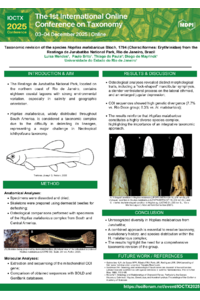
Poster - Luísa Mendes.pdf
Morphological And Vocal Divergence In Disjunct Populations Of Three Endemic Atlantic Forest Rhynchocyclidae Species
The systematics of Nemesia Vent. (Scrophulariaceae): The current status and New Insights