Event submissions
Published
This submission belongs to the session S4. Plant Taxonomy of the event The 1st International Online Conference on Taxonomy
Published date
01 Dec, 2025
Academic Editor
'%3e%3cpath%20d='M12.6657%2010.9104C12.4185%2010.325%2012.0599%209.79327%2011.6097%209.34482C11.1609%208.89508%2010.6293%208.5365%2010.0442%208.28888C10.0389%208.28626%2010.0337%208.28495%2010.0285%208.28233C10.8446%207.69279%2011.3752%206.73249%2011.3752%205.64904C11.3752%203.8542%209.92103%202.39999%208.1262%202.39999C6.33136%202.39999%204.87715%203.8542%204.87715%205.64904C4.87715%206.73249%205.40774%207.69279%206.22393%208.28364C6.21869%208.28626%206.21345%208.28757%206.20821%208.29019C5.62129%208.5378%205.09463%208.89284%204.64265%209.34613C4.1929%209.79493%203.83432%2010.3266%203.58671%2010.9117C3.34345%2011.4845%203.21226%2012.0987%203.20023%2012.7209C3.19988%2012.7349%203.20233%2012.7488%203.20744%2012.7619C3.21255%2012.7749%203.22022%2012.7867%203.22998%2012.7968C3.23975%2012.8068%203.25142%2012.8147%203.26431%2012.8202C3.2772%2012.8256%203.29105%2012.8284%203.30504%2012.8284H4.09109C4.14874%2012.8284%204.19459%2012.7825%204.1959%2012.7262C4.2221%2011.7148%204.62823%2010.7676%205.34617%2010.0497C6.08899%209.30683%207.0755%208.89808%208.1262%208.89808C9.17689%208.89808%2010.1634%209.30683%2010.9062%2010.0497C11.6242%2010.7676%2012.0303%2011.7148%2012.0565%2012.7262C12.0578%2012.7838%2012.1037%2012.8284%2012.1613%2012.8284H12.9474C12.9613%2012.8284%2012.9752%2012.8256%2012.9881%2012.8202C13.001%2012.8147%2013.0126%2012.8068%2013.0224%2012.7968C13.0322%2012.7867%2013.0398%2012.7749%2013.0449%2012.7619C13.0501%2012.7488%2013.0525%2012.7349%2013.0522%2012.7209C13.0391%2012.0947%2012.9094%2011.4855%2012.6657%2010.9104ZM8.1262%207.9024C7.52486%207.9024%206.9589%207.6679%206.53312%207.24211C6.10733%206.81633%205.87283%206.25037%205.87283%205.64904C5.87283%205.0477%206.10733%204.48174%206.53312%204.05596C6.9589%203.63018%207.52486%203.39567%208.1262%203.39567C8.72753%203.39567%209.29349%203.63018%209.71927%204.05596C10.1451%204.48174%2010.3796%205.0477%2010.3796%205.64904C10.3796%206.25037%2010.1451%206.81633%209.71927%207.24211C9.29349%207.6679%208.72753%207.9024%208.1262%207.9024Z'%20fill='%235D1EE1'/%3e%3c/g%3e%3c/svg%3e) Saraj Bahadur
Saraj BahadurCitation
Stoffel Petrus (Pieter) Bester, Mariëtte Jackson, Lize Joubert, Towards a comprehensive taxonomic revision of Nemesia Vent. (Scrophulariaceae, Hemimerideae), in Proceedings of The 1st International Online Conference on Taxonomy, 3 December–4 December 2025, MDPI: Basel, Switzerland
Share
Email
Facebook
Twitter
LinkedIn
Towards a comprehensive taxonomic revision of Nemesia Vent. (Scrophulariaceae, Hemimerideae)
'%3e%3cpath%20d='M12.6647%2010.9104C12.4176%2010.325%2012.0589%209.7933%2011.6088%209.34485C11.16%208.89511%2010.6283%208.53653%2010.0432%208.28891C10.038%208.28629%2010.0327%208.28498%2010.0275%208.28236C10.8437%207.69282%2011.3743%206.73252%2011.3743%205.64907C11.3743%203.85423%209.92005%202.40002%208.12522%202.40002C6.33038%202.40002%204.87618%203.85423%204.87618%205.64907C4.87618%206.73252%205.40677%207.69282%206.22296%208.28367C6.21772%208.28629%206.21248%208.2876%206.20724%208.29022C5.62031%208.53783%205.09365%208.89287%204.64167%209.34616C4.19192%209.79496%203.83334%2010.3266%203.58573%2010.9117C3.34247%2011.4846%203.21128%2012.0987%203.19925%2012.721C3.1989%2012.735%203.20135%2012.7489%203.20646%2012.7619C3.21157%2012.7749%203.21924%2012.7868%203.22901%2012.7968C3.23877%2012.8068%203.25045%2012.8148%203.26334%2012.8202C3.27623%2012.8256%203.29007%2012.8284%203.30406%2012.8284H4.09012C4.14776%2012.8284%204.19362%2012.7825%204.19493%2012.7262C4.22113%2011.7148%204.62726%2010.7676%205.34519%2010.0497C6.08802%209.30686%207.07452%208.89811%208.12522%208.89811C9.17592%208.89811%2010.1624%209.30686%2010.9052%2010.0497C11.6232%2010.7676%2012.0293%2011.7148%2012.0555%2012.7262C12.0568%2012.7839%2012.1027%2012.8284%2012.1603%2012.8284H12.9464C12.9604%2012.8284%2012.9742%2012.8256%2012.9871%2012.8202C13%2012.8148%2013.0117%2012.8068%2013.0214%2012.7968C13.0312%2012.7868%2013.0389%2012.7749%2013.044%2012.7619C13.0491%2012.7489%2013.0515%2012.735%2013.0512%2012.721C13.0381%2012.0947%2012.9084%2011.4856%2012.6647%2010.9104ZM8.12522%207.90243C7.52388%207.90243%206.95792%207.66793%206.53214%207.24215C6.10636%206.81636%205.87185%206.2504%205.87185%205.64907C5.87185%205.04773%206.10636%204.48177%206.53214%204.05599C6.95792%203.63021%207.52388%203.3957%208.12522%203.3957C8.72655%203.3957%209.29252%203.63021%209.7183%204.05599C10.1441%204.48177%2010.3786%205.04773%2010.3786%205.64907C10.3786%206.2504%2010.1441%206.81636%209.7183%207.24215C9.29252%207.66793%208.72655%207.90243%208.12522%207.90243Z'%20fill='%235D1EE1'/%3e%3c/g%3e%3c/svg%3e)
Stoffel Petrus (Pieter) Bester 1
Mariëtte Jackson 2
Lize Joubert 2
1. South African National Biodiversity Institute (SANBI), Foundational Research and Services Division, National Herbarium (PRE), Private Bag X101, Silverton, 0184, South Africa
2. Department of Plant Sciences, Faculty of Natural and Agricultural Sciences, University of the Free State, P.O. Box 339, Bloemfontein, 9300, South Africa
Abstract
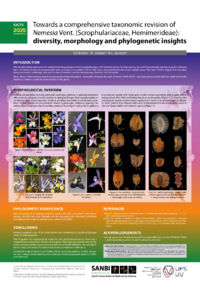
The tribe Hemimerideae (Scrophulariaceae) is the earliest branching lineage of the family, with Nemesia as one of its most diverse and horticulturally significant genera. The genus currently comprises 77 species of annuals and perennials, all endemic to southern Africa, with greatest diversity in the Cape Floristic Region and Succulent Karoo, and additional species in Namibia, Zimbabwe, and Mozambique. South Africa is the centre of endemism, with many species restricted to the winter rainfall region. Since Hiern’s 1904 revision, several species have been described, notably by Steiner (1994–2010), yet many remain inadequately treated, underscoring the need for a comprehensive revision.
Nemesia is characterized by zygomorphic, bilabiate flowers, usually with a single spur (versus paired spurs in Diascia), and fruit as a laterally compressed capsule. Floral diversity and annual life history underpin its wide horticultural use in bedding, containers, and hybrid breeding. The genus also provides insight into evolutionary processes in southern Africa. One species (N. micrantha) is extinct, and 14% are of conservation concern. The only published molecular phylogeny (Datson et al. 2008) indicated multiple life-history shifts between perennials of summer rainfall areas and annuals of winter rainfall regions, with diversification linked to Miocene–Pliocene climatic shifts.
Our recent phylogenetic analyses of 48 species using nuclear (ITS, ETS) and plastid (trnL intron) markers reveal two major lineages and five geographically structured subclades, also incorporating provisionally recognized taxa. These results, combined with morphological and distributional evidence, establish the framework for a full taxonomic revision to describe new taxa, update species circumscriptions, refine identification keys and maps, and expand herbarium and molecular resources.
This presentation provides an overview of Nemesia, highlighting key morphological traits and phylogenetic evidence guiding the ongoing revision.
Keywords
Hemimerideae
Morphology
Nemesia
Phylogeny
Scrophulariaceae
Taxonomy
Poster
Towards a comprehensive taxonomic revision of Nemesia poster -SP Bester et al FINAL.pdf
Genus Amphinema Haeckel, 1879 (Cnidaria, Hydrozoa): A brief taxonomic review with the description of a new species?
Notes on the diversity and conservation of three threatened subtidal octocorals of the highly urbanised coastal regions of Mumbai, Arabian Sea