Event submissions
Published
This submission belongs to the session S4. Plant Taxonomy of the event The 1st International Online Conference on Taxonomy
Published date
01 Dec, 2025
Academic Editor
'%3e%3cpath%20d='M12.6657%2010.9104C12.4185%2010.325%2012.0599%209.79327%2011.6097%209.34482C11.1609%208.89508%2010.6293%208.5365%2010.0442%208.28888C10.0389%208.28626%2010.0337%208.28495%2010.0285%208.28233C10.8446%207.69279%2011.3752%206.73249%2011.3752%205.64904C11.3752%203.8542%209.92103%202.39999%208.1262%202.39999C6.33136%202.39999%204.87715%203.8542%204.87715%205.64904C4.87715%206.73249%205.40774%207.69279%206.22393%208.28364C6.21869%208.28626%206.21345%208.28757%206.20821%208.29019C5.62129%208.5378%205.09463%208.89284%204.64265%209.34613C4.1929%209.79493%203.83432%2010.3266%203.58671%2010.9117C3.34345%2011.4845%203.21226%2012.0987%203.20023%2012.7209C3.19988%2012.7349%203.20233%2012.7488%203.20744%2012.7619C3.21255%2012.7749%203.22022%2012.7867%203.22998%2012.7968C3.23975%2012.8068%203.25142%2012.8147%203.26431%2012.8202C3.2772%2012.8256%203.29105%2012.8284%203.30504%2012.8284H4.09109C4.14874%2012.8284%204.19459%2012.7825%204.1959%2012.7262C4.2221%2011.7148%204.62823%2010.7676%205.34617%2010.0497C6.08899%209.30683%207.0755%208.89808%208.1262%208.89808C9.17689%208.89808%2010.1634%209.30683%2010.9062%2010.0497C11.6242%2010.7676%2012.0303%2011.7148%2012.0565%2012.7262C12.0578%2012.7838%2012.1037%2012.8284%2012.1613%2012.8284H12.9474C12.9613%2012.8284%2012.9752%2012.8256%2012.9881%2012.8202C13.001%2012.8147%2013.0126%2012.8068%2013.0224%2012.7968C13.0322%2012.7867%2013.0398%2012.7749%2013.0449%2012.7619C13.0501%2012.7488%2013.0525%2012.7349%2013.0522%2012.7209C13.0391%2012.0947%2012.9094%2011.4855%2012.6657%2010.9104ZM8.1262%207.9024C7.52486%207.9024%206.9589%207.6679%206.53312%207.24211C6.10733%206.81633%205.87283%206.25037%205.87283%205.64904C5.87283%205.0477%206.10733%204.48174%206.53312%204.05596C6.9589%203.63018%207.52486%203.39567%208.1262%203.39567C8.72753%203.39567%209.29349%203.63018%209.71927%204.05596C10.1451%204.48174%2010.3796%205.0477%2010.3796%205.64904C10.3796%206.25037%2010.1451%206.81633%209.71927%207.24211C9.29349%207.6679%208.72753%207.9024%208.1262%207.9024Z'%20fill='%235D1EE1'/%3e%3c/g%3e%3c/svg%3e) Saraj Bahadur
Saraj BahadurCitation
Elham Hatami, Taxonomic contribution on genus Dactylohiza (Orchidaceae) from Iranian flora, in Proceedings of The 1st International Online Conference on Taxonomy, 3 December–4 December 2025, MDPI: Basel, Switzerland
Share
Email
Facebook
Twitter
LinkedIn
Taxonomic contribution on genus Dactylohiza (Orchidaceae) from Iranian flora
'%3e%3cpath%20d='M12.6647%2010.9104C12.4176%2010.325%2012.0589%209.7933%2011.6088%209.34485C11.16%208.89511%2010.6283%208.53653%2010.0432%208.28891C10.038%208.28629%2010.0327%208.28498%2010.0275%208.28236C10.8437%207.69282%2011.3743%206.73252%2011.3743%205.64907C11.3743%203.85423%209.92005%202.40002%208.12522%202.40002C6.33038%202.40002%204.87618%203.85423%204.87618%205.64907C4.87618%206.73252%205.40677%207.69282%206.22296%208.28367C6.21772%208.28629%206.21248%208.2876%206.20724%208.29022C5.62031%208.53783%205.09365%208.89287%204.64167%209.34616C4.19192%209.79496%203.83334%2010.3266%203.58573%2010.9117C3.34247%2011.4846%203.21128%2012.0987%203.19925%2012.721C3.1989%2012.735%203.20135%2012.7489%203.20646%2012.7619C3.21157%2012.7749%203.21924%2012.7868%203.22901%2012.7968C3.23877%2012.8068%203.25045%2012.8148%203.26334%2012.8202C3.27623%2012.8256%203.29007%2012.8284%203.30406%2012.8284H4.09012C4.14776%2012.8284%204.19362%2012.7825%204.19493%2012.7262C4.22113%2011.7148%204.62726%2010.7676%205.34519%2010.0497C6.08802%209.30686%207.07452%208.89811%208.12522%208.89811C9.17592%208.89811%2010.1624%209.30686%2010.9052%2010.0497C11.6232%2010.7676%2012.0293%2011.7148%2012.0555%2012.7262C12.0568%2012.7839%2012.1027%2012.8284%2012.1603%2012.8284H12.9464C12.9604%2012.8284%2012.9742%2012.8256%2012.9871%2012.8202C13%2012.8148%2013.0117%2012.8068%2013.0214%2012.7968C13.0312%2012.7868%2013.0389%2012.7749%2013.044%2012.7619C13.0491%2012.7489%2013.0515%2012.735%2013.0512%2012.721C13.0381%2012.0947%2012.9084%2011.4856%2012.6647%2010.9104ZM8.12522%207.90243C7.52388%207.90243%206.95792%207.66793%206.53214%207.24215C6.10636%206.81636%205.87185%206.2504%205.87185%205.64907C5.87185%205.04773%206.10636%204.48177%206.53214%204.05599C6.95792%203.63021%207.52388%203.3957%208.12522%203.3957C8.72655%203.3957%209.29252%203.63021%209.7183%204.05599C10.1441%204.48177%2010.3786%205.04773%2010.3786%205.64907C10.3786%206.2504%2010.1441%206.81636%209.7183%207.24215C9.29252%207.66793%208.72655%207.90243%208.12522%207.90243Z'%20fill='%235D1EE1'/%3e%3c/g%3e%3c/svg%3e)
Elham Hatami 1
1. Department of Biology, Faculty of Science, Razi university, Kermanshah, 6714414971, Iran
Abstract
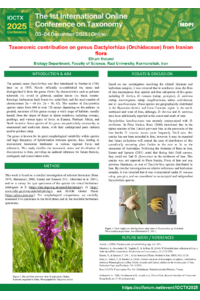
The generic name Dactylorhiza was first introduced by Necker in 1790; later on in 1935, Nevski officially re-established the name and distinguished it from the genus Orchis by characteristics such as palmate tuberoids (vs. ovoid or globose), cauline leaves (vs. basal, rosette-forming), herbaceous leafy bracts (vs. scale-like), and the usual number of chromosomes 2n = 40 (vs. 2n = 36, 42). Dactylorhiza is known for its very high propensity of hybridization and morphological variability, so some taxonomic concepts are difficult to apply in practice when only based on morphology. The number of Dactylorhiza species varies from 660 to over 720 names depending on the authors. In general, members of this genus occupy a wide range of habitats, usually humid, from the slopes of dunes to alpine meadows, including swamps, peatbogs, and various types of forest in Eurasia, Northern Africa, and North America. Some species of this genus are particularly noteworthy as ornamental and medicinal plants, with their underground parts (tubers) used to produce salep. Due to importance of this genus in the context of ornamental and medicinal uses and conservation priorities in flora of Iran and because of dispersed and inconsistent information in previous references, the present study focuses on organizing and updating the taxonomic information on Dactylorhiza species distributed in Iran. Based on our investigation involving the related literature and herbarium samples, it was revealed that in southwest Asia, the flora of Iran encompasses four species and four subspecies of this genus including D. iberica, D. romana (subsp. georgica), D. umbrosa (subsp. knorringiana, subsp. longibracteata, subsp. ochroleuca), and D. lancibracteata. These species are geographically distributed in the Hyrcanian district and Irano-Turanian region in the north, northwest, and west of Iran, although, D. iberica and D. umbrosa have been additionally reported in the center and south of Iran. Dactylorhiza lancibracteata was recently synonymized with D. urvilleana. In Flora Iranica, Renz (2008) noted that D. cuneata may be found in the Azerbaijani mountains of the westernmost part of Iran, but, until now, this species has not been recorded in Iran. Following the footsteps of Renz in Iran, Kreutz and Spencer (2011) mentioned the presence of D. flavescence in the northwest of Iran but they could not find this species during their trip; thus, it is not yet confirmed whether D. flavescence is distributed in Iran.
Keywords
Dactylorhiza
Iran
Taxonomy
Morphology
Poster
Dactylorhiza-Hatami-Poster.pdf
Karst flora of Hainan Island, China
Rarity and Endemism in Coutaportla Urb.: An Updated Taxonomic Perspective (Chiococceae, Rubiaceae)