Event submissions
Published
This submission belongs to the session S4. Plant Taxonomy of the event The 1st International Online Conference on Taxonomy
Published date
01 Dec, 2025
Academic Editor
'%3e%3cpath%20d='M12.6657%2010.9104C12.4185%2010.325%2012.0599%209.79327%2011.6097%209.34482C11.1609%208.89508%2010.6293%208.5365%2010.0442%208.28888C10.0389%208.28626%2010.0337%208.28495%2010.0285%208.28233C10.8446%207.69279%2011.3752%206.73249%2011.3752%205.64904C11.3752%203.8542%209.92103%202.39999%208.1262%202.39999C6.33136%202.39999%204.87715%203.8542%204.87715%205.64904C4.87715%206.73249%205.40774%207.69279%206.22393%208.28364C6.21869%208.28626%206.21345%208.28757%206.20821%208.29019C5.62129%208.5378%205.09463%208.89284%204.64265%209.34613C4.1929%209.79493%203.83432%2010.3266%203.58671%2010.9117C3.34345%2011.4845%203.21226%2012.0987%203.20023%2012.7209C3.19988%2012.7349%203.20233%2012.7488%203.20744%2012.7619C3.21255%2012.7749%203.22022%2012.7867%203.22998%2012.7968C3.23975%2012.8068%203.25142%2012.8147%203.26431%2012.8202C3.2772%2012.8256%203.29105%2012.8284%203.30504%2012.8284H4.09109C4.14874%2012.8284%204.19459%2012.7825%204.1959%2012.7262C4.2221%2011.7148%204.62823%2010.7676%205.34617%2010.0497C6.08899%209.30683%207.0755%208.89808%208.1262%208.89808C9.17689%208.89808%2010.1634%209.30683%2010.9062%2010.0497C11.6242%2010.7676%2012.0303%2011.7148%2012.0565%2012.7262C12.0578%2012.7838%2012.1037%2012.8284%2012.1613%2012.8284H12.9474C12.9613%2012.8284%2012.9752%2012.8256%2012.9881%2012.8202C13.001%2012.8147%2013.0126%2012.8068%2013.0224%2012.7968C13.0322%2012.7867%2013.0398%2012.7749%2013.0449%2012.7619C13.0501%2012.7488%2013.0525%2012.7349%2013.0522%2012.7209C13.0391%2012.0947%2012.9094%2011.4855%2012.6657%2010.9104ZM8.1262%207.9024C7.52486%207.9024%206.9589%207.6679%206.53312%207.24211C6.10733%206.81633%205.87283%206.25037%205.87283%205.64904C5.87283%205.0477%206.10733%204.48174%206.53312%204.05596C6.9589%203.63018%207.52486%203.39567%208.1262%203.39567C8.72753%203.39567%209.29349%203.63018%209.71927%204.05596C10.1451%204.48174%2010.3796%205.0477%2010.3796%205.64904C10.3796%206.25037%2010.1451%206.81633%209.71927%207.24211C9.29349%207.6679%208.72753%207.9024%208.1262%207.9024Z'%20fill='%235D1EE1'/%3e%3c/g%3e%3c/svg%3e) Mathias Harzhauser
Mathias HarzhauserCitation
Khansae Kamal, Khaoula Khaya, Zahira Belattmania, Abdellatif Chaouti, Joao Neiva, Aschwin Hillebrand Engelen, Valérie Stiger-Pouvreau, Ester A. Serrão, Brahim Sabour, First Record of Stranded Holopelagic Sargassum Morphotypes and Associated Fauna on the Moroccan Atlantic Coast, in Proceedings of The 1st International Online Conference on Taxonomy, 3 December–4 December 2025, MDPI: Basel, Switzerland
Share
Email
Facebook
Twitter
LinkedIn
First Record of Stranded Holopelagic Sargassum Morphotypes and Associated Fauna on the Moroccan Atlantic Coast
'%3e%3cpath%20d='M12.6647%2010.9104C12.4176%2010.325%2012.0589%209.7933%2011.6088%209.34485C11.16%208.89511%2010.6283%208.53653%2010.0432%208.28891C10.038%208.28629%2010.0327%208.28498%2010.0275%208.28236C10.8437%207.69282%2011.3743%206.73252%2011.3743%205.64907C11.3743%203.85423%209.92005%202.40002%208.12522%202.40002C6.33038%202.40002%204.87618%203.85423%204.87618%205.64907C4.87618%206.73252%205.40677%207.69282%206.22296%208.28367C6.21772%208.28629%206.21248%208.2876%206.20724%208.29022C5.62031%208.53783%205.09365%208.89287%204.64167%209.34616C4.19192%209.79496%203.83334%2010.3266%203.58573%2010.9117C3.34247%2011.4846%203.21128%2012.0987%203.19925%2012.721C3.1989%2012.735%203.20135%2012.7489%203.20646%2012.7619C3.21157%2012.7749%203.21924%2012.7868%203.22901%2012.7968C3.23877%2012.8068%203.25045%2012.8148%203.26334%2012.8202C3.27623%2012.8256%203.29007%2012.8284%203.30406%2012.8284H4.09012C4.14776%2012.8284%204.19362%2012.7825%204.19493%2012.7262C4.22113%2011.7148%204.62726%2010.7676%205.34519%2010.0497C6.08802%209.30686%207.07452%208.89811%208.12522%208.89811C9.17592%208.89811%2010.1624%209.30686%2010.9052%2010.0497C11.6232%2010.7676%2012.0293%2011.7148%2012.0555%2012.7262C12.0568%2012.7839%2012.1027%2012.8284%2012.1603%2012.8284H12.9464C12.9604%2012.8284%2012.9742%2012.8256%2012.9871%2012.8202C13%2012.8148%2013.0117%2012.8068%2013.0214%2012.7968C13.0312%2012.7868%2013.0389%2012.7749%2013.044%2012.7619C13.0491%2012.7489%2013.0515%2012.735%2013.0512%2012.721C13.0381%2012.0947%2012.9084%2011.4856%2012.6647%2010.9104ZM8.12522%207.90243C7.52388%207.90243%206.95792%207.66793%206.53214%207.24215C6.10636%206.81636%205.87185%206.2504%205.87185%205.64907C5.87185%205.04773%206.10636%204.48177%206.53214%204.05599C6.95792%203.63021%207.52388%203.3957%208.12522%203.3957C8.72655%203.3957%209.29252%203.63021%209.7183%204.05599C10.1441%204.48177%2010.3786%205.04773%2010.3786%205.64907C10.3786%206.2504%2010.1441%206.81636%209.7183%207.24215C9.29252%207.66793%208.72655%207.90243%208.12522%207.90243Z'%20fill='%235D1EE1'/%3e%3c/g%3e%3c/svg%3e)
Khansae Kamal 1
Khaoula Khaya 1

Zahira Belattmania 1
Abdellatif Chaouti 1
Joao Neiva 2
Aschwin Hillebrand Engelen 2
Valérie Stiger-Pouvreau 3
Ester A. Serrão 2
Brahim Sabour 1
1. Phycology, Blue Biodiversity and Biotechnology RU, LB2VE URL CNRST n°10, Faculty of Sciences, University Chouaib Doukkali, PO Box 20, 24000 El Jadida, Morocco
2. Centre of Marine Sciences, CCMAR/CIMAR-LA, Campus de Gambelas, Universidade do Algarve, 8005-139 Faro, Portugal
3. Univ Brest, CNRS, IRD, Ifremer, LEMAR, IUEM, 29280 Plouzané, France
Abstract
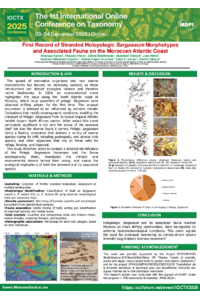
In early 2024, a large influx of holopelagic Sargassum were discovered drifting along the Atlantic coast of Morocco, marking the first recorded occurrence of these drifting macroalgae in the region. This event revealed a striking morphological diversity within the drifted biomass, with three distinct morphotypes identified: Sargassum natans morphotypes I and VIII, and Sargassum fluitans morphotype III. The biomass density reached 10 ± 3 ind/m², with S. natans VIII dominating at 58%. Alongside the algal masses, a diverse associated fauna was observed, including hydroids and crustaceans, highlighting the role of Sargassum mats as transient pelagic habitats. The diversity of morphotypes observed reflects complex dispersal dynamics and potentially multiple origins or developmental pathways, possibly shaped by environmental drivers. The arrival of these forms following the Nelson storm underscores the influence of extreme hydrometeorological events in facilitating long-distance transport from the tropical Atlantic to the North Atlantic coast of Africa. As climate change continues to intensify such events, the frequency and morphotype variability of holopelagic Sargassum blooms are likely to increase. This study highlights the importance of monitoring not just biomass but also morphological variability, which can influence ecological impact and inform future coastal management strategies.
Keywords
Holopelagic Sargassum
morphotype diversity
associated fauna
climate change impacts
Poster
poster sciforum-142704 -kamal khansae.pdf
Cleisostoma linearilobulatum (Seidenfaden & Smitinand) Garay (Orchidaceae): a new record for West Bengal, India
How to classify a species-rich genus