Event submissions
Published
This submission belongs to the session S3. Animal Taxonomy of the event The 1st International Online Conference on Taxonomy
Published date
01 Dec, 2025
Academic Editor
'%3e%3cpath%20d='M12.6657%2010.9104C12.4185%2010.325%2012.0599%209.79327%2011.6097%209.34482C11.1609%208.89508%2010.6293%208.5365%2010.0442%208.28888C10.0389%208.28626%2010.0337%208.28495%2010.0285%208.28233C10.8446%207.69279%2011.3752%206.73249%2011.3752%205.64904C11.3752%203.8542%209.92103%202.39999%208.1262%202.39999C6.33136%202.39999%204.87715%203.8542%204.87715%205.64904C4.87715%206.73249%205.40774%207.69279%206.22393%208.28364C6.21869%208.28626%206.21345%208.28757%206.20821%208.29019C5.62129%208.5378%205.09463%208.89284%204.64265%209.34613C4.1929%209.79493%203.83432%2010.3266%203.58671%2010.9117C3.34345%2011.4845%203.21226%2012.0987%203.20023%2012.7209C3.19988%2012.7349%203.20233%2012.7488%203.20744%2012.7619C3.21255%2012.7749%203.22022%2012.7867%203.22998%2012.7968C3.23975%2012.8068%203.25142%2012.8147%203.26431%2012.8202C3.2772%2012.8256%203.29105%2012.8284%203.30504%2012.8284H4.09109C4.14874%2012.8284%204.19459%2012.7825%204.1959%2012.7262C4.2221%2011.7148%204.62823%2010.7676%205.34617%2010.0497C6.08899%209.30683%207.0755%208.89808%208.1262%208.89808C9.17689%208.89808%2010.1634%209.30683%2010.9062%2010.0497C11.6242%2010.7676%2012.0303%2011.7148%2012.0565%2012.7262C12.0578%2012.7838%2012.1037%2012.8284%2012.1613%2012.8284H12.9474C12.9613%2012.8284%2012.9752%2012.8256%2012.9881%2012.8202C13.001%2012.8147%2013.0126%2012.8068%2013.0224%2012.7968C13.0322%2012.7867%2013.0398%2012.7749%2013.0449%2012.7619C13.0501%2012.7488%2013.0525%2012.7349%2013.0522%2012.7209C13.0391%2012.0947%2012.9094%2011.4855%2012.6657%2010.9104ZM8.1262%207.9024C7.52486%207.9024%206.9589%207.6679%206.53312%207.24211C6.10733%206.81633%205.87283%206.25037%205.87283%205.64904C5.87283%205.0477%206.10733%204.48174%206.53312%204.05596C6.9589%203.63018%207.52486%203.39567%208.1262%203.39567C8.72753%203.39567%209.29349%203.63018%209.71927%204.05596C10.1451%204.48174%2010.3796%205.0477%2010.3796%205.64904C10.3796%206.25037%2010.1451%206.81633%209.71927%207.24211C9.29349%207.6679%208.72753%207.9024%208.1262%207.9024Z'%20fill='%235D1EE1'/%3e%3c/g%3e%3c/svg%3e) Mathias Harzhauser
Mathias HarzhauserCitation
Ian Solon B. Ito, Lenice Souza-Shibatta, José Luís Olivan Birindelli, Use of DNA Barcoding as an Auxiliary Investigative Tool Reveals High Hidden Diversity in the Genus Hypomasticus (Characiformes, Anostomidae), in Proceedings of The 1st International Online Conference on Taxonomy, 3 December–4 December 2025, MDPI: Basel, Switzerland
Share
Email
Facebook
Twitter
LinkedIn
Use of DNA Barcoding as an Auxiliary Investigative Tool Reveals High Hidden Diversity in the Genus Hypomasticus (Characiformes, Anostomidae)
'%3e%3cpath%20d='M12.6647%2010.9104C12.4176%2010.325%2012.0589%209.7933%2011.6088%209.34485C11.16%208.89511%2010.6283%208.53653%2010.0432%208.28891C10.038%208.28629%2010.0327%208.28498%2010.0275%208.28236C10.8437%207.69282%2011.3743%206.73252%2011.3743%205.64907C11.3743%203.85423%209.92005%202.40002%208.12522%202.40002C6.33038%202.40002%204.87618%203.85423%204.87618%205.64907C4.87618%206.73252%205.40677%207.69282%206.22296%208.28367C6.21772%208.28629%206.21248%208.2876%206.20724%208.29022C5.62031%208.53783%205.09365%208.89287%204.64167%209.34616C4.19192%209.79496%203.83334%2010.3266%203.58573%2010.9117C3.34247%2011.4846%203.21128%2012.0987%203.19925%2012.721C3.1989%2012.735%203.20135%2012.7489%203.20646%2012.7619C3.21157%2012.7749%203.21924%2012.7868%203.22901%2012.7968C3.23877%2012.8068%203.25045%2012.8148%203.26334%2012.8202C3.27623%2012.8256%203.29007%2012.8284%203.30406%2012.8284H4.09012C4.14776%2012.8284%204.19362%2012.7825%204.19493%2012.7262C4.22113%2011.7148%204.62726%2010.7676%205.34519%2010.0497C6.08802%209.30686%207.07452%208.89811%208.12522%208.89811C9.17592%208.89811%2010.1624%209.30686%2010.9052%2010.0497C11.6232%2010.7676%2012.0293%2011.7148%2012.0555%2012.7262C12.0568%2012.7839%2012.1027%2012.8284%2012.1603%2012.8284H12.9464C12.9604%2012.8284%2012.9742%2012.8256%2012.9871%2012.8202C13%2012.8148%2013.0117%2012.8068%2013.0214%2012.7968C13.0312%2012.7868%2013.0389%2012.7749%2013.044%2012.7619C13.0491%2012.7489%2013.0515%2012.735%2013.0512%2012.721C13.0381%2012.0947%2012.9084%2011.4856%2012.6647%2010.9104ZM8.12522%207.90243C7.52388%207.90243%206.95792%207.66793%206.53214%207.24215C6.10636%206.81636%205.87185%206.2504%205.87185%205.64907C5.87185%205.04773%206.10636%204.48177%206.53214%204.05599C6.95792%203.63021%207.52388%203.3957%208.12522%203.3957C8.72655%203.3957%209.29252%203.63021%209.7183%204.05599C10.1441%204.48177%2010.3786%205.04773%2010.3786%205.64907C10.3786%206.2504%2010.1441%206.81636%209.7183%207.24215C9.29252%207.66793%208.72655%207.90243%208.12522%207.90243Z'%20fill='%235D1EE1'/%3e%3c/g%3e%3c/svg%3e)
Ian Solon B. Ito 1
Lenice Souza-Shibatta 2
José Luís Olivan Birindelli 2
1. Postgraduate Program in Biological Sciences, Department of Animal and Plant Biology, State University of Londrina, Londrina, Paraná, Rodovia Celso Garcia Cid, PR-445, km 380,Caixa Postal 10.001, 86057-970, Brazil
2. Department of Animal and Plant Biology, State University of Londrina, Londrina, Paraná, Rodovia Celso Garcia Cid, PR-445, km 380,Caixa Postal 10.001, 86057-970, Brazil
Abstract
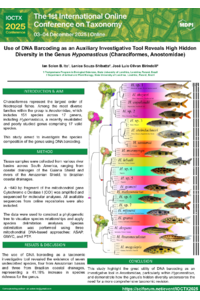
Characiformes represent the largest order of fish in the Neotropical region. Among the most diverse families within the group is Anostomidae, which includes 148 species across 17 genera, including Hypomasticus—a recently revalidated genus comprising 17 valid species—although its composition and diagnosis remain uncertain. This study aimed to investigate the species composition of the genus using DNA barcoding. Tissue samples were collected from various river basins where the genus occurs across South America, ranging from coastal drainages of the Guiana Shield, rivers of the Amazonian Shield, to Brazilian coastal drainages. A ~640 bp fragment of the mitochondrial gene Cytochrome c Oxidase I (COI) was amplified and sequenced for molecular analyses. All available sequences from online repositories were also included. The data were used to construct a phylogenetic tree to visualize species relationships and apply species delimitation analyses. Species delimitation was performed using three mitochondrial DNA-based approaches: ASAP, GMYC, and PTP. The use of DNA barcoding as a taxonomic investigative tool revealed the existence of seven undescribed species—four from Amazonian basins and three from Brazilian coastal drainages—representing a 41.18% increase in species richness for the genus. The analyses highlight the great utility of DNA barcoding as an investigative tool in the family Anostomidae, particularly within Hypomasticus, and demonstrate how the genus’s hidden diversity underscores the need for a more comprehensive taxonomic revision.
Keywords
Anostomoidea
DNA Barcode
Neotropical
Ostariophysi
Poster
Poster.pdf
A Rare Lateral Line Variation in Cynoglossus quadrilineatus (Bleeker, 1851): Insights from Morphological and Molecular Analyses
Integrative taxonomic assessment of Cruzia sp. (Nematoda: Cosmocercoidea, Kathlaniidae) from the Argentine black and white tegu lizard: insights into the long-standing Kathlaniidae taxonomic puzzle