Event submissions
Published
This submission belongs to the session S3. Animal Taxonomy of the event The 1st International Online Conference on Taxonomy
Published date
01 Dec, 2025
Academic Editor
'%3e%3cpath%20d='M12.6657%2010.9104C12.4185%2010.325%2012.0599%209.79327%2011.6097%209.34482C11.1609%208.89508%2010.6293%208.5365%2010.0442%208.28888C10.0389%208.28626%2010.0337%208.28495%2010.0285%208.28233C10.8446%207.69279%2011.3752%206.73249%2011.3752%205.64904C11.3752%203.8542%209.92103%202.39999%208.1262%202.39999C6.33136%202.39999%204.87715%203.8542%204.87715%205.64904C4.87715%206.73249%205.40774%207.69279%206.22393%208.28364C6.21869%208.28626%206.21345%208.28757%206.20821%208.29019C5.62129%208.5378%205.09463%208.89284%204.64265%209.34613C4.1929%209.79493%203.83432%2010.3266%203.58671%2010.9117C3.34345%2011.4845%203.21226%2012.0987%203.20023%2012.7209C3.19988%2012.7349%203.20233%2012.7488%203.20744%2012.7619C3.21255%2012.7749%203.22022%2012.7867%203.22998%2012.7968C3.23975%2012.8068%203.25142%2012.8147%203.26431%2012.8202C3.2772%2012.8256%203.29105%2012.8284%203.30504%2012.8284H4.09109C4.14874%2012.8284%204.19459%2012.7825%204.1959%2012.7262C4.2221%2011.7148%204.62823%2010.7676%205.34617%2010.0497C6.08899%209.30683%207.0755%208.89808%208.1262%208.89808C9.17689%208.89808%2010.1634%209.30683%2010.9062%2010.0497C11.6242%2010.7676%2012.0303%2011.7148%2012.0565%2012.7262C12.0578%2012.7838%2012.1037%2012.8284%2012.1613%2012.8284H12.9474C12.9613%2012.8284%2012.9752%2012.8256%2012.9881%2012.8202C13.001%2012.8147%2013.0126%2012.8068%2013.0224%2012.7968C13.0322%2012.7867%2013.0398%2012.7749%2013.0449%2012.7619C13.0501%2012.7488%2013.0525%2012.7349%2013.0522%2012.7209C13.0391%2012.0947%2012.9094%2011.4855%2012.6657%2010.9104ZM8.1262%207.9024C7.52486%207.9024%206.9589%207.6679%206.53312%207.24211C6.10733%206.81633%205.87283%206.25037%205.87283%205.64904C5.87283%205.0477%206.10733%204.48174%206.53312%204.05596C6.9589%203.63018%207.52486%203.39567%208.1262%203.39567C8.72753%203.39567%209.29349%203.63018%209.71927%204.05596C10.1451%204.48174%2010.3796%205.0477%2010.3796%205.64904C10.3796%206.25037%2010.1451%206.81633%209.71927%207.24211C9.29349%207.6679%208.72753%207.9024%208.1262%207.9024Z'%20fill='%235D1EE1'/%3e%3c/g%3e%3c/svg%3e) Mathias Harzhauser
Mathias HarzhauserCitation
Jonathan Allen, James Albert, Lineage diversity and craniofacial disparity of Navajini (Apteronotidae, Gymnotiformes) in deep river channels of tropical South America, in Proceedings of The 1st International Online Conference on Taxonomy, 3 December–4 December 2025, MDPI: Basel, Switzerland
Share
Email
Facebook
Twitter
LinkedIn
Lineage diversity and craniofacial disparity of Navajini (Apteronotidae, Gymnotiformes) in deep river channels of tropical South America
'%3e%3cpath%20d='M12.6647%2010.9104C12.4176%2010.325%2012.0589%209.7933%2011.6088%209.34485C11.16%208.89511%2010.6283%208.53653%2010.0432%208.28891C10.038%208.28629%2010.0327%208.28498%2010.0275%208.28236C10.8437%207.69282%2011.3743%206.73252%2011.3743%205.64907C11.3743%203.85423%209.92005%202.40002%208.12522%202.40002C6.33038%202.40002%204.87618%203.85423%204.87618%205.64907C4.87618%206.73252%205.40677%207.69282%206.22296%208.28367C6.21772%208.28629%206.21248%208.2876%206.20724%208.29022C5.62031%208.53783%205.09365%208.89287%204.64167%209.34616C4.19192%209.79496%203.83334%2010.3266%203.58573%2010.9117C3.34247%2011.4846%203.21128%2012.0987%203.19925%2012.721C3.1989%2012.735%203.20135%2012.7489%203.20646%2012.7619C3.21157%2012.7749%203.21924%2012.7868%203.22901%2012.7968C3.23877%2012.8068%203.25045%2012.8148%203.26334%2012.8202C3.27623%2012.8256%203.29007%2012.8284%203.30406%2012.8284H4.09012C4.14776%2012.8284%204.19362%2012.7825%204.19493%2012.7262C4.22113%2011.7148%204.62726%2010.7676%205.34519%2010.0497C6.08802%209.30686%207.07452%208.89811%208.12522%208.89811C9.17592%208.89811%2010.1624%209.30686%2010.9052%2010.0497C11.6232%2010.7676%2012.0293%2011.7148%2012.0555%2012.7262C12.0568%2012.7839%2012.1027%2012.8284%2012.1603%2012.8284H12.9464C12.9604%2012.8284%2012.9742%2012.8256%2012.9871%2012.8202C13%2012.8148%2013.0117%2012.8068%2013.0214%2012.7968C13.0312%2012.7868%2013.0389%2012.7749%2013.044%2012.7619C13.0491%2012.7489%2013.0515%2012.735%2013.0512%2012.721C13.0381%2012.0947%2012.9084%2011.4856%2012.6647%2010.9104ZM8.12522%207.90243C7.52388%207.90243%206.95792%207.66793%206.53214%207.24215C6.10636%206.81636%205.87185%206.2504%205.87185%205.64907C5.87185%205.04773%206.10636%204.48177%206.53214%204.05599C6.95792%203.63021%207.52388%203.3957%208.12522%203.3957C8.72655%203.3957%209.29252%203.63021%209.7183%204.05599C10.1441%204.48177%2010.3786%205.04773%2010.3786%205.64907C10.3786%206.2504%2010.1441%206.81636%209.7183%207.24215C9.29252%207.66793%208.72655%207.90243%208.12522%207.90243Z'%20fill='%235D1EE1'/%3e%3c/g%3e%3c/svg%3e)
Jonathan Allen 1
James Albert 1
1. Department of Biology, University of Louisiana at Lafayette, Lafayette, Louisiana, 70503, USA
Abstract
The Navajini, a clade of Neotropical electric fishes within the family Apteronotidae, exhibit exceptional craniofacial diversity that reflects a dynamic interplay of evolutionary forces. This study examines the morphological, ecological, and developmental drivers of phenotypic diversification in this group, which includes some of the most specialized skull morphologies among South American freshwater fishes. We integrate 3D geometric morphometrics, high-resolution micro-computed tomography (micro-CT), and multivariate statistical analyses within a robust phylogenetic comparative framework to assess patterns of skull shape evolution across the clade. Ancestral state reconstruction and tests for phylogenetic signal reveal that key cranial traits such as lower jaw elongation, opercle morphology, and maxilla orientation are not randomly distributed but instead show significant phylogenetic structure and ecological relevance. Morphological disparity is strongly influenced by sexual dimorphism in certain lineages, particularly those exhibiting hypertrophied male traits, while other groups display more conservative, modular cranial architectures. We find that access to novel regions of morphospace has been facilitated by shifts in feeding ecology and developmental modularity, enabling trophic specialization and repeated convergent evolution among ecologically similar taxa. These findings support a model in which cranial evolution is shaped by both adaptive responses to ecological opportunity and intrinsic developmental constraints. Overall, this work sheds light on the mechanisms generating phenotypic diversity in Apteronotidae and contributes to a broader understanding of how ecological and evolutionary processes interact to shape morphological evolution in Neotropical freshwater fishes.
Keywords
Biodiversity
Geometric Morphometrics
Functional Morphology
Ecological Specialization
Poster
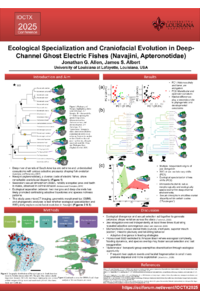
Allen_IOCoT_Poster_2025.pdf
INTEGRATIVE TAXONOMY OF A NEW SPECIES OF HOPLIAS GILL (CHARACIFORMES: ERYTHRINIDAE) FROM THE UPPER PARANÁ RIVER BASIN, BRAZIL
New Astyanax Baird & Girard from the Madeira and Tapajós River drainages, Southern Amazon (Characiformes: Acestrorhamphidae)