Event submissions
Published
This submission belongs to the session S5. "Paleotaxonomy" of the event The 1st International Online Conference on Taxonomy
Published date
01 Dec, 2025
Academic Editor
'%3e%3cpath%20d='M12.6657%2010.9104C12.4185%2010.325%2012.0599%209.79327%2011.6097%209.34482C11.1609%208.89508%2010.6293%208.5365%2010.0442%208.28888C10.0389%208.28626%2010.0337%208.28495%2010.0285%208.28233C10.8446%207.69279%2011.3752%206.73249%2011.3752%205.64904C11.3752%203.8542%209.92103%202.39999%208.1262%202.39999C6.33136%202.39999%204.87715%203.8542%204.87715%205.64904C4.87715%206.73249%205.40774%207.69279%206.22393%208.28364C6.21869%208.28626%206.21345%208.28757%206.20821%208.29019C5.62129%208.5378%205.09463%208.89284%204.64265%209.34613C4.1929%209.79493%203.83432%2010.3266%203.58671%2010.9117C3.34345%2011.4845%203.21226%2012.0987%203.20023%2012.7209C3.19988%2012.7349%203.20233%2012.7488%203.20744%2012.7619C3.21255%2012.7749%203.22022%2012.7867%203.22998%2012.7968C3.23975%2012.8068%203.25142%2012.8147%203.26431%2012.8202C3.2772%2012.8256%203.29105%2012.8284%203.30504%2012.8284H4.09109C4.14874%2012.8284%204.19459%2012.7825%204.1959%2012.7262C4.2221%2011.7148%204.62823%2010.7676%205.34617%2010.0497C6.08899%209.30683%207.0755%208.89808%208.1262%208.89808C9.17689%208.89808%2010.1634%209.30683%2010.9062%2010.0497C11.6242%2010.7676%2012.0303%2011.7148%2012.0565%2012.7262C12.0578%2012.7838%2012.1037%2012.8284%2012.1613%2012.8284H12.9474C12.9613%2012.8284%2012.9752%2012.8256%2012.9881%2012.8202C13.001%2012.8147%2013.0126%2012.8068%2013.0224%2012.7968C13.0322%2012.7867%2013.0398%2012.7749%2013.0449%2012.7619C13.0501%2012.7488%2013.0525%2012.7349%2013.0522%2012.7209C13.0391%2012.0947%2012.9094%2011.4855%2012.6657%2010.9104ZM8.1262%207.9024C7.52486%207.9024%206.9589%207.6679%206.53312%207.24211C6.10733%206.81633%205.87283%206.25037%205.87283%205.64904C5.87283%205.0477%206.10733%204.48174%206.53312%204.05596C6.9589%203.63018%207.52486%203.39567%208.1262%203.39567C8.72753%203.39567%209.29349%203.63018%209.71927%204.05596C10.1451%204.48174%2010.3796%205.0477%2010.3796%205.64904C10.3796%206.25037%2010.1451%206.81633%209.71927%207.24211C9.29349%207.6679%208.72753%207.9024%208.1262%207.9024Z'%20fill='%235D1EE1'/%3e%3c/g%3e%3c/svg%3e) Davit Vasilyan
Davit VasilyanCitation
Jonathan P. Miller, Julio Talavan Serna, Diana Delicado, Uncovering hidden diversity in Iberian freshwater fossil snails: an integrative approach to Horatia schlosseri (Royo-Gómez, 1922) (Gastropoda: Hydrobiidae), in Proceedings of The 1st International Online Conference on Taxonomy, 3 December–4 December 2025, MDPI: Basel, Switzerland
Share
Email
Facebook
Twitter
LinkedIn
Uncovering hidden diversity in Iberian freshwater fossil snails: an integrative approach to Horatia schlosseri (Royo-Gómez, 1922) (Gastropoda: Hydrobiidae)
'%3e%3cpath%20d='M12.6647%2010.9104C12.4176%2010.325%2012.0589%209.7933%2011.6088%209.34485C11.16%208.89511%2010.6283%208.53653%2010.0432%208.28891C10.038%208.28629%2010.0327%208.28498%2010.0275%208.28236C10.8437%207.69282%2011.3743%206.73252%2011.3743%205.64907C11.3743%203.85423%209.92005%202.40002%208.12522%202.40002C6.33038%202.40002%204.87618%203.85423%204.87618%205.64907C4.87618%206.73252%205.40677%207.69282%206.22296%208.28367C6.21772%208.28629%206.21248%208.2876%206.20724%208.29022C5.62031%208.53783%205.09365%208.89287%204.64167%209.34616C4.19192%209.79496%203.83334%2010.3266%203.58573%2010.9117C3.34247%2011.4846%203.21128%2012.0987%203.19925%2012.721C3.1989%2012.735%203.20135%2012.7489%203.20646%2012.7619C3.21157%2012.7749%203.21924%2012.7868%203.22901%2012.7968C3.23877%2012.8068%203.25045%2012.8148%203.26334%2012.8202C3.27623%2012.8256%203.29007%2012.8284%203.30406%2012.8284H4.09012C4.14776%2012.8284%204.19362%2012.7825%204.19493%2012.7262C4.22113%2011.7148%204.62726%2010.7676%205.34519%2010.0497C6.08802%209.30686%207.07452%208.89811%208.12522%208.89811C9.17592%208.89811%2010.1624%209.30686%2010.9052%2010.0497C11.6232%2010.7676%2012.0293%2011.7148%2012.0555%2012.7262C12.0568%2012.7839%2012.1027%2012.8284%2012.1603%2012.8284H12.9464C12.9604%2012.8284%2012.9742%2012.8256%2012.9871%2012.8202C13%2012.8148%2013.0117%2012.8068%2013.0214%2012.7968C13.0312%2012.7868%2013.0389%2012.7749%2013.044%2012.7619C13.0491%2012.7489%2013.0515%2012.735%2013.0512%2012.721C13.0381%2012.0947%2012.9084%2011.4856%2012.6647%2010.9104ZM8.12522%207.90243C7.52388%207.90243%206.95792%207.66793%206.53214%207.24215C6.10636%206.81636%205.87185%206.2504%205.87185%205.64907C5.87185%205.04773%206.10636%204.48177%206.53214%204.05599C6.95792%203.63021%207.52388%203.3957%208.12522%203.3957C8.72655%203.3957%209.29252%203.63021%209.7183%204.05599C10.1441%204.48177%2010.3786%205.04773%2010.3786%205.64907C10.3786%206.2504%2010.1441%206.81636%209.7183%207.24215C9.29252%207.66793%208.72655%207.90243%208.12522%207.90243Z'%20fill='%235D1EE1'/%3e%3c/g%3e%3c/svg%3e)
Jonathan P. Miller 1
Julio Talavan Serna 2
Diana Delicado 1
1. Museo Nacional de Ciencias Naturales – CSIC, Madrid, Spain
2. Independent Researcher, Madrid, Spain
Abstract
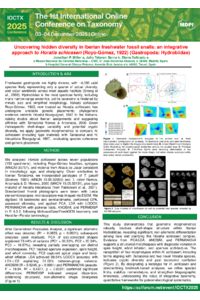
The classification of Hydrobiidae Stimpson, 1865, a diverse family of freshwater gastropods, is hindered by their minute size and simplified shell morphology, resulting in a lack of diagnostic features in fossils. This leads to taxonomic ambiguities and the concealment of cryptic diversity, as seen in Horatia schlosseri (Royo-Gómez, 1922), a species that is frequently reassigned without consistent analysis. An integrative taxonomic approach is thus essential for accurate fossil identification and systematic resolution. To assess morphological variation within H. schlosseri, we applied geometric morphometrics (GMs), analyzing shell shape across 163 specimens from eight Iberian localities. These included syntypes of H. schlosseri, type material of Horatia klecakiana (type species of Horatia), and paratypes of the similar genus Tarraconia. Shells were digitized with 18 landmarks/semi-landmarks and analyzed using Procrustes superimposition, Linear Discriminant Analysis (LDA), and ANOSIM.GM analysis revealed four distinct morphotypes within the H. schlosseri complex. Specimens from Alcalá del Júcar, previously attributed to H. schlosseri, clustered statistically with Tarraconia (ANOSIM p > 0.05) and were reassigned as Tarraconia sp. 1, further supported by the presence of a diagnostic varix. Two new cryptic species were also identified: Horatia sp. 1 (La Hontanilla Spring, Cuenca) and Horatia sp. 2 (Concud, Teruel), both from localities historically linked to H. schlosseri. Our results highlight the limitations of traditional morphological methods in Hydrobiidae systematics and emphasize the value of GM in revealing cryptic diversity. This study underscores the need for a comprehensive revision of Iberian caenogastropod fossils using integrative, quantitative approaches.
Keywords
HYDROBIIDAE
FOSSIL
TAXONOMY
FRESHWATER
Poster
Jonathan poster.pdf
Nomenclature is the scientific language of Taxonomy, and you already know everything about it
Re-evaluation of the taxonomy of Compsemys: an enigmatic turtle from around the Cretaceous–Paleogene boundary