Event submissions
Published
This submission belongs to the session S1. Applied Biosciences and Bioengineering of the event The 6th International Electronic Conference on Applied Sciences
Published date
03 Dec, 2025
Academic Editor
'%3e%3cpath%20d='M12.6657%2010.9104C12.4185%2010.325%2012.0599%209.79327%2011.6097%209.34482C11.1609%208.89508%2010.6293%208.5365%2010.0442%208.28888C10.0389%208.28626%2010.0337%208.28495%2010.0285%208.28233C10.8446%207.69279%2011.3752%206.73249%2011.3752%205.64904C11.3752%203.8542%209.92103%202.39999%208.1262%202.39999C6.33136%202.39999%204.87715%203.8542%204.87715%205.64904C4.87715%206.73249%205.40774%207.69279%206.22393%208.28364C6.21869%208.28626%206.21345%208.28757%206.20821%208.29019C5.62129%208.5378%205.09463%208.89284%204.64265%209.34613C4.1929%209.79493%203.83432%2010.3266%203.58671%2010.9117C3.34345%2011.4845%203.21226%2012.0987%203.20023%2012.7209C3.19988%2012.7349%203.20233%2012.7488%203.20744%2012.7619C3.21255%2012.7749%203.22022%2012.7867%203.22998%2012.7968C3.23975%2012.8068%203.25142%2012.8147%203.26431%2012.8202C3.2772%2012.8256%203.29105%2012.8284%203.30504%2012.8284H4.09109C4.14874%2012.8284%204.19459%2012.7825%204.1959%2012.7262C4.2221%2011.7148%204.62823%2010.7676%205.34617%2010.0497C6.08899%209.30683%207.0755%208.89808%208.1262%208.89808C9.17689%208.89808%2010.1634%209.30683%2010.9062%2010.0497C11.6242%2010.7676%2012.0303%2011.7148%2012.0565%2012.7262C12.0578%2012.7838%2012.1037%2012.8284%2012.1613%2012.8284H12.9474C12.9613%2012.8284%2012.9752%2012.8256%2012.9881%2012.8202C13.001%2012.8147%2013.0126%2012.8068%2013.0224%2012.7968C13.0322%2012.7867%2013.0398%2012.7749%2013.0449%2012.7619C13.0501%2012.7488%2013.0525%2012.7349%2013.0522%2012.7209C13.0391%2012.0947%2012.9094%2011.4855%2012.6657%2010.9104ZM8.1262%207.9024C7.52486%207.9024%206.9589%207.6679%206.53312%207.24211C6.10733%206.81633%205.87283%206.25037%205.87283%205.64904C5.87283%205.0477%206.10733%204.48174%206.53312%204.05596C6.9589%203.63018%207.52486%203.39567%208.1262%203.39567C8.72753%203.39567%209.29349%203.63018%209.71927%204.05596C10.1451%204.48174%2010.3796%205.0477%2010.3796%205.64904C10.3796%206.25037%2010.1451%206.81633%209.71927%207.24211C9.29349%207.6679%208.72753%207.9024%208.1262%207.9024Z'%20fill='%235D1EE1'/%3e%3c/g%3e%3c/svg%3e) Roger Narayan
Roger NarayanCitation
Francis Ceniza, Harll Fawwenn Hayes Paderanga, Sheena Alexa Yacapin, Nesteve John Agosto, Computational Evaluation of Philippine Vitex negundo Phytochemicals as Potential Inhibitors of Rhinovirus 3C Protease: Molecular Docking, Pharmacokinetic Analysis, and ADMET Studies, in Proceedings of The 6th International Electronic Conference on Applied Sciences, 9 December–11 December 2025, MDPI: Basel, Switzerland
Share
Email
Facebook
Twitter
LinkedIn
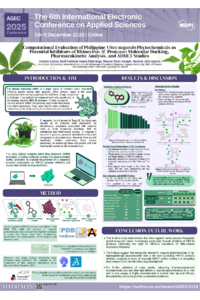
Computational Evaluation of Philippine Vitex negundo Phytochemicals as Potential Inhibitors of Rhinovirus 3C Protease: Molecular Docking, Pharmacokinetic Analysis, and ADMET Studies
'%3e%3cpath%20d='M12.6647%2010.9104C12.4176%2010.325%2012.0589%209.7933%2011.6088%209.34485C11.16%208.89511%2010.6283%208.53653%2010.0432%208.28891C10.038%208.28629%2010.0327%208.28498%2010.0275%208.28236C10.8437%207.69282%2011.3743%206.73252%2011.3743%205.64907C11.3743%203.85423%209.92005%202.40002%208.12522%202.40002C6.33038%202.40002%204.87618%203.85423%204.87618%205.64907C4.87618%206.73252%205.40677%207.69282%206.22296%208.28367C6.21772%208.28629%206.21248%208.2876%206.20724%208.29022C5.62031%208.53783%205.09365%208.89287%204.64167%209.34616C4.19192%209.79496%203.83334%2010.3266%203.58573%2010.9117C3.34247%2011.4846%203.21128%2012.0987%203.19925%2012.721C3.1989%2012.735%203.20135%2012.7489%203.20646%2012.7619C3.21157%2012.7749%203.21924%2012.7868%203.22901%2012.7968C3.23877%2012.8068%203.25045%2012.8148%203.26334%2012.8202C3.27623%2012.8256%203.29007%2012.8284%203.30406%2012.8284H4.09012C4.14776%2012.8284%204.19362%2012.7825%204.19493%2012.7262C4.22113%2011.7148%204.62726%2010.7676%205.34519%2010.0497C6.08802%209.30686%207.07452%208.89811%208.12522%208.89811C9.17592%208.89811%2010.1624%209.30686%2010.9052%2010.0497C11.6232%2010.7676%2012.0293%2011.7148%2012.0555%2012.7262C12.0568%2012.7839%2012.1027%2012.8284%2012.1603%2012.8284H12.9464C12.9604%2012.8284%2012.9742%2012.8256%2012.9871%2012.8202C13%2012.8148%2013.0117%2012.8068%2013.0214%2012.7968C13.0312%2012.7868%2013.0389%2012.7749%2013.044%2012.7619C13.0491%2012.7489%2013.0515%2012.735%2013.0512%2012.721C13.0381%2012.0947%2012.9084%2011.4856%2012.6647%2010.9104ZM8.12522%207.90243C7.52388%207.90243%206.95792%207.66793%206.53214%207.24215C6.10636%206.81636%205.87185%206.2504%205.87185%205.64907C5.87185%205.04773%206.10636%204.48177%206.53214%204.05599C6.95792%203.63021%207.52388%203.3957%208.12522%203.3957C8.72655%203.3957%209.29252%203.63021%209.7183%204.05599C10.1441%204.48177%2010.3786%205.04773%2010.3786%205.64907C10.3786%206.2504%2010.1441%206.81636%209.7183%207.24215C9.29252%207.66793%208.72655%207.90243%208.12522%207.90243Z'%20fill='%235D1EE1'/%3e%3c/g%3e%3c/svg%3e)
Francis Ceniza 1
Harll Fawwenn Hayes Paderanga 1
Sheena Alexa Yacapin 1

Nesteve John Agosto 1,2
1. Department of Chemistry, University of Science and Technology of Southern Philippines, Cagayan de Oro City, 9000, Philippines
2. Center for Natural Products Research, University of Science and Technology of Southern Philippines, Cagayan de Oro City, 9000, Philippines
Abstract
Human rhinoviruses (HRVs) are the primary cause of the common cold, a highly contagious upper respiratory tract infection characterized by nasal congestion, sneezing, and sore throat. HRV replication depends on its 3C protease (HRV-3Cpro), a key enzyme that cleaves the viral polyprotein into functional proteins essential for viral maturation. Currently, no FDA-approved inhibitors specifically target HRV-3Cpro. While rupintrivir, a synthetic inhibitor, advanced to clinical trials, it ultimately failed due to limited efficacy. This study investigated the potential of Vitex negundo (or lagundi)—a medicinal plant traditionally used in the Philippines for treating colds and respiratory ailments—as a source of natural HRV-3Cpro inhibitors through in silico molecular docking and pharmacokinetic (ADMET) evaluation. Fifteen phytochemicals reported from Philippine V. negundo were screened, with four compounds—agnuside (-6.9 kcal/mol), luteolin 7-O-glucoside (-6.7 kcal/mol), 2′-p-hydroxybenzoyl mussaenosidic acid (-6.6 kcal/mol), and 6′-(p-hydroxybenzoyl) mussaenosidic acid (-6.5 kcal/mol)—exhibiting stronger binding affinities than the reference inhibitor rupintrivir (-6.2 kcal/mol), suggesting potential for more effective enzyme inhibition. While agnuside had the strongest binding affinity, 6′-(p-hydroxybenzoyl) mussaenosidic acid exhibited the most favorable drug-likeness and ADMET profile, being predicted as non-mutagenic, non-hepatotoxic, and non-inhibitory to major drug-metabolizing enzymes. Nevertheless, their low oral bioavailability and gastrointestinal absorption suggest the need for alternative delivery methods to enhance therapeutic efficacy. Therefore, these findings highlight the antiviral potential of V. negundo phytochemicals as plant-based HRV-3Cpro inhibitors. Further in vitro and in vivo studies are recommended to validate their bioactivity.
Keywords
antiviral activity
Vitex negundo
human rhinovirus 3C protease
molecular docking
ADMET
computer-aided drug discovery (CADD)
Poster
sciforum-132263-Agosto-poster.pdf
Analysis of the antifungal and biocontrol potential of fungi of the genus Trichoderma
Effects of Support Stays in a Soft Knee Brace on Muscle Activity during Jogging