Event submissions
Published
This submission belongs to the session S1. Applied Biosciences and Bioengineering of the event The 6th International Electronic Conference on Applied Sciences
Published date
03 Dec, 2025
Academic Editor
'%3e%3cpath%20d='M12.6657%2010.9104C12.4185%2010.325%2012.0599%209.79327%2011.6097%209.34482C11.1609%208.89508%2010.6293%208.5365%2010.0442%208.28888C10.0389%208.28626%2010.0337%208.28495%2010.0285%208.28233C10.8446%207.69279%2011.3752%206.73249%2011.3752%205.64904C11.3752%203.8542%209.92103%202.39999%208.1262%202.39999C6.33136%202.39999%204.87715%203.8542%204.87715%205.64904C4.87715%206.73249%205.40774%207.69279%206.22393%208.28364C6.21869%208.28626%206.21345%208.28757%206.20821%208.29019C5.62129%208.5378%205.09463%208.89284%204.64265%209.34613C4.1929%209.79493%203.83432%2010.3266%203.58671%2010.9117C3.34345%2011.4845%203.21226%2012.0987%203.20023%2012.7209C3.19988%2012.7349%203.20233%2012.7488%203.20744%2012.7619C3.21255%2012.7749%203.22022%2012.7867%203.22998%2012.7968C3.23975%2012.8068%203.25142%2012.8147%203.26431%2012.8202C3.2772%2012.8256%203.29105%2012.8284%203.30504%2012.8284H4.09109C4.14874%2012.8284%204.19459%2012.7825%204.1959%2012.7262C4.2221%2011.7148%204.62823%2010.7676%205.34617%2010.0497C6.08899%209.30683%207.0755%208.89808%208.1262%208.89808C9.17689%208.89808%2010.1634%209.30683%2010.9062%2010.0497C11.6242%2010.7676%2012.0303%2011.7148%2012.0565%2012.7262C12.0578%2012.7838%2012.1037%2012.8284%2012.1613%2012.8284H12.9474C12.9613%2012.8284%2012.9752%2012.8256%2012.9881%2012.8202C13.001%2012.8147%2013.0126%2012.8068%2013.0224%2012.7968C13.0322%2012.7867%2013.0398%2012.7749%2013.0449%2012.7619C13.0501%2012.7488%2013.0525%2012.7349%2013.0522%2012.7209C13.0391%2012.0947%2012.9094%2011.4855%2012.6657%2010.9104ZM8.1262%207.9024C7.52486%207.9024%206.9589%207.6679%206.53312%207.24211C6.10733%206.81633%205.87283%206.25037%205.87283%205.64904C5.87283%205.0477%206.10733%204.48174%206.53312%204.05596C6.9589%203.63018%207.52486%203.39567%208.1262%203.39567C8.72753%203.39567%209.29349%203.63018%209.71927%204.05596C10.1451%204.48174%2010.3796%205.0477%2010.3796%205.64904C10.3796%206.25037%2010.1451%206.81633%209.71927%207.24211C9.29349%207.6679%208.72753%207.9024%208.1262%207.9024Z'%20fill='%235D1EE1'/%3e%3c/g%3e%3c/svg%3e) Roger Narayan
Roger NarayanCitation
Marco Annunziata, Francesco Arcadio, Emanuela Stampone, Debora Bencivenga, Gennaro Cecoro, Chiara Marzano, Angelantonio Piccirillo, Fulvio Della Ragione, Nunzio Cennamo, Luigi Zeni, Adriana Borriello, Luigi Guida, Multichannel Plasmonic Point-of-Care Device for Salivary Detection of Periodontal MIP-1α: Analytical Comparison with ELISA, in Proceedings of The 6th International Electronic Conference on Applied Sciences, 9 December–11 December 2025, MDPI: Basel, Switzerland
Share
Email
Facebook
Twitter
LinkedIn
Multichannel Plasmonic Point-of-Care Device for Salivary Detection of Periodontal MIP-1α: Analytical Comparison with ELISA

Marco Annunziata 1

Francesco Arcadio 2

Emanuela Stampone 3
'%3e%3cpath%20d='M12.6647%2010.9104C12.4176%2010.325%2012.0589%209.7933%2011.6088%209.34485C11.16%208.89511%2010.6283%208.53653%2010.0432%208.28891C10.038%208.28629%2010.0327%208.28498%2010.0275%208.28236C10.8437%207.69282%2011.3743%206.73252%2011.3743%205.64907C11.3743%203.85423%209.92005%202.40002%208.12522%202.40002C6.33038%202.40002%204.87618%203.85423%204.87618%205.64907C4.87618%206.73252%205.40677%207.69282%206.22296%208.28367C6.21772%208.28629%206.21248%208.2876%206.20724%208.29022C5.62031%208.53783%205.09365%208.89287%204.64167%209.34616C4.19192%209.79496%203.83334%2010.3266%203.58573%2010.9117C3.34247%2011.4846%203.21128%2012.0987%203.19925%2012.721C3.1989%2012.735%203.20135%2012.7489%203.20646%2012.7619C3.21157%2012.7749%203.21924%2012.7868%203.22901%2012.7968C3.23877%2012.8068%203.25045%2012.8148%203.26334%2012.8202C3.27623%2012.8256%203.29007%2012.8284%203.30406%2012.8284H4.09012C4.14776%2012.8284%204.19362%2012.7825%204.19493%2012.7262C4.22113%2011.7148%204.62726%2010.7676%205.34519%2010.0497C6.08802%209.30686%207.07452%208.89811%208.12522%208.89811C9.17592%208.89811%2010.1624%209.30686%2010.9052%2010.0497C11.6232%2010.7676%2012.0293%2011.7148%2012.0555%2012.7262C12.0568%2012.7839%2012.1027%2012.8284%2012.1603%2012.8284H12.9464C12.9604%2012.8284%2012.9742%2012.8256%2012.9871%2012.8202C13%2012.8148%2013.0117%2012.8068%2013.0214%2012.7968C13.0312%2012.7868%2013.0389%2012.7749%2013.044%2012.7619C13.0491%2012.7489%2013.0515%2012.735%2013.0512%2012.721C13.0381%2012.0947%2012.9084%2011.4856%2012.6647%2010.9104ZM8.12522%207.90243C7.52388%207.90243%206.95792%207.66793%206.53214%207.24215C6.10636%206.81636%205.87185%206.2504%205.87185%205.64907C5.87185%205.04773%206.10636%204.48177%206.53214%204.05599C6.95792%203.63021%207.52388%203.3957%208.12522%203.3957C8.72655%203.3957%209.29252%203.63021%209.7183%204.05599C10.1441%204.48177%2010.3786%205.04773%2010.3786%205.64907C10.3786%206.2504%2010.1441%206.81636%209.7183%207.24215C9.29252%207.66793%208.72655%207.90243%208.12522%207.90243Z'%20fill='%235D1EE1'/%3e%3c/g%3e%3c/svg%3e)
Debora Bencivenga 3

Gennaro Cecoro 1
Chiara Marzano 2
Angelantonio Piccirillo 1

Fulvio Della Ragione 3

Nunzio Cennamo 2
Luigi Zeni 2

Adriana Borriello 3
Luigi Guida 1
1. Multidisciplinary Department of Medical-Surgical and Dental Specialties, University of Campania “Luigi Vanvitelli”, via L. De Crecchio, 6 – 80138 - Naples, Italy
2. Department of Engineering, University of Campania “Luigi Vanvitelli”, Via Roma, 9 - 81031 -Aversa, CE, Italy
3. Department of Precision Medicine, University of Campania “Luigi Vanvitelli”, via L. De Crecchio, 7 - 80138 - Naples, Italy
Abstract
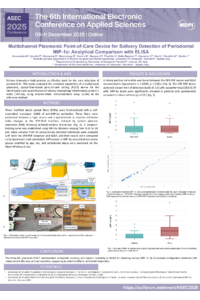
Introduction: Salivary biomarkers are increasingly gaining trust as promising candidates for the non-invasive diagnosis of periodontal diseases and the monitoring of periodontal tissue health. This study investigated the analytical capabilities of a multichannel, plasmonic point-of-care (POC) test based on optical fiber technology for detecting and quantifying salivary macrophage inflammatory protein-1 alpha (MIP-1α), using enzyme-linked immunosorbent assay (ELISA) as a comparison.
Methods: Three plastic optical fibers (POFs) were functionalized with a self-assembled monolayer (SAM) containing MIP-1α antibodies. The POFs were placed between a spectrometer and a light source to monitor refractive index shifts at the POF-SAM interface, corresponding to the occurrence of surface plasmon resonance (SPR) during antigen–antibody interaction. A dose–response curve was generated using a range of MIP-1α concentrations. Salivary samples were collected from a cohort of fifty participants and analyzed using both the SPR-based biosensor and ELISA. Spearman’s Rank test assessed the correlation between the two techniques. Differences in MIP-1α expression were further analyzed in relation to clinical variables, including periodontal status, age, and gender (Mann–Whitney U-test).
Results: A significant correlation was observed between the measurements obtained from the biosensor and those from ELISA. The sensitivity of the SPR-POF device allowed for the detection of MIP-1α at lower concentrations than ELISA. Patients with periodontal disease exhibited significantly higher levels of MIP-1α compared to those without the disease, supporting its potential as a diagnostic biomarker.
Conclusions: The developed three-channel plasmonic POCT exhibited comparable accuracy and superior sensitivity to ELISA for detecting salivary MIP-1α. Moreover, the multichannel plasmonic configuration enhanced both measurement efficiency and the reliability of the results.
Keywords
point-of-care test
plasmonic optical-fiber-based biosensor
salivary MIP-1α
periodontitis
Poster
Poster ASEC.pdf
Comparative Study of Rigid and Flexible Multibody Dynamics in a 3D-Printed Two-Link Robotic Mechanism
Inactivation of Respiratory Syncytial Virus in Aerosols by Means of Selected Radiated Microwaves