Event submissions
Published
This submission belongs to the session S1. Applied Biosciences and Bioengineering of the event The 6th International Electronic Conference on Applied Sciences
Published date
03 Dec, 2025
Academic Editor
'%3e%3cpath%20d='M12.6657%2010.9104C12.4185%2010.325%2012.0599%209.79327%2011.6097%209.34482C11.1609%208.89508%2010.6293%208.5365%2010.0442%208.28888C10.0389%208.28626%2010.0337%208.28495%2010.0285%208.28233C10.8446%207.69279%2011.3752%206.73249%2011.3752%205.64904C11.3752%203.8542%209.92103%202.39999%208.1262%202.39999C6.33136%202.39999%204.87715%203.8542%204.87715%205.64904C4.87715%206.73249%205.40774%207.69279%206.22393%208.28364C6.21869%208.28626%206.21345%208.28757%206.20821%208.29019C5.62129%208.5378%205.09463%208.89284%204.64265%209.34613C4.1929%209.79493%203.83432%2010.3266%203.58671%2010.9117C3.34345%2011.4845%203.21226%2012.0987%203.20023%2012.7209C3.19988%2012.7349%203.20233%2012.7488%203.20744%2012.7619C3.21255%2012.7749%203.22022%2012.7867%203.22998%2012.7968C3.23975%2012.8068%203.25142%2012.8147%203.26431%2012.8202C3.2772%2012.8256%203.29105%2012.8284%203.30504%2012.8284H4.09109C4.14874%2012.8284%204.19459%2012.7825%204.1959%2012.7262C4.2221%2011.7148%204.62823%2010.7676%205.34617%2010.0497C6.08899%209.30683%207.0755%208.89808%208.1262%208.89808C9.17689%208.89808%2010.1634%209.30683%2010.9062%2010.0497C11.6242%2010.7676%2012.0303%2011.7148%2012.0565%2012.7262C12.0578%2012.7838%2012.1037%2012.8284%2012.1613%2012.8284H12.9474C12.9613%2012.8284%2012.9752%2012.8256%2012.9881%2012.8202C13.001%2012.8147%2013.0126%2012.8068%2013.0224%2012.7968C13.0322%2012.7867%2013.0398%2012.7749%2013.0449%2012.7619C13.0501%2012.7488%2013.0525%2012.7349%2013.0522%2012.7209C13.0391%2012.0947%2012.9094%2011.4855%2012.6657%2010.9104ZM8.1262%207.9024C7.52486%207.9024%206.9589%207.6679%206.53312%207.24211C6.10733%206.81633%205.87283%206.25037%205.87283%205.64904C5.87283%205.0477%206.10733%204.48174%206.53312%204.05596C6.9589%203.63018%207.52486%203.39567%208.1262%203.39567C8.72753%203.39567%209.29349%203.63018%209.71927%204.05596C10.1451%204.48174%2010.3796%205.0477%2010.3796%205.64904C10.3796%206.25037%2010.1451%206.81633%209.71927%207.24211C9.29349%207.6679%208.72753%207.9024%208.1262%207.9024Z'%20fill='%235D1EE1'/%3e%3c/g%3e%3c/svg%3e) Roger Narayan
Roger NarayanCitation
Paolo Pellegrino, Isabella Farella, Valeria De Matteis, Mariafrancesca Cascione, Stefania Villani, Matteo Calcagnile, Lorenzo Vincenti, Fabio Quaranta, Pietro Alifano, Antonio Della Torre, Christian Demitri, Rosaria Rinaldi, Engineered Nanostructured Surfaces for Dual Antibacterial and Cell-Guiding Applications in Biomedical Devices, in Proceedings of The 6th International Electronic Conference on Applied Sciences, 9 December–11 December 2025, MDPI: Basel, Switzerland
Share
Email
Facebook
Twitter
LinkedIn
Engineered Nanostructured Surfaces for Dual Antibacterial and Cell-Guiding Applications in Biomedical Devices
'%3e%3cpath%20d='M12.6647%2010.9104C12.4176%2010.325%2012.0589%209.7933%2011.6088%209.34485C11.16%208.89511%2010.6283%208.53653%2010.0432%208.28891C10.038%208.28629%2010.0327%208.28498%2010.0275%208.28236C10.8437%207.69282%2011.3743%206.73252%2011.3743%205.64907C11.3743%203.85423%209.92005%202.40002%208.12522%202.40002C6.33038%202.40002%204.87618%203.85423%204.87618%205.64907C4.87618%206.73252%205.40677%207.69282%206.22296%208.28367C6.21772%208.28629%206.21248%208.2876%206.20724%208.29022C5.62031%208.53783%205.09365%208.89287%204.64167%209.34616C4.19192%209.79496%203.83334%2010.3266%203.58573%2010.9117C3.34247%2011.4846%203.21128%2012.0987%203.19925%2012.721C3.1989%2012.735%203.20135%2012.7489%203.20646%2012.7619C3.21157%2012.7749%203.21924%2012.7868%203.22901%2012.7968C3.23877%2012.8068%203.25045%2012.8148%203.26334%2012.8202C3.27623%2012.8256%203.29007%2012.8284%203.30406%2012.8284H4.09012C4.14776%2012.8284%204.19362%2012.7825%204.19493%2012.7262C4.22113%2011.7148%204.62726%2010.7676%205.34519%2010.0497C6.08802%209.30686%207.07452%208.89811%208.12522%208.89811C9.17592%208.89811%2010.1624%209.30686%2010.9052%2010.0497C11.6232%2010.7676%2012.0293%2011.7148%2012.0555%2012.7262C12.0568%2012.7839%2012.1027%2012.8284%2012.1603%2012.8284H12.9464C12.9604%2012.8284%2012.9742%2012.8256%2012.9871%2012.8202C13%2012.8148%2013.0117%2012.8068%2013.0214%2012.7968C13.0312%2012.7868%2013.0389%2012.7749%2013.044%2012.7619C13.0491%2012.7489%2013.0515%2012.735%2013.0512%2012.721C13.0381%2012.0947%2012.9084%2011.4856%2012.6647%2010.9104ZM8.12522%207.90243C7.52388%207.90243%206.95792%207.66793%206.53214%207.24215C6.10636%206.81636%205.87185%206.2504%205.87185%205.64907C5.87185%205.04773%206.10636%204.48177%206.53214%204.05599C6.95792%203.63021%207.52388%203.3957%208.12522%203.3957C8.72655%203.3957%209.29252%203.63021%209.7183%204.05599C10.1441%204.48177%2010.3786%205.04773%2010.3786%205.64907C10.3786%206.2504%2010.1441%206.81636%209.7183%207.24215C9.29252%207.66793%208.72655%207.90243%208.12522%207.90243Z'%20fill='%235D1EE1'/%3e%3c/g%3e%3c/svg%3e)
Paolo Pellegrino 1,2
Isabella Farella 1

Valeria De Matteis 1,3

Mariafrancesca Cascione 1,2

Stefania Villani 4

Matteo Calcagnile 3
Lorenzo Vincenti 1,2
Fabio Quaranta 1
Pietro Alifano 3
Antonio Della Torre 1

Christian Demitri 3

Rosaria Rinaldi 1,2
1. Institute for Microelectronics and Microsystems (IMM), CNR, Via Monteroni, 73100 Lecce, Italy
2. Department of Mathematics and Physics “E. De Giorgi”, University of Salento, Via Monteroni, 73100 Lecce, Italy
3. Department of Experimental Medicine, University of Salento, Via Monteroni, 73100 Lecce, Italy
4. Department of Engineering for Innovation (DII), Campus Ecotekne, University of Salento, Via Monteroni, 73100 Lecce, Italy
Abstract
Title:
Engineered Nanostructured Surfaces for Dual Antibacterial and Cell-Guiding Applications in Biomedical Devices
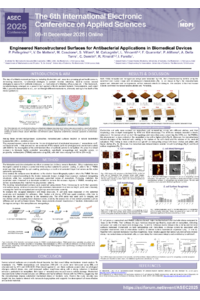
The rise of antibiotic-resistant pathogens, including Escherichia coli, presents a pressing global health concern, demanding innovative, non-chemical strategies to combat microbial infections. Among these, nanostructured surfaces inspired by natural bactericidal topographies offer a promising route. In this work, we present a robust approach to fabricate highly controlled nanopatterns—specifically nanogratings and nanopillar arrays—on poly(methyl methacrylate) (PMMA) substrates using Electron Beam Lithography, with pitch sizes varying from 160 to 210 nm.
Following detailed surface characterization, the interaction between these engineered nanotopographies and E. coli was assessed, focusing on bacterial adhesion, viability, and mechanical integrity. Advanced imaging techniques including Atomic Force Microscopy (AFM), Ultra High-Resolution Scanning Electron Microscopy (UHR-SEM), and Focused Ion Beam (FIB) milling enabled the observation of nanoscale morphological changes and structural damage to bacterial membranes, shedding light on the physical mechanisms behind their antibacterial activity.
Beyond antimicrobial functionality, these nanostructured surfaces were evaluated for their compatibility with human cells to explore their potential for biomedical applications. Cell adhesion, proliferation, and alignment were studied to determine cellular responses to the topographic features. The results confirm the feasibility of using a single platform to investigate and modulate both bacterial inhibition and guided cell behavior.
This study highlights a multifunctional surface engineering strategy that integrates bactericidal performance with cell-instructive capabilities, paving the way for next-generation implantable devices with enhanced infection resistance and improved tissue integration.
Keywords
AFM
EBL
Biomimicry
Nanopillars
Antibacterial Surfaces
Nanogratings
Poster
ASEC2025_Poster _Pellegrino.pdf
Chicken Manure Compost as an Amendment during Phytoremediation of Mercury in Soils Using Brachiaria dyctioneura
Scaling and Environmental Analysis of a Heterogeneous Photocatalytic Rotary Photoreactor for Cyanide Treatment