Event submissions
Published
This submission belongs to the session S6. Energy, Environmental and Earth Science of the event The 6th International Electronic Conference on Applied Sciences
Published date
03 Dec, 2025
Academic Editor
'%3e%3cpath%20d='M12.6657%2010.9104C12.4185%2010.325%2012.0599%209.79327%2011.6097%209.34482C11.1609%208.89508%2010.6293%208.5365%2010.0442%208.28888C10.0389%208.28626%2010.0337%208.28495%2010.0285%208.28233C10.8446%207.69279%2011.3752%206.73249%2011.3752%205.64904C11.3752%203.8542%209.92103%202.39999%208.1262%202.39999C6.33136%202.39999%204.87715%203.8542%204.87715%205.64904C4.87715%206.73249%205.40774%207.69279%206.22393%208.28364C6.21869%208.28626%206.21345%208.28757%206.20821%208.29019C5.62129%208.5378%205.09463%208.89284%204.64265%209.34613C4.1929%209.79493%203.83432%2010.3266%203.58671%2010.9117C3.34345%2011.4845%203.21226%2012.0987%203.20023%2012.7209C3.19988%2012.7349%203.20233%2012.7488%203.20744%2012.7619C3.21255%2012.7749%203.22022%2012.7867%203.22998%2012.7968C3.23975%2012.8068%203.25142%2012.8147%203.26431%2012.8202C3.2772%2012.8256%203.29105%2012.8284%203.30504%2012.8284H4.09109C4.14874%2012.8284%204.19459%2012.7825%204.1959%2012.7262C4.2221%2011.7148%204.62823%2010.7676%205.34617%2010.0497C6.08899%209.30683%207.0755%208.89808%208.1262%208.89808C9.17689%208.89808%2010.1634%209.30683%2010.9062%2010.0497C11.6242%2010.7676%2012.0303%2011.7148%2012.0565%2012.7262C12.0578%2012.7838%2012.1037%2012.8284%2012.1613%2012.8284H12.9474C12.9613%2012.8284%2012.9752%2012.8256%2012.9881%2012.8202C13.001%2012.8147%2013.0126%2012.8068%2013.0224%2012.7968C13.0322%2012.7867%2013.0398%2012.7749%2013.0449%2012.7619C13.0501%2012.7488%2013.0525%2012.7349%2013.0522%2012.7209C13.0391%2012.0947%2012.9094%2011.4855%2012.6657%2010.9104ZM8.1262%207.9024C7.52486%207.9024%206.9589%207.6679%206.53312%207.24211C6.10733%206.81633%205.87283%206.25037%205.87283%205.64904C5.87283%205.0477%206.10733%204.48174%206.53312%204.05596C6.9589%203.63018%207.52486%203.39567%208.1262%203.39567C8.72753%203.39567%209.29349%203.63018%209.71927%204.05596C10.1451%204.48174%2010.3796%205.0477%2010.3796%205.64904C10.3796%206.25037%2010.1451%206.81633%209.71927%207.24211C9.29349%207.6679%208.72753%207.9024%208.1262%207.9024Z'%20fill='%235D1EE1'/%3e%3c/g%3e%3c/svg%3e) Simeone Chianese
Simeone ChianeseCitation
Jorge L. Gallego, Omar Tirado-Munoz, Fernando Aricapa-Palacio, Alejandra Balaguera-Quintero., Alejandro Silva-Cortés, Irina Patricia Tirado-Ballestas, Scaling and Environmental Analysis of a Heterogeneous Photocatalytic Rotary Photoreactor for Cyanide Treatment, in Proceedings of The 6th International Electronic Conference on Applied Sciences, 9 December–11 December 2025, MDPI: Basel, Switzerland
Share
Email
Facebook
Twitter
LinkedIn
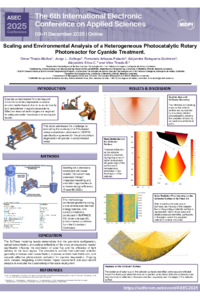
Scaling and Environmental Analysis of a Heterogeneous Photocatalytic Rotary Photoreactor for Cyanide Treatment

Jorge L. Gallego 1
'%3e%3cpath%20d='M12.6647%2010.9104C12.4176%2010.325%2012.0589%209.7933%2011.6088%209.34485C11.16%208.89511%2010.6283%208.53653%2010.0432%208.28891C10.038%208.28629%2010.0327%208.28498%2010.0275%208.28236C10.8437%207.69282%2011.3743%206.73252%2011.3743%205.64907C11.3743%203.85423%209.92005%202.40002%208.12522%202.40002C6.33038%202.40002%204.87618%203.85423%204.87618%205.64907C4.87618%206.73252%205.40677%207.69282%206.22296%208.28367C6.21772%208.28629%206.21248%208.2876%206.20724%208.29022C5.62031%208.53783%205.09365%208.89287%204.64167%209.34616C4.19192%209.79496%203.83334%2010.3266%203.58573%2010.9117C3.34247%2011.4846%203.21128%2012.0987%203.19925%2012.721C3.1989%2012.735%203.20135%2012.7489%203.20646%2012.7619C3.21157%2012.7749%203.21924%2012.7868%203.22901%2012.7968C3.23877%2012.8068%203.25045%2012.8148%203.26334%2012.8202C3.27623%2012.8256%203.29007%2012.8284%203.30406%2012.8284H4.09012C4.14776%2012.8284%204.19362%2012.7825%204.19493%2012.7262C4.22113%2011.7148%204.62726%2010.7676%205.34519%2010.0497C6.08802%209.30686%207.07452%208.89811%208.12522%208.89811C9.17592%208.89811%2010.1624%209.30686%2010.9052%2010.0497C11.6232%2010.7676%2012.0293%2011.7148%2012.0555%2012.7262C12.0568%2012.7839%2012.1027%2012.8284%2012.1603%2012.8284H12.9464C12.9604%2012.8284%2012.9742%2012.8256%2012.9871%2012.8202C13%2012.8148%2013.0117%2012.8068%2013.0214%2012.7968C13.0312%2012.7868%2013.0389%2012.7749%2013.044%2012.7619C13.0491%2012.7489%2013.0515%2012.735%2013.0512%2012.721C13.0381%2012.0947%2012.9084%2011.4856%2012.6647%2010.9104ZM8.12522%207.90243C7.52388%207.90243%206.95792%207.66793%206.53214%207.24215C6.10636%206.81636%205.87185%206.2504%205.87185%205.64907C5.87185%205.04773%206.10636%204.48177%206.53214%204.05599C6.95792%203.63021%207.52388%203.3957%208.12522%203.3957C8.72655%203.3957%209.29252%203.63021%209.7183%204.05599C10.1441%204.48177%2010.3786%205.04773%2010.3786%205.64907C10.3786%206.2504%2010.1441%206.81636%209.7183%207.24215C9.29252%207.66793%208.72655%207.90243%208.12522%207.90243Z'%20fill='%235D1EE1'/%3e%3c/g%3e%3c/svg%3e)
Omar Tirado-Munoz 2
Fernando Aricapa-Palacio 3
Alejandra Balaguera-Quintero. 4
Alejandro Silva-Cortés 5
Irina Patricia Tirado-Ballestas 6
1. Biodiversity, Biotechnology and Bioengineering Research Group GRINBIO, Department of Engineering, University of Medellin, 050026, Medellín, Colombia
2. Technological University of Bolivar, Carlos Vélez Pombo Industrial and Technological Park, Cartagena 130010, Colombia
3. GISAH Research Group, Environmental Engineering Program, Universidad Tecnológica de Bolívar Campus Tecnológico km 1 vía Turbaco Cartagena, Cartagena de Indias, Colombia
4. Department of Engineering, University of Medellin, 050026, Medellín, Colombia
5. Department of Management Sciences, Instituto Tecnológico Metropolitano, 050034; Medellín, Colombia
6. Grupo de Investigación GENOMA, Facultad de Medicina, Universidad del Sinu, Cartagena de Indias 130014, Colombia
Abstract
Cyanide contamination from mining and industrial activities represents a severe environmental hazard due to its acute toxicity and persistence in aquatic ecosystems. Effective removal technologies are urgently required to safeguard water resources and ecological health. This study addresses this challenge by evaluating the scale-up of a TiO₂-based rotary concentrator photoreactor (RCPR) specifically engineered for the photocatalytic degradation of cyanide in contaminated water. Building on a previously developed pilot-scale reactor, the system was assessed through integrated modeling and simulation approaches to enhance design efficiency. The methodology combined geometric sizing, a one-dimensional thermal energy balance, and optical simulations conducted in SolTRACE 3.0, under site-specific environmental conditions from the Colombian Caribbean. Results demonstrated that geometric configuration, optical concentration, and material selection exerted a strong influence on reactor performance. Cyanide removal efficiency was confirmed experimentally and validated by acute toxicity bioassays using Daphnia magna, which provided ecotoxicological evidence of treatment effectiveness. Degradation kinetics closely matched mathematical predictions, underscoring the robustness of the model. In addition, scenario analyses explored alternative reactor geometries and construction materials to support real-scale deployment. Environmental efficiency indicators and cost–benefit analyses further highlighted the feasibility of this technology for mining wastewater treatment. These findings deliver technical, ecological, and economic insights that advance photocatalytic processes toward sustainable and scalable water treatment solutions.
Keywords
Cyanide degradation
Photocatalysis
Water treatment
Mining wastewater
Poster
sciforum-151880.pdf
Engineered Nanostructured Surfaces for Dual Antibacterial and Cell-Guiding Applications in Biomedical Devices
New Developed Spectrophotometric Visible Analysis for Metformin Hydrochloride in Tablets of a Pharmaceutical