Event submissions
Published
This submission belongs to the session S1. Applied Biosciences and Bioengineering of the event The 6th International Electronic Conference on Applied Sciences
Published date
03 Dec, 2025
Academic Editor
'%3e%3cpath%20d='M12.6657%2010.9104C12.4185%2010.325%2012.0599%209.79327%2011.6097%209.34482C11.1609%208.89508%2010.6293%208.5365%2010.0442%208.28888C10.0389%208.28626%2010.0337%208.28495%2010.0285%208.28233C10.8446%207.69279%2011.3752%206.73249%2011.3752%205.64904C11.3752%203.8542%209.92103%202.39999%208.1262%202.39999C6.33136%202.39999%204.87715%203.8542%204.87715%205.64904C4.87715%206.73249%205.40774%207.69279%206.22393%208.28364C6.21869%208.28626%206.21345%208.28757%206.20821%208.29019C5.62129%208.5378%205.09463%208.89284%204.64265%209.34613C4.1929%209.79493%203.83432%2010.3266%203.58671%2010.9117C3.34345%2011.4845%203.21226%2012.0987%203.20023%2012.7209C3.19988%2012.7349%203.20233%2012.7488%203.20744%2012.7619C3.21255%2012.7749%203.22022%2012.7867%203.22998%2012.7968C3.23975%2012.8068%203.25142%2012.8147%203.26431%2012.8202C3.2772%2012.8256%203.29105%2012.8284%203.30504%2012.8284H4.09109C4.14874%2012.8284%204.19459%2012.7825%204.1959%2012.7262C4.2221%2011.7148%204.62823%2010.7676%205.34617%2010.0497C6.08899%209.30683%207.0755%208.89808%208.1262%208.89808C9.17689%208.89808%2010.1634%209.30683%2010.9062%2010.0497C11.6242%2010.7676%2012.0303%2011.7148%2012.0565%2012.7262C12.0578%2012.7838%2012.1037%2012.8284%2012.1613%2012.8284H12.9474C12.9613%2012.8284%2012.9752%2012.8256%2012.9881%2012.8202C13.001%2012.8147%2013.0126%2012.8068%2013.0224%2012.7968C13.0322%2012.7867%2013.0398%2012.7749%2013.0449%2012.7619C13.0501%2012.7488%2013.0525%2012.7349%2013.0522%2012.7209C13.0391%2012.0947%2012.9094%2011.4855%2012.6657%2010.9104ZM8.1262%207.9024C7.52486%207.9024%206.9589%207.6679%206.53312%207.24211C6.10733%206.81633%205.87283%206.25037%205.87283%205.64904C5.87283%205.0477%206.10733%204.48174%206.53312%204.05596C6.9589%203.63018%207.52486%203.39567%208.1262%203.39567C8.72753%203.39567%209.29349%203.63018%209.71927%204.05596C10.1451%204.48174%2010.3796%205.0477%2010.3796%205.64904C10.3796%206.25037%2010.1451%206.81633%209.71927%207.24211C9.29349%207.6679%208.72753%207.9024%208.1262%207.9024Z'%20fill='%235D1EE1'/%3e%3c/g%3e%3c/svg%3e) Roger Narayan
Roger NarayanCitation
DEEPAK CHAURASIYA, Puja Kumari, Lalit Pratap Singh, Therapeutic Opportunities in Disorder: Integrated Analysis of Cancer-Linked IDPs Reveals Druggable Motifs and Interaction Hubs, in Proceedings of The 6th International Electronic Conference on Applied Sciences, 9 December–11 December 2025, MDPI: Basel, Switzerland
Share
Email
Facebook
Twitter
LinkedIn
Therapeutic Opportunities in Disorder: Integrated Analysis of Cancer-Linked IDPs Reveals Druggable Motifs and Interaction Hubs
'%3e%3cpath%20d='M12.6647%2010.9104C12.4176%2010.325%2012.0589%209.7933%2011.6088%209.34485C11.16%208.89511%2010.6283%208.53653%2010.0432%208.28891C10.038%208.28629%2010.0327%208.28498%2010.0275%208.28236C10.8437%207.69282%2011.3743%206.73252%2011.3743%205.64907C11.3743%203.85423%209.92005%202.40002%208.12522%202.40002C6.33038%202.40002%204.87618%203.85423%204.87618%205.64907C4.87618%206.73252%205.40677%207.69282%206.22296%208.28367C6.21772%208.28629%206.21248%208.2876%206.20724%208.29022C5.62031%208.53783%205.09365%208.89287%204.64167%209.34616C4.19192%209.79496%203.83334%2010.3266%203.58573%2010.9117C3.34247%2011.4846%203.21128%2012.0987%203.19925%2012.721C3.1989%2012.735%203.20135%2012.7489%203.20646%2012.7619C3.21157%2012.7749%203.21924%2012.7868%203.22901%2012.7968C3.23877%2012.8068%203.25045%2012.8148%203.26334%2012.8202C3.27623%2012.8256%203.29007%2012.8284%203.30406%2012.8284H4.09012C4.14776%2012.8284%204.19362%2012.7825%204.19493%2012.7262C4.22113%2011.7148%204.62726%2010.7676%205.34519%2010.0497C6.08802%209.30686%207.07452%208.89811%208.12522%208.89811C9.17592%208.89811%2010.1624%209.30686%2010.9052%2010.0497C11.6232%2010.7676%2012.0293%2011.7148%2012.0555%2012.7262C12.0568%2012.7839%2012.1027%2012.8284%2012.1603%2012.8284H12.9464C12.9604%2012.8284%2012.9742%2012.8256%2012.9871%2012.8202C13%2012.8148%2013.0117%2012.8068%2013.0214%2012.7968C13.0312%2012.7868%2013.0389%2012.7749%2013.044%2012.7619C13.0491%2012.7489%2013.0515%2012.735%2013.0512%2012.721C13.0381%2012.0947%2012.9084%2011.4856%2012.6647%2010.9104ZM8.12522%207.90243C7.52388%207.90243%206.95792%207.66793%206.53214%207.24215C6.10636%206.81636%205.87185%206.2504%205.87185%205.64907C5.87185%205.04773%206.10636%204.48177%206.53214%204.05599C6.95792%203.63021%207.52388%203.3957%208.12522%203.3957C8.72655%203.3957%209.29252%203.63021%209.7183%204.05599C10.1441%204.48177%2010.3786%205.04773%2010.3786%205.64907C10.3786%206.2504%2010.1441%206.81636%209.7183%207.24215C9.29252%207.66793%208.72655%207.90243%208.12522%207.90243Z'%20fill='%235D1EE1'/%3e%3c/g%3e%3c/svg%3e)
DEEPAK CHAURASIYA 1
Puja Kumari 2
Lalit Pratap Singh 3
1. Department of Applied Sciences, Indian Institute of Information Technology Allahabad, Prayagraj, 211015 , India
2. Department of Infectious Diseases Biology, ICMR-National Institute for Research In Reproductive and Child Health , Parel, Mumbai, Maharashtra, 400012, India
3. Department of Animal Biotechnology, NATIONAL Dairy Research Institute, Karnal, Haryana, 132001, India
Abstract
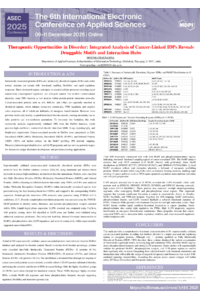
Intrinsically disordered proteins (IDPs), defined by their lack of stable tertiary structures, play pivotal roles in cancer development by modulating signaling cascades, transcriptional activity, and essential cellular processes. In the present analysis, experimentally validated cancer-associated IDPs from the DisProt database were systematically categorized into Fully Intrinsically Disordered Proteins (FIDPs, ≥90% disorder), Moderately Intrinsically Disordered Proteins (MIDPs, 30–90% disorder), and Ordered Proteins (ODPs, <30% disorder). A multi-layered computational framework, incorporating machine learning-based tools including PONDR, PONDR-DEPP, Depictor2, FuzDrop, and STRING, enabled functional profiling of these classes. FIDPs demonstrated a higher density of molecular recognition features (MoRFs), increased phosphorylation site prediction, and elevated liquid–liquid phase separation (LLPS) propensity compared to MIDPs and ODPs. Protein–protein interaction network analysis via STRING revealed that FIDPs are frequently positioned as central hubs in networks governing apoptosis, DNA repair, and cell cycle regulation. Furthermore, detailed mapping identified functionally relevant disordered regions enriched with predicted phosphorylation hotspots, MoRF segments, and LLPS-favorable domains. These intrinsically disordered segments reflect a high potential for dynamic regulation and molecular adaptability. The annotated IDR sites possess notable translational relevance, offering promising avenues for the design of natural disordered-based biosensors, the development of disorder-targeted therapeutics, and the exploitation of post-translational modification (PTM) patterns in cancer diagnostics and treatment strategies.
Keywords
Intrinsically Disordered Proteins (IDPs)
Cancer Biology
Precision Oncology
Druggable Targets
Poster
deepak _applied_sciences conference2025.pdf
Evaluation of the antimicrobial and anti-inflammatory activity of Lippia javanica against pathogenic microorganisms
Modification of acrylamide-N,N'-methylenebisacrylamide hydrogel with quaternary ammonium monomethacrylate.