Event submissions
Published
This submission belongs to the session S1. Applied Biosciences and Bioengineering of the event The 6th International Electronic Conference on Applied Sciences
Published date
03 Dec, 2025
Academic Editor
'%3e%3cpath%20d='M12.6657%2010.9104C12.4185%2010.325%2012.0599%209.79327%2011.6097%209.34482C11.1609%208.89508%2010.6293%208.5365%2010.0442%208.28888C10.0389%208.28626%2010.0337%208.28495%2010.0285%208.28233C10.8446%207.69279%2011.3752%206.73249%2011.3752%205.64904C11.3752%203.8542%209.92103%202.39999%208.1262%202.39999C6.33136%202.39999%204.87715%203.8542%204.87715%205.64904C4.87715%206.73249%205.40774%207.69279%206.22393%208.28364C6.21869%208.28626%206.21345%208.28757%206.20821%208.29019C5.62129%208.5378%205.09463%208.89284%204.64265%209.34613C4.1929%209.79493%203.83432%2010.3266%203.58671%2010.9117C3.34345%2011.4845%203.21226%2012.0987%203.20023%2012.7209C3.19988%2012.7349%203.20233%2012.7488%203.20744%2012.7619C3.21255%2012.7749%203.22022%2012.7867%203.22998%2012.7968C3.23975%2012.8068%203.25142%2012.8147%203.26431%2012.8202C3.2772%2012.8256%203.29105%2012.8284%203.30504%2012.8284H4.09109C4.14874%2012.8284%204.19459%2012.7825%204.1959%2012.7262C4.2221%2011.7148%204.62823%2010.7676%205.34617%2010.0497C6.08899%209.30683%207.0755%208.89808%208.1262%208.89808C9.17689%208.89808%2010.1634%209.30683%2010.9062%2010.0497C11.6242%2010.7676%2012.0303%2011.7148%2012.0565%2012.7262C12.0578%2012.7838%2012.1037%2012.8284%2012.1613%2012.8284H12.9474C12.9613%2012.8284%2012.9752%2012.8256%2012.9881%2012.8202C13.001%2012.8147%2013.0126%2012.8068%2013.0224%2012.7968C13.0322%2012.7867%2013.0398%2012.7749%2013.0449%2012.7619C13.0501%2012.7488%2013.0525%2012.7349%2013.0522%2012.7209C13.0391%2012.0947%2012.9094%2011.4855%2012.6657%2010.9104ZM8.1262%207.9024C7.52486%207.9024%206.9589%207.6679%206.53312%207.24211C6.10733%206.81633%205.87283%206.25037%205.87283%205.64904C5.87283%205.0477%206.10733%204.48174%206.53312%204.05596C6.9589%203.63018%207.52486%203.39567%208.1262%203.39567C8.72753%203.39567%209.29349%203.63018%209.71927%204.05596C10.1451%204.48174%2010.3796%205.0477%2010.3796%205.64904C10.3796%206.25037%2010.1451%206.81633%209.71927%207.24211C9.29349%207.6679%208.72753%207.9024%208.1262%207.9024Z'%20fill='%235D1EE1'/%3e%3c/g%3e%3c/svg%3e) Roger Narayan
Roger NarayanCitation
Young-Cheol Chang, Evaluation of the Applicability of Alkaline Pretreatment for the Development of a Simple Quantification Method of Biodegradable Plastics, in Proceedings of The 6th International Electronic Conference on Applied Sciences, 9 December–11 December 2025, MDPI: Basel, Switzerland
Share
Email
Facebook
Twitter
LinkedIn
Evaluation of the Applicability of Alkaline Pretreatment for the Development of a Simple Quantification Method of Biodegradable Plastics

Young-Cheol Chang 1
1. Course of Chemical and Biological Engineering, Division of Sustainable and Environmental Engineering, Muroran Institute of Technology, Hokkaido 050-8585, Japan
Abstract
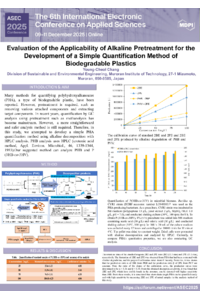
Polyhydroxyalkanoates (PHAs) are biodegradable polyesters synthesized by microorganisms and have attracted significant attention as sustainable alternatives to petroleum-based plastics. Accurate quantification of intracellularly accumulated PHAs often requires complex pretreatment procedures, including polymer extraction and purification. In this study, we propose a simplified and reliable method for the quantification of PHAs based on alkaline decomposition followed by high-performance liquid chromatography (HPLC). We focused on the copolymer poly(3-hydroxybutyrate-co-3-hydroxyvalerate) [P(3HB-co-3HV)], which consists of two monomer units: 3-hydroxybutyrate (3HB) and 3-hydroxyvalerate (3HV). Under alkaline conditions, these monomers are decomposed into 2-butenoic acid (2BE) and 2-pentenoic acid (2PE), respectively. The molar conversion factors from PHB to 2BE (α) and PHV to 2PE (β) were experimentally determined through calibration curves constructed using both commercially available standards and alkaline-treated PHA samples. These constants were then used to calculate the concentrations of PHB and PHV. The conversion factors were calculated to be α = 3.26 and β = 3.30. Standard P(3HB-co-3HV) samples were analyzed using this method, and the measured values closely matched the theoretical concentrations, confirming the method's accuracy. This approach simplifies PHA quantification without compromising reliability and eliminates the need for solvent-based extraction. Future work will explore the applicability of this method for analyzing intracellular PHAs in bacterial cells, potentially streamlining PHA analysis in various environmental and industrial settings.
Keywords
Polyhydroxyalkanoates (PHAs)
poly(3-hydroxybutyrate-co-3-hydroxyvalerate)
HPLC
Alkaline Pretreatment
Poster
Poster CHANG The 6th International Electronic Conference on Applied Sciences.pdf
Can Biometric Signals Capture Mental Tension During Golf? A Pilot Study Using ECG and Wearable Pulse Sensors
Plant-Derived Antimicrobial Agents: Bioactivity Screening of Nelsonia canescens Against Clinically Relevant Pathogens