Event submissions
Published
This submission belongs to the session S2. Nanosciences, Chemistry and Materials Science of the event The 6th International Electronic Conference on Applied Sciences
Published date
03 Dec, 2025
Academic Editor
'%3e%3cpath%20d='M12.6657%2010.9104C12.4185%2010.325%2012.0599%209.79327%2011.6097%209.34482C11.1609%208.89508%2010.6293%208.5365%2010.0442%208.28888C10.0389%208.28626%2010.0337%208.28495%2010.0285%208.28233C10.8446%207.69279%2011.3752%206.73249%2011.3752%205.64904C11.3752%203.8542%209.92103%202.39999%208.1262%202.39999C6.33136%202.39999%204.87715%203.8542%204.87715%205.64904C4.87715%206.73249%205.40774%207.69279%206.22393%208.28364C6.21869%208.28626%206.21345%208.28757%206.20821%208.29019C5.62129%208.5378%205.09463%208.89284%204.64265%209.34613C4.1929%209.79493%203.83432%2010.3266%203.58671%2010.9117C3.34345%2011.4845%203.21226%2012.0987%203.20023%2012.7209C3.19988%2012.7349%203.20233%2012.7488%203.20744%2012.7619C3.21255%2012.7749%203.22022%2012.7867%203.22998%2012.7968C3.23975%2012.8068%203.25142%2012.8147%203.26431%2012.8202C3.2772%2012.8256%203.29105%2012.8284%203.30504%2012.8284H4.09109C4.14874%2012.8284%204.19459%2012.7825%204.1959%2012.7262C4.2221%2011.7148%204.62823%2010.7676%205.34617%2010.0497C6.08899%209.30683%207.0755%208.89808%208.1262%208.89808C9.17689%208.89808%2010.1634%209.30683%2010.9062%2010.0497C11.6242%2010.7676%2012.0303%2011.7148%2012.0565%2012.7262C12.0578%2012.7838%2012.1037%2012.8284%2012.1613%2012.8284H12.9474C12.9613%2012.8284%2012.9752%2012.8256%2012.9881%2012.8202C13.001%2012.8147%2013.0126%2012.8068%2013.0224%2012.7968C13.0322%2012.7867%2013.0398%2012.7749%2013.0449%2012.7619C13.0501%2012.7488%2013.0525%2012.7349%2013.0522%2012.7209C13.0391%2012.0947%2012.9094%2011.4855%2012.6657%2010.9104ZM8.1262%207.9024C7.52486%207.9024%206.9589%207.6679%206.53312%207.24211C6.10733%206.81633%205.87283%206.25037%205.87283%205.64904C5.87283%205.0477%206.10733%204.48174%206.53312%204.05596C6.9589%203.63018%207.52486%203.39567%208.1262%203.39567C8.72753%203.39567%209.29349%203.63018%209.71927%204.05596C10.1451%204.48174%2010.3796%205.0477%2010.3796%205.64904C10.3796%206.25037%2010.1451%206.81633%209.71927%207.24211C9.29349%207.6679%208.72753%207.9024%208.1262%207.9024Z'%20fill='%235D1EE1'/%3e%3c/g%3e%3c/svg%3e) Mimimorena Seggio
Mimimorena SeggioCitation
Levko Arbanas, Irina Kaurova, Galina Kuz’micheva, Victor Khrustalev, Vladimir Lazarenko, Methodological features of determining the composition of α-NiSO₄·6H₂O single crystals activated by low concentration Co²⁺ ions: laboratory diffractometer and synchrotron, in Proceedings of The 6th International Electronic Conference on Applied Sciences, 9 December–11 December 2025, MDPI: Basel, Switzerland
Share
Email
Facebook
Twitter
LinkedIn
Methodological features of determining the composition of α-NiSO4·6H2O single crystals activated by low concentration Co2+ ions: laboratory diffractometer and synchrotron

Levko Arbanas 1,2

Irina Kaurova 1

Galina Kuz’micheva 1
'%3e%3cpath%20d='M12.6647%2010.9104C12.4176%2010.325%2012.0589%209.7933%2011.6088%209.34485C11.16%208.89511%2010.6283%208.53653%2010.0432%208.28891C10.038%208.28629%2010.0327%208.28498%2010.0275%208.28236C10.8437%207.69282%2011.3743%206.73252%2011.3743%205.64907C11.3743%203.85423%209.92005%202.40002%208.12522%202.40002C6.33038%202.40002%204.87618%203.85423%204.87618%205.64907C4.87618%206.73252%205.40677%207.69282%206.22296%208.28367C6.21772%208.28629%206.21248%208.2876%206.20724%208.29022C5.62031%208.53783%205.09365%208.89287%204.64167%209.34616C4.19192%209.79496%203.83334%2010.3266%203.58573%2010.9117C3.34247%2011.4846%203.21128%2012.0987%203.19925%2012.721C3.1989%2012.735%203.20135%2012.7489%203.20646%2012.7619C3.21157%2012.7749%203.21924%2012.7868%203.22901%2012.7968C3.23877%2012.8068%203.25045%2012.8148%203.26334%2012.8202C3.27623%2012.8256%203.29007%2012.8284%203.30406%2012.8284H4.09012C4.14776%2012.8284%204.19362%2012.7825%204.19493%2012.7262C4.22113%2011.7148%204.62726%2010.7676%205.34519%2010.0497C6.08802%209.30686%207.07452%208.89811%208.12522%208.89811C9.17592%208.89811%2010.1624%209.30686%2010.9052%2010.0497C11.6232%2010.7676%2012.0293%2011.7148%2012.0555%2012.7262C12.0568%2012.7839%2012.1027%2012.8284%2012.1603%2012.8284H12.9464C12.9604%2012.8284%2012.9742%2012.8256%2012.9871%2012.8202C13%2012.8148%2013.0117%2012.8068%2013.0214%2012.7968C13.0312%2012.7868%2013.0389%2012.7749%2013.044%2012.7619C13.0491%2012.7489%2013.0515%2012.735%2013.0512%2012.721C13.0381%2012.0947%2012.9084%2011.4856%2012.6647%2010.9104ZM8.12522%207.90243C7.52388%207.90243%206.95792%207.66793%206.53214%207.24215C6.10636%206.81636%205.87185%206.2504%205.87185%205.64907C5.87185%205.04773%206.10636%204.48177%206.53214%204.05599C6.95792%203.63021%207.52388%203.3957%208.12522%203.3957C8.72655%203.3957%209.29252%203.63021%209.7183%204.05599C10.1441%204.48177%2010.3786%205.04773%2010.3786%205.64907C10.3786%206.2504%2010.1441%206.81636%209.7183%207.24215C9.29252%207.66793%208.72655%207.90243%208.12522%207.90243Z'%20fill='%235D1EE1'/%3e%3c/g%3e%3c/svg%3e)
Victor Khrustalev 2
Vladimir Lazarenko 1,3
1. Scientific educational center “Multi-scale design of materials”, MIREA - Russian Technological University, Moscow, 119454, Russian Federation
2. Department of Inorganic Chemistry, Peoples' Friendship University of Russia, Moscow, 117198, Russian Federation
3. Department of Synchrotron and Neutron Radiation, National Research Center «Kurchatov Institute», Moscow, 123182, Russian Federation
Abstract
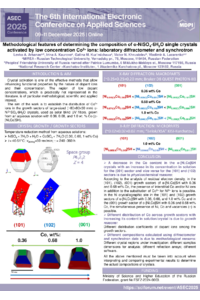
Crystal activation is one of the effective methods that allows influencing functional properties by the nature of dopant ions and their concentration. The region of low dopant concentrations, which is not well represented in the literature, is of particular methodological, scientific, and applied interest.
This work aims to establish the distribution of Со2+ ions in the growth sectors of large-sized (~80×80×50 mm) α-Ni2+SO4·6H2O crystals, used as solar-blind UV filters, grown from an aqueous solution with 0.36 (α-NSH:0.36Co), 0.68 (α-NSH:0.68Co), and 1.0 wt. % Со (α-NSH:1.0Co).
The unit cell volume (V, Å3) of macroparts (~0.25×0.25×0.20 mm; Bruker D8 QUEST PHOTON-III) of α-NSH:Со (sp. gr. P41212, Z = 4) decreases in the series V(102)>V(001)>V(101) (a-NSH:0.36Со), V(102)>V(101)>V(001) (a-NSH:0.68Со), V(101)>V(102)>V(001) (a-NSH:1.0Со), as well as V(001)>V(102)≈V(101) (a-NSH:1.0Со) for microparts (~0.02×0.02×0.02 mm; “Belok/XSA” beamline, Kurchatov Synchrotron Radiation Source). This change in V, Å3 is caused by a different distribution of Co2+ across growth sectors, and for a-NSH:1.0Co, also by different conditions of X-ray experiments. The Co2+ content decreases in the series р(001)>р(101)>р(102) (a-NSH:0.36Со; a-NSH:0.68Со), р(101)>р(102)>р(001) (a-NSH:1.0Со) (р, site occupancy). Comparison of these series shows the substitution of Co2+ for Ni2+ ions, a symbate correlation between V, Å3 and p, p and the D–H and D···A distances, but an antibate correlation between p and the H···A distance for a-NSH:1.0Co.
Funding: Ministry of Science and Higher Education of the Russian Federation, grant № FSFZ-2024-0003.
Keywords
optical materials
crystal growth
structure
composition
X-ray diffraction
diffractometer
synchrotron
Poster
NSH Co MDPI.pdf
Characterization of the Photophysical properties of carbazole based hole transporting material thin films deposited by physical vapor deposition (PVD)
Threshold moderation effects: how body length modifies the effect of temperature on parasite abundance