Event submissions
Published
This submission belongs to the session S5. Mechanical and Aerospace Engineering of the event The 6th International Electronic Conference on Applied Sciences
Published date
03 Dec, 2025
Academic Editor
'%3e%3cpath%20d='M12.6657%2010.9104C12.4185%2010.325%2012.0599%209.79327%2011.6097%209.34482C11.1609%208.89508%2010.6293%208.5365%2010.0442%208.28888C10.0389%208.28626%2010.0337%208.28495%2010.0285%208.28233C10.8446%207.69279%2011.3752%206.73249%2011.3752%205.64904C11.3752%203.8542%209.92103%202.39999%208.1262%202.39999C6.33136%202.39999%204.87715%203.8542%204.87715%205.64904C4.87715%206.73249%205.40774%207.69279%206.22393%208.28364C6.21869%208.28626%206.21345%208.28757%206.20821%208.29019C5.62129%208.5378%205.09463%208.89284%204.64265%209.34613C4.1929%209.79493%203.83432%2010.3266%203.58671%2010.9117C3.34345%2011.4845%203.21226%2012.0987%203.20023%2012.7209C3.19988%2012.7349%203.20233%2012.7488%203.20744%2012.7619C3.21255%2012.7749%203.22022%2012.7867%203.22998%2012.7968C3.23975%2012.8068%203.25142%2012.8147%203.26431%2012.8202C3.2772%2012.8256%203.29105%2012.8284%203.30504%2012.8284H4.09109C4.14874%2012.8284%204.19459%2012.7825%204.1959%2012.7262C4.2221%2011.7148%204.62823%2010.7676%205.34617%2010.0497C6.08899%209.30683%207.0755%208.89808%208.1262%208.89808C9.17689%208.89808%2010.1634%209.30683%2010.9062%2010.0497C11.6242%2010.7676%2012.0303%2011.7148%2012.0565%2012.7262C12.0578%2012.7838%2012.1037%2012.8284%2012.1613%2012.8284H12.9474C12.9613%2012.8284%2012.9752%2012.8256%2012.9881%2012.8202C13.001%2012.8147%2013.0126%2012.8068%2013.0224%2012.7968C13.0322%2012.7867%2013.0398%2012.7749%2013.0449%2012.7619C13.0501%2012.7488%2013.0525%2012.7349%2013.0522%2012.7209C13.0391%2012.0947%2012.9094%2011.4855%2012.6657%2010.9104ZM8.1262%207.9024C7.52486%207.9024%206.9589%207.6679%206.53312%207.24211C6.10733%206.81633%205.87283%206.25037%205.87283%205.64904C5.87283%205.0477%206.10733%204.48174%206.53312%204.05596C6.9589%203.63018%207.52486%203.39567%208.1262%203.39567C8.72753%203.39567%209.29349%203.63018%209.71927%204.05596C10.1451%204.48174%2010.3796%205.0477%2010.3796%205.64904C10.3796%206.25037%2010.1451%206.81633%209.71927%207.24211C9.29349%207.6679%208.72753%207.9024%208.1262%207.9024Z'%20fill='%235D1EE1'/%3e%3c/g%3e%3c/svg%3e) Ana Martins Amaro
Ana Martins AmaroCitation
Muhammad Al Aiman Mohd Firdhaus, Saravanan Karuppanan, Mohsin Iqbal, Parametric Study of Stress Concentration Factors on Reinforced Tubular X-Joints under Out-of-Plane Bending, in Proceedings of The 6th International Electronic Conference on Applied Sciences, 9 December–11 December 2025, MDPI: Basel, Switzerland
Share
Email
Facebook
Twitter
LinkedIn
Parametric Study of Stress Concentration Factors on Reinforced Tubular X-Joints under Out-of-Plane Bending
'%3e%3cpath%20d='M12.6647%2010.9104C12.4176%2010.325%2012.0589%209.7933%2011.6088%209.34485C11.16%208.89511%2010.6283%208.53653%2010.0432%208.28891C10.038%208.28629%2010.0327%208.28498%2010.0275%208.28236C10.8437%207.69282%2011.3743%206.73252%2011.3743%205.64907C11.3743%203.85423%209.92005%202.40002%208.12522%202.40002C6.33038%202.40002%204.87618%203.85423%204.87618%205.64907C4.87618%206.73252%205.40677%207.69282%206.22296%208.28367C6.21772%208.28629%206.21248%208.2876%206.20724%208.29022C5.62031%208.53783%205.09365%208.89287%204.64167%209.34616C4.19192%209.79496%203.83334%2010.3266%203.58573%2010.9117C3.34247%2011.4846%203.21128%2012.0987%203.19925%2012.721C3.1989%2012.735%203.20135%2012.7489%203.20646%2012.7619C3.21157%2012.7749%203.21924%2012.7868%203.22901%2012.7968C3.23877%2012.8068%203.25045%2012.8148%203.26334%2012.8202C3.27623%2012.8256%203.29007%2012.8284%203.30406%2012.8284H4.09012C4.14776%2012.8284%204.19362%2012.7825%204.19493%2012.7262C4.22113%2011.7148%204.62726%2010.7676%205.34519%2010.0497C6.08802%209.30686%207.07452%208.89811%208.12522%208.89811C9.17592%208.89811%2010.1624%209.30686%2010.9052%2010.0497C11.6232%2010.7676%2012.0293%2011.7148%2012.0555%2012.7262C12.0568%2012.7839%2012.1027%2012.8284%2012.1603%2012.8284H12.9464C12.9604%2012.8284%2012.9742%2012.8256%2012.9871%2012.8202C13%2012.8148%2013.0117%2012.8068%2013.0214%2012.7968C13.0312%2012.7868%2013.0389%2012.7749%2013.044%2012.7619C13.0491%2012.7489%2013.0515%2012.735%2013.0512%2012.721C13.0381%2012.0947%2012.9084%2011.4856%2012.6647%2010.9104ZM8.12522%207.90243C7.52388%207.90243%206.95792%207.66793%206.53214%207.24215C6.10636%206.81636%205.87185%206.2504%205.87185%205.64907C5.87185%205.04773%206.10636%204.48177%206.53214%204.05599C6.95792%203.63021%207.52388%203.3957%208.12522%203.3957C8.72655%203.3957%209.29252%203.63021%209.7183%204.05599C10.1441%204.48177%2010.3786%205.04773%2010.3786%205.64907C10.3786%206.2504%2010.1441%206.81636%209.7183%207.24215C9.29252%207.66793%208.72655%207.90243%208.12522%207.90243Z'%20fill='%235D1EE1'/%3e%3c/g%3e%3c/svg%3e)
Muhammad Al Aiman Mohd Firdhaus 1
Saravanan Karuppanan 1

Mohsin Iqbal 1
1. Department of Mechanical Engineering, Universiti Teknologi PETRONAS, 32610 Seri Iskandar, Malaysia
Abstract
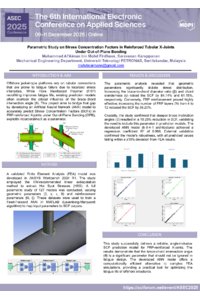
Offshore jacket-type platforms utilize tubular X-joints, among other configurations, for their high strength-to-weight ratio and bending resistance. However, weld geometry at the brace–chord intersection induces localized stress intensities, quantified as Stress Concentration Factors (SCFs), which strongly affect fatigue performance. Accurate SCF prediction under out-of-plane bending (OPB) is especially critical in joints retrofitted with fibre-reinforced polymer (FRP) composites. While existing models address several geometric and material parameters, the influence of brace inclination (θ) has often been overlooked.
This study develops an artificial neural network (ANN) model that incorporates θ alongside five additional parameters, which are the brace-to-chord diameter ratio (β), chord diameter-to-thickness ratio (γ), brace-to-chord thickness ratio (τ), number of FRP layers (N), and FRP-to-steel stiffness ratio (ξ), to predict SCFs in FRP-reinforced tubular X-joints. Finite element analysis (FEA) of 127 parametric joint configurations was performed in ANSYS Workbench 2024 R1, with SCFs extracted following International Institute of Welding (IIW) guidelines. Results revealed that increases in β, γ, and τ raised SCFs by up to 84.14%, 61.15%, and 58.44%, respectively, whereas steeper brace angles, additional FRP layers, and higher ξ reduced SCFs by up to 38.29%.
The ANN, designed with a 6–8–4–1 architecture and trained in MATLAB, achieved an R² of 0.996. External validation confirmed predictive accuracy within ±10% of FEA values. This study delivers a reliable, angle-inclusive SCF prediction model, supporting more efficient fatigue assessment and retrofitting strategies for offshore tubular joints.
Keywords
stress concentration factor
tubular joints
artificial neural network
fibre-reinforced polymer
finite element analysis
out-of-plane bending
Poster
Sciforum Poster.pdf
Enhancing the adsorption capacity of modified biopolymer thorugh anionic hydration effects for dye removal from water
Modeling of Total Reducible Sugars Using Artificial Neural Networks in Agro-waste Pretreatment Using Nepenthes mirabi-lis Pitcher Fluids as Enzymatic Agents