Event submissions
Published
This submission belongs to the session S5. Mechanical and Aerospace Engineering of the event The 6th International Electronic Conference on Applied Sciences
Published date
03 Dec, 2025
Academic Editor
'%3e%3cpath%20d='M12.6657%2010.9104C12.4185%2010.325%2012.0599%209.79327%2011.6097%209.34482C11.1609%208.89508%2010.6293%208.5365%2010.0442%208.28888C10.0389%208.28626%2010.0337%208.28495%2010.0285%208.28233C10.8446%207.69279%2011.3752%206.73249%2011.3752%205.64904C11.3752%203.8542%209.92103%202.39999%208.1262%202.39999C6.33136%202.39999%204.87715%203.8542%204.87715%205.64904C4.87715%206.73249%205.40774%207.69279%206.22393%208.28364C6.21869%208.28626%206.21345%208.28757%206.20821%208.29019C5.62129%208.5378%205.09463%208.89284%204.64265%209.34613C4.1929%209.79493%203.83432%2010.3266%203.58671%2010.9117C3.34345%2011.4845%203.21226%2012.0987%203.20023%2012.7209C3.19988%2012.7349%203.20233%2012.7488%203.20744%2012.7619C3.21255%2012.7749%203.22022%2012.7867%203.22998%2012.7968C3.23975%2012.8068%203.25142%2012.8147%203.26431%2012.8202C3.2772%2012.8256%203.29105%2012.8284%203.30504%2012.8284H4.09109C4.14874%2012.8284%204.19459%2012.7825%204.1959%2012.7262C4.2221%2011.7148%204.62823%2010.7676%205.34617%2010.0497C6.08899%209.30683%207.0755%208.89808%208.1262%208.89808C9.17689%208.89808%2010.1634%209.30683%2010.9062%2010.0497C11.6242%2010.7676%2012.0303%2011.7148%2012.0565%2012.7262C12.0578%2012.7838%2012.1037%2012.8284%2012.1613%2012.8284H12.9474C12.9613%2012.8284%2012.9752%2012.8256%2012.9881%2012.8202C13.001%2012.8147%2013.0126%2012.8068%2013.0224%2012.7968C13.0322%2012.7867%2013.0398%2012.7749%2013.0449%2012.7619C13.0501%2012.7488%2013.0525%2012.7349%2013.0522%2012.7209C13.0391%2012.0947%2012.9094%2011.4855%2012.6657%2010.9104ZM8.1262%207.9024C7.52486%207.9024%206.9589%207.6679%206.53312%207.24211C6.10733%206.81633%205.87283%206.25037%205.87283%205.64904C5.87283%205.0477%206.10733%204.48174%206.53312%204.05596C6.9589%203.63018%207.52486%203.39567%208.1262%203.39567C8.72753%203.39567%209.29349%203.63018%209.71927%204.05596C10.1451%204.48174%2010.3796%205.0477%2010.3796%205.64904C10.3796%206.25037%2010.1451%206.81633%209.71927%207.24211C9.29349%207.6679%208.72753%207.9024%208.1262%207.9024Z'%20fill='%235D1EE1'/%3e%3c/g%3e%3c/svg%3e) André Furtado
André FurtadoCitation
Amir Shaheed Alkhafaji, Daniel Camas, Effect of Stirring Efficiency on Fatigue Behavior of Graphene Nanoplatelets-Reinforced Friction Stir Spot Welded Aluminum Sheets, in Proceedings of The 6th International Electronic Conference on Applied Sciences, 9 December–11 December 2025, MDPI: Basel, Switzerland
Share
Email
Facebook
Twitter
LinkedIn
Effect of Stirring Efficiency on Fatigue Behavior of Graphene Nanoplatelets-Reinforced Friction Stir Spot Welded Aluminum Sheets

Amir Shaheed Alkhafaji 1
'%3e%3cpath%20d='M12.6647%2010.9104C12.4176%2010.325%2012.0589%209.7933%2011.6088%209.34485C11.16%208.89511%2010.6283%208.53653%2010.0432%208.28891C10.038%208.28629%2010.0327%208.28498%2010.0275%208.28236C10.8437%207.69282%2011.3743%206.73252%2011.3743%205.64907C11.3743%203.85423%209.92005%202.40002%208.12522%202.40002C6.33038%202.40002%204.87618%203.85423%204.87618%205.64907C4.87618%206.73252%205.40677%207.69282%206.22296%208.28367C6.21772%208.28629%206.21248%208.2876%206.20724%208.29022C5.62031%208.53783%205.09365%208.89287%204.64167%209.34616C4.19192%209.79496%203.83334%2010.3266%203.58573%2010.9117C3.34247%2011.4846%203.21128%2012.0987%203.19925%2012.721C3.1989%2012.735%203.20135%2012.7489%203.20646%2012.7619C3.21157%2012.7749%203.21924%2012.7868%203.22901%2012.7968C3.23877%2012.8068%203.25045%2012.8148%203.26334%2012.8202C3.27623%2012.8256%203.29007%2012.8284%203.30406%2012.8284H4.09012C4.14776%2012.8284%204.19362%2012.7825%204.19493%2012.7262C4.22113%2011.7148%204.62726%2010.7676%205.34519%2010.0497C6.08802%209.30686%207.07452%208.89811%208.12522%208.89811C9.17592%208.89811%2010.1624%209.30686%2010.9052%2010.0497C11.6232%2010.7676%2012.0293%2011.7148%2012.0555%2012.7262C12.0568%2012.7839%2012.1027%2012.8284%2012.1603%2012.8284H12.9464C12.9604%2012.8284%2012.9742%2012.8256%2012.9871%2012.8202C13%2012.8148%2013.0117%2012.8068%2013.0214%2012.7968C13.0312%2012.7868%2013.0389%2012.7749%2013.044%2012.7619C13.0491%2012.7489%2013.0515%2012.735%2013.0512%2012.721C13.0381%2012.0947%2012.9084%2011.4856%2012.6647%2010.9104ZM8.12522%207.90243C7.52388%207.90243%206.95792%207.66793%206.53214%207.24215C6.10636%206.81636%205.87185%206.2504%205.87185%205.64907C5.87185%205.04773%206.10636%204.48177%206.53214%204.05599C6.95792%203.63021%207.52388%203.3957%208.12522%203.3957C8.72655%203.3957%209.29252%203.63021%209.7183%204.05599C10.1441%204.48177%2010.3786%205.04773%2010.3786%205.64907C10.3786%206.2504%2010.1441%206.81636%209.7183%207.24215C9.29252%207.66793%208.72655%207.90243%208.12522%207.90243Z'%20fill='%235D1EE1'/%3e%3c/g%3e%3c/svg%3e)
Daniel Camas 1
1. Department of Civil and Materials Engineering, University of Malaga, E-29071 Malaga, Spain
Abstract
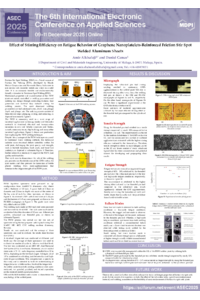
Friction stir spot welding (FSSW) was developed by Mazda Motors and Kawasaki Heavy Industries to join similar and dissimilar materials in a solid state as an economic and environmentally friendly alternative to resistance spot welding. The FSSW technique, however, includes some structural defects imbedded within the weld joint, such as keyhole formation, hook crack, and bond line oxidation, challenging the joint strength. The unique properties of nanomaterials in the reinforcement of metal matrices motivated researchers to enhance the FSSW joints' strength. At different ratios of nano-reinforcement, nanoparticles may agglomerate due to inefficient stirring during welding, forming stress concentration sites and brittle phases affecting tensile and fatigue strength under static and cyclic loading conditions, respectively.
This work investigated how the welding tool pin affects stirring efficiency by controlling the distribution of a nano-reinforcing material within the joint stir zone (SZ) and thus the tensile and fatigue strength of the joints. Sheets of AA6061-T6 of 1.8 mm thickness were used as a base material. In addition, graphene nanoplatelets (GNPs) with a lateral size of 1–10 µm and a thickness of 3–9 nm were used as nano-reinforcements. OM and SEM micrographs of as-welded specimens visualized the GNPs' incorporation into the SZs of the FSSW joints. Moreover, lower formations of scattered GNPs were achieved by the threaded pin tool compared to continuous agglomerations observed when the cylindrical pin tool was used.
Tensile and fatigue test results revealed significant improvements of 30% and 18%−38%, respectively, exhibited by the threaded pin compared to the cylindrical one.
Keywords
FSSW
GNP-reinforcement
tool pin
fatigue behavior
stirring effect
lap joint
Poster
Conference Poster_Amir Alkhafaji.pdf
A Comprehensive Review and Experimental Study on Biodiesel Upgrade through Selective Partial Catalytic Hydrogenation
INVESTIGATION ON AMMONIUM HYDROXIDE BASED PROCESS FOR THE PRODUCTION OF HIGH-GRADE TITANIUM DIOXIDE FROM ILMENITE MUD