Event submissions
Published
This submission belongs to the session S2. Nanosciences, Chemistry and Materials Science of the event The 6th International Electronic Conference on Applied Sciences
Published date
03 Dec, 2025
Academic Editor
'%3e%3cpath%20d='M12.6657%2010.9104C12.4185%2010.325%2012.0599%209.79327%2011.6097%209.34482C11.1609%208.89508%2010.6293%208.5365%2010.0442%208.28888C10.0389%208.28626%2010.0337%208.28495%2010.0285%208.28233C10.8446%207.69279%2011.3752%206.73249%2011.3752%205.64904C11.3752%203.8542%209.92103%202.39999%208.1262%202.39999C6.33136%202.39999%204.87715%203.8542%204.87715%205.64904C4.87715%206.73249%205.40774%207.69279%206.22393%208.28364C6.21869%208.28626%206.21345%208.28757%206.20821%208.29019C5.62129%208.5378%205.09463%208.89284%204.64265%209.34613C4.1929%209.79493%203.83432%2010.3266%203.58671%2010.9117C3.34345%2011.4845%203.21226%2012.0987%203.20023%2012.7209C3.19988%2012.7349%203.20233%2012.7488%203.20744%2012.7619C3.21255%2012.7749%203.22022%2012.7867%203.22998%2012.7968C3.23975%2012.8068%203.25142%2012.8147%203.26431%2012.8202C3.2772%2012.8256%203.29105%2012.8284%203.30504%2012.8284H4.09109C4.14874%2012.8284%204.19459%2012.7825%204.1959%2012.7262C4.2221%2011.7148%204.62823%2010.7676%205.34617%2010.0497C6.08899%209.30683%207.0755%208.89808%208.1262%208.89808C9.17689%208.89808%2010.1634%209.30683%2010.9062%2010.0497C11.6242%2010.7676%2012.0303%2011.7148%2012.0565%2012.7262C12.0578%2012.7838%2012.1037%2012.8284%2012.1613%2012.8284H12.9474C12.9613%2012.8284%2012.9752%2012.8256%2012.9881%2012.8202C13.001%2012.8147%2013.0126%2012.8068%2013.0224%2012.7968C13.0322%2012.7867%2013.0398%2012.7749%2013.0449%2012.7619C13.0501%2012.7488%2013.0525%2012.7349%2013.0522%2012.7209C13.0391%2012.0947%2012.9094%2011.4855%2012.6657%2010.9104ZM8.1262%207.9024C7.52486%207.9024%206.9589%207.6679%206.53312%207.24211C6.10733%206.81633%205.87283%206.25037%205.87283%205.64904C5.87283%205.0477%206.10733%204.48174%206.53312%204.05596C6.9589%203.63018%207.52486%203.39567%208.1262%203.39567C8.72753%203.39567%209.29349%203.63018%209.71927%204.05596C10.1451%204.48174%2010.3796%205.0477%2010.3796%205.64904C10.3796%206.25037%2010.1451%206.81633%209.71927%207.24211C9.29349%207.6679%208.72753%207.9024%208.1262%207.9024Z'%20fill='%235D1EE1'/%3e%3c/g%3e%3c/svg%3e) Alberto Jiménez Suárez
Alberto Jiménez SuárezCitation
Abdelqader El Guerraf, Abdelaziz El Mouden, Kamal Essifi, Ridouan El Yousfi, Conductive polymer–natural clay nanocomposites for efficient heavy metal removal from aqueous solutions, in Proceedings of The 6th International Electronic Conference on Applied Sciences, 9 December–11 December 2025, MDPI: Basel, Switzerland
Share
Email
Facebook
Twitter
LinkedIn
Conductive polymer–natural clay nanocomposites for efficient heavy metal removal from aqueous solutions

Abdelqader El Guerraf 1
'%3e%3cpath%20d='M12.6647%2010.9104C12.4176%2010.325%2012.0589%209.7933%2011.6088%209.34485C11.16%208.89511%2010.6283%208.53653%2010.0432%208.28891C10.038%208.28629%2010.0327%208.28498%2010.0275%208.28236C10.8437%207.69282%2011.3743%206.73252%2011.3743%205.64907C11.3743%203.85423%209.92005%202.40002%208.12522%202.40002C6.33038%202.40002%204.87618%203.85423%204.87618%205.64907C4.87618%206.73252%205.40677%207.69282%206.22296%208.28367C6.21772%208.28629%206.21248%208.2876%206.20724%208.29022C5.62031%208.53783%205.09365%208.89287%204.64167%209.34616C4.19192%209.79496%203.83334%2010.3266%203.58573%2010.9117C3.34247%2011.4846%203.21128%2012.0987%203.19925%2012.721C3.1989%2012.735%203.20135%2012.7489%203.20646%2012.7619C3.21157%2012.7749%203.21924%2012.7868%203.22901%2012.7968C3.23877%2012.8068%203.25045%2012.8148%203.26334%2012.8202C3.27623%2012.8256%203.29007%2012.8284%203.30406%2012.8284H4.09012C4.14776%2012.8284%204.19362%2012.7825%204.19493%2012.7262C4.22113%2011.7148%204.62726%2010.7676%205.34519%2010.0497C6.08802%209.30686%207.07452%208.89811%208.12522%208.89811C9.17592%208.89811%2010.1624%209.30686%2010.9052%2010.0497C11.6232%2010.7676%2012.0293%2011.7148%2012.0555%2012.7262C12.0568%2012.7839%2012.1027%2012.8284%2012.1603%2012.8284H12.9464C12.9604%2012.8284%2012.9742%2012.8256%2012.9871%2012.8202C13%2012.8148%2013.0117%2012.8068%2013.0214%2012.7968C13.0312%2012.7868%2013.0389%2012.7749%2013.044%2012.7619C13.0491%2012.7489%2013.0515%2012.735%2013.0512%2012.721C13.0381%2012.0947%2012.9084%2011.4856%2012.6647%2010.9104ZM8.12522%207.90243C7.52388%207.90243%206.95792%207.66793%206.53214%207.24215C6.10636%206.81636%205.87185%206.2504%205.87185%205.64907C5.87185%205.04773%206.10636%204.48177%206.53214%204.05599C6.95792%203.63021%207.52388%203.3957%208.12522%203.3957C8.72655%203.3957%209.29252%203.63021%209.7183%204.05599C10.1441%204.48177%2010.3786%205.04773%2010.3786%205.64907C10.3786%206.2504%2010.1441%206.81636%209.7183%207.24215C9.29252%207.66793%208.72655%207.90243%208.12522%207.90243Z'%20fill='%235D1EE1'/%3e%3c/g%3e%3c/svg%3e)
Abdelaziz El Mouden 2
Kamal Essifi 3
Ridouan El Yousfi 4
1. Laboratory of Applied Chemistry and Environment, Faculty of Sciences and Technologies, Hassan First University, 26002 Settat, Morocco
2. Laboratory of Applied Chemistry and Environment, Faculty of Sciences, Ibn Zohr University, Agadir, 80000, Morocco
3. Coordination and Analytical Chemistry Laboratory, Faculty of Sciences, University of Chouaïb Doukkali, El Jadida, Morocco
4. Laboratory of Applied Chemistry and Environment, Faculty of Sciences, Mohamed First University, 60000 Oujda, Morocco
Abstract
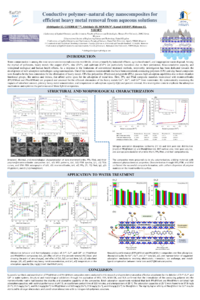
Water pollution caused by heavy metals such as zinc (Zn(II)), copper (Cu(II)), and cadmium (Cd(II)) poses significant environmental and health risks due to their persistence and toxicity. This study investigates the synthesis and characterization of novel conductive polymer (polypyrrole and polyaniline) montmorillonite nanocomposites (PPy@Mont and PAni@Mont) as efficient adsorbents for heavy metal removal from aqueous solutions. The composites were prepared via intercalation of the polymers into sodium-exchanged montmorillonite using in situ polymerization, yielding materials with enhanced adsorption properties. Comprehensive characterization was performed using XRD, FTIR, TGA, SEM, and EDX spectroscopic and microscopic techniques to confirm successful polymer incorporation and evaluate structural and thermal stability. Batch adsorption experiments assessed the effects of pH, contact time, adsorbent dosage, initial metal concentration, and temperature on the adsorption performance. Both composites exhibited optimal adsorption at pH 7.5 and equilibrium at 110 minutes. PPy@Mont demonstrated higher adsorption capacities for Zn(II) and Cu(II), while PAni@Mont showed superior performance for Cd(II). Adsorption isotherms and kinetic studies revealed that the process aligns with Langmuir and pseudo-second-order models, indicating chemisorption as the dominant mechanism. These findings highlight the potential of PPy@Mont and PAni@Mont as cost-effective, efficient, and reusable adsorbents for heavy metal remediation.
Keywords
Heavy metal removal
Montmorillonite nanocomposites
conducting polymers
Wastewater treatment
Environmental remediation.
Poster
Poster.pdf
Studying Geopolymer as an eco-friendly material in the restoration of mural paintings
EVALUATION OF THE CHEMICAL COMPOSITION AND THE HISTOCHEMICAL LOCALIZATION OF SALVIA NEMOROSA L. ESSENTIAL OILS