Event submissions
Published
This submission belongs to the session S5. Mechanical and Aerospace Engineering of the event The 6th International Electronic Conference on Applied Sciences
Published date
03 Dec, 2025
Academic Editor
'%3e%3cpath%20d='M12.6657%2010.9104C12.4185%2010.325%2012.0599%209.79327%2011.6097%209.34482C11.1609%208.89508%2010.6293%208.5365%2010.0442%208.28888C10.0389%208.28626%2010.0337%208.28495%2010.0285%208.28233C10.8446%207.69279%2011.3752%206.73249%2011.3752%205.64904C11.3752%203.8542%209.92103%202.39999%208.1262%202.39999C6.33136%202.39999%204.87715%203.8542%204.87715%205.64904C4.87715%206.73249%205.40774%207.69279%206.22393%208.28364C6.21869%208.28626%206.21345%208.28757%206.20821%208.29019C5.62129%208.5378%205.09463%208.89284%204.64265%209.34613C4.1929%209.79493%203.83432%2010.3266%203.58671%2010.9117C3.34345%2011.4845%203.21226%2012.0987%203.20023%2012.7209C3.19988%2012.7349%203.20233%2012.7488%203.20744%2012.7619C3.21255%2012.7749%203.22022%2012.7867%203.22998%2012.7968C3.23975%2012.8068%203.25142%2012.8147%203.26431%2012.8202C3.2772%2012.8256%203.29105%2012.8284%203.30504%2012.8284H4.09109C4.14874%2012.8284%204.19459%2012.7825%204.1959%2012.7262C4.2221%2011.7148%204.62823%2010.7676%205.34617%2010.0497C6.08899%209.30683%207.0755%208.89808%208.1262%208.89808C9.17689%208.89808%2010.1634%209.30683%2010.9062%2010.0497C11.6242%2010.7676%2012.0303%2011.7148%2012.0565%2012.7262C12.0578%2012.7838%2012.1037%2012.8284%2012.1613%2012.8284H12.9474C12.9613%2012.8284%2012.9752%2012.8256%2012.9881%2012.8202C13.001%2012.8147%2013.0126%2012.8068%2013.0224%2012.7968C13.0322%2012.7867%2013.0398%2012.7749%2013.0449%2012.7619C13.0501%2012.7488%2013.0525%2012.7349%2013.0522%2012.7209C13.0391%2012.0947%2012.9094%2011.4855%2012.6657%2010.9104ZM8.1262%207.9024C7.52486%207.9024%206.9589%207.6679%206.53312%207.24211C6.10733%206.81633%205.87283%206.25037%205.87283%205.64904C5.87283%205.0477%206.10733%204.48174%206.53312%204.05596C6.9589%203.63018%207.52486%203.39567%208.1262%203.39567C8.72753%203.39567%209.29349%203.63018%209.71927%204.05596C10.1451%204.48174%2010.3796%205.0477%2010.3796%205.64904C10.3796%206.25037%2010.1451%206.81633%209.71927%207.24211C9.29349%207.6679%208.72753%207.9024%208.1262%207.9024Z'%20fill='%235D1EE1'/%3e%3c/g%3e%3c/svg%3e) André Furtado
André FurtadoCitation
Marielle Jewel Mendoza Villacarlos, Justine Noel Ulat, Paolo Rommel Sanchez, Ralph Kristoffer Gallegos, Marita Natividad Taize De Lumen, Airflow and Thermal Analysis of a Small Data Center under Varying Load Conditions Through Computational Fluid Dynamics in Steady-State Conditions, in Proceedings of The 6th International Electronic Conference on Applied Sciences, 9 December–11 December 2025, MDPI: Basel, Switzerland
Share
Email
Facebook
Twitter
LinkedIn
Airflow and Thermal Analysis of a Small Data Center under Varying Load Conditions Through Computational Fluid Dynamics in Steady-State Conditions
'%3e%3cpath%20d='M12.6647%2010.9104C12.4176%2010.325%2012.0589%209.7933%2011.6088%209.34485C11.16%208.89511%2010.6283%208.53653%2010.0432%208.28891C10.038%208.28629%2010.0327%208.28498%2010.0275%208.28236C10.8437%207.69282%2011.3743%206.73252%2011.3743%205.64907C11.3743%203.85423%209.92005%202.40002%208.12522%202.40002C6.33038%202.40002%204.87618%203.85423%204.87618%205.64907C4.87618%206.73252%205.40677%207.69282%206.22296%208.28367C6.21772%208.28629%206.21248%208.2876%206.20724%208.29022C5.62031%208.53783%205.09365%208.89287%204.64167%209.34616C4.19192%209.79496%203.83334%2010.3266%203.58573%2010.9117C3.34247%2011.4846%203.21128%2012.0987%203.19925%2012.721C3.1989%2012.735%203.20135%2012.7489%203.20646%2012.7619C3.21157%2012.7749%203.21924%2012.7868%203.22901%2012.7968C3.23877%2012.8068%203.25045%2012.8148%203.26334%2012.8202C3.27623%2012.8256%203.29007%2012.8284%203.30406%2012.8284H4.09012C4.14776%2012.8284%204.19362%2012.7825%204.19493%2012.7262C4.22113%2011.7148%204.62726%2010.7676%205.34519%2010.0497C6.08802%209.30686%207.07452%208.89811%208.12522%208.89811C9.17592%208.89811%2010.1624%209.30686%2010.9052%2010.0497C11.6232%2010.7676%2012.0293%2011.7148%2012.0555%2012.7262C12.0568%2012.7839%2012.1027%2012.8284%2012.1603%2012.8284H12.9464C12.9604%2012.8284%2012.9742%2012.8256%2012.9871%2012.8202C13%2012.8148%2013.0117%2012.8068%2013.0214%2012.7968C13.0312%2012.7868%2013.0389%2012.7749%2013.044%2012.7619C13.0491%2012.7489%2013.0515%2012.735%2013.0512%2012.721C13.0381%2012.0947%2012.9084%2011.4856%2012.6647%2010.9104ZM8.12522%207.90243C7.52388%207.90243%206.95792%207.66793%206.53214%207.24215C6.10636%206.81636%205.87185%206.2504%205.87185%205.64907C5.87185%205.04773%206.10636%204.48177%206.53214%204.05599C6.95792%203.63021%207.52388%203.3957%208.12522%203.3957C8.72655%203.3957%209.29252%203.63021%209.7183%204.05599C10.1441%204.48177%2010.3786%205.04773%2010.3786%205.64907C10.3786%206.2504%2010.1441%206.81636%209.7183%207.24215C9.29252%207.66793%208.72655%207.90243%208.12522%207.90243Z'%20fill='%235D1EE1'/%3e%3c/g%3e%3c/svg%3e)
Marielle Jewel Mendoza Villacarlos 1
Justine Noel Ulat 1
Paolo Rommel Sanchez 2

Ralph Kristoffer Gallegos 2
Marita Natividad Taize De Lumen 1
1. Department of Mechanical Engineering, University of the Philippines Los Baños, College, Laguna 4031, Philippines
2. Institute of Agricultural and Biosystems Engineering, University of the Philippines Los Baños, College, Laguna 4031, Philippines
Abstract
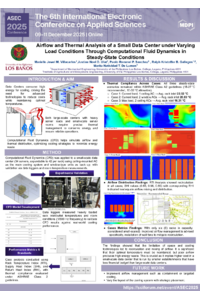
The optimization of cooling systems and temperature management in data centers has been widely researched; however, this focus has been overly concentrated on large enterprises, leading to an oversight of small-scale ones. This study aimed to develop a validated Computational Fluid Dynamics (CFD) model and assess airflow and temperature distribution under varying heat loads and cooling systems in steady-state conditions. The study utilized CFD simulations and validated these through experimentation at the Digital Innovation Center data center of the University of the Philippines Los Baños. Three cases were analyzed: (1) the current server load and main cooling system, (2) the operation of a backup cooling system, and (3) a scenario of a maximized server load while using the main cooling system. Our results showed that all cases maintained compliance within the ASHRAE Thermal Guidelines, with rack inlet temperatures of 22.52ºC, 26.93ºC, and 16.31ºC. On the other hand, the airflow performance metrics of the Rack Temperature Index (RTI), Supply Heat Index (SHI), and Return Heat Index (RHI) reflected that there was recirculation of air in the server room. Specifically, the mixing that was interpreted based on the SHI, with values of 0.85, 0.98, and 0.60. Using a wall fan was recommended in these cases of recirculation for small-scale data centers. In conclusion, the thermal distribution inside the room is adequate for the heat loads, while the airflow distribution requires improvement. This study offers practical recommendations to enhance energy efficiency and reliability in small-scale data center operations.
Keywords
computational fluid dynamics
data center
thermal analysis
steady-state
energy efficiency
Poster
sciforum-132802_POSTER.pdf
A Predictive Framework for Investigating Nanoscale Elastic Modulus in PVDF/Fe3O4 Nanocomposite Fibers
Numerical Study on the Effect of Influent Flow for Film Pressure in a Helical Grooved Plain Bearing of a Canned Motor Pump