Event submissions
Published
This submission belongs to the session S2. Nanosciences, Chemistry and Materials Science of the event The 6th International Electronic Conference on Applied Sciences
Published date
03 Dec, 2025
Academic Editor
'%3e%3cpath%20d='M12.6657%2010.9104C12.4185%2010.325%2012.0599%209.79327%2011.6097%209.34482C11.1609%208.89508%2010.6293%208.5365%2010.0442%208.28888C10.0389%208.28626%2010.0337%208.28495%2010.0285%208.28233C10.8446%207.69279%2011.3752%206.73249%2011.3752%205.64904C11.3752%203.8542%209.92103%202.39999%208.1262%202.39999C6.33136%202.39999%204.87715%203.8542%204.87715%205.64904C4.87715%206.73249%205.40774%207.69279%206.22393%208.28364C6.21869%208.28626%206.21345%208.28757%206.20821%208.29019C5.62129%208.5378%205.09463%208.89284%204.64265%209.34613C4.1929%209.79493%203.83432%2010.3266%203.58671%2010.9117C3.34345%2011.4845%203.21226%2012.0987%203.20023%2012.7209C3.19988%2012.7349%203.20233%2012.7488%203.20744%2012.7619C3.21255%2012.7749%203.22022%2012.7867%203.22998%2012.7968C3.23975%2012.8068%203.25142%2012.8147%203.26431%2012.8202C3.2772%2012.8256%203.29105%2012.8284%203.30504%2012.8284H4.09109C4.14874%2012.8284%204.19459%2012.7825%204.1959%2012.7262C4.2221%2011.7148%204.62823%2010.7676%205.34617%2010.0497C6.08899%209.30683%207.0755%208.89808%208.1262%208.89808C9.17689%208.89808%2010.1634%209.30683%2010.9062%2010.0497C11.6242%2010.7676%2012.0303%2011.7148%2012.0565%2012.7262C12.0578%2012.7838%2012.1037%2012.8284%2012.1613%2012.8284H12.9474C12.9613%2012.8284%2012.9752%2012.8256%2012.9881%2012.8202C13.001%2012.8147%2013.0126%2012.8068%2013.0224%2012.7968C13.0322%2012.7867%2013.0398%2012.7749%2013.0449%2012.7619C13.0501%2012.7488%2013.0525%2012.7349%2013.0522%2012.7209C13.0391%2012.0947%2012.9094%2011.4855%2012.6657%2010.9104ZM8.1262%207.9024C7.52486%207.9024%206.9589%207.6679%206.53312%207.24211C6.10733%206.81633%205.87283%206.25037%205.87283%205.64904C5.87283%205.0477%206.10733%204.48174%206.53312%204.05596C6.9589%203.63018%207.52486%203.39567%208.1262%203.39567C8.72753%203.39567%209.29349%203.63018%209.71927%204.05596C10.1451%204.48174%2010.3796%205.0477%2010.3796%205.64904C10.3796%206.25037%2010.1451%206.81633%209.71927%207.24211C9.29349%207.6679%208.72753%207.9024%208.1262%207.9024Z'%20fill='%235D1EE1'/%3e%3c/g%3e%3c/svg%3e) Alberto Jiménez Suárez
Alberto Jiménez SuárezCitation
Lucia Kuyet CHRISTOPHER, Toyese OYEGOKE, Sharon OLORUNFEMI, Quantum Mechanical Insights into the Extraction of Quercetin and Caffeic Acid Using Choline Chloride–Glycerol Deep Eutectic Solvent, in Proceedings of The 6th International Electronic Conference on Applied Sciences, 9 December–11 December 2025, MDPI: Basel, Switzerland
Share
Email
Facebook
Twitter
LinkedIn
Quantum Mechanical Insights into the Extraction of Quercetin and Caffeic Acid Using Choline Chloride–Glycerol Deep Eutectic Solvent
'%3e%3cpath%20d='M12.6647%2010.9104C12.4176%2010.325%2012.0589%209.7933%2011.6088%209.34485C11.16%208.89511%2010.6283%208.53653%2010.0432%208.28891C10.038%208.28629%2010.0327%208.28498%2010.0275%208.28236C10.8437%207.69282%2011.3743%206.73252%2011.3743%205.64907C11.3743%203.85423%209.92005%202.40002%208.12522%202.40002C6.33038%202.40002%204.87618%203.85423%204.87618%205.64907C4.87618%206.73252%205.40677%207.69282%206.22296%208.28367C6.21772%208.28629%206.21248%208.2876%206.20724%208.29022C5.62031%208.53783%205.09365%208.89287%204.64167%209.34616C4.19192%209.79496%203.83334%2010.3266%203.58573%2010.9117C3.34247%2011.4846%203.21128%2012.0987%203.19925%2012.721C3.1989%2012.735%203.20135%2012.7489%203.20646%2012.7619C3.21157%2012.7749%203.21924%2012.7868%203.22901%2012.7968C3.23877%2012.8068%203.25045%2012.8148%203.26334%2012.8202C3.27623%2012.8256%203.29007%2012.8284%203.30406%2012.8284H4.09012C4.14776%2012.8284%204.19362%2012.7825%204.19493%2012.7262C4.22113%2011.7148%204.62726%2010.7676%205.34519%2010.0497C6.08802%209.30686%207.07452%208.89811%208.12522%208.89811C9.17592%208.89811%2010.1624%209.30686%2010.9052%2010.0497C11.6232%2010.7676%2012.0293%2011.7148%2012.0555%2012.7262C12.0568%2012.7839%2012.1027%2012.8284%2012.1603%2012.8284H12.9464C12.9604%2012.8284%2012.9742%2012.8256%2012.9871%2012.8202C13%2012.8148%2013.0117%2012.8068%2013.0214%2012.7968C13.0312%2012.7868%2013.0389%2012.7749%2013.044%2012.7619C13.0491%2012.7489%2013.0515%2012.735%2013.0512%2012.721C13.0381%2012.0947%2012.9084%2011.4856%2012.6647%2010.9104ZM8.12522%207.90243C7.52388%207.90243%206.95792%207.66793%206.53214%207.24215C6.10636%206.81636%205.87185%206.2504%205.87185%205.64907C5.87185%205.04773%206.10636%204.48177%206.53214%204.05599C6.95792%203.63021%207.52388%203.3957%208.12522%203.3957C8.72655%203.3957%209.29252%203.63021%209.7183%204.05599C10.1441%204.48177%2010.3786%205.04773%2010.3786%205.64907C10.3786%206.2504%2010.1441%206.81636%209.7183%207.24215C9.29252%207.66793%208.72655%207.90243%208.12522%207.90243Z'%20fill='%235D1EE1'/%3e%3c/g%3e%3c/svg%3e)
Lucia Kuyet CHRISTOPHER 1

Toyese OYEGOKE 1
Sharon OLORUNFEMI 1
1. CAD Engineering of Processes and Reactive Interfaces Group, Chemical Engineering Department, Ahmadu Bello University, Samaru, Sabon-gari LGA, Zaria 810106, Kaduna State, Nigeria
Abstract
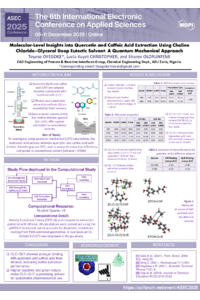
Quercetin (QUE) and caffeic acid (CAF) are bioactive compounds with proven antioxidant, anti-inflammatory, and anticancer properties. The development of efficient and eco-friendly extraction techniques for these compounds is essential for advancing sustainable pharmaceutical and nutraceutical applications. In this study, a choline chloride–glycerol (CLC–GLY) deep eutectic solvent (DES) was explored as a green alternative to conventional solvents such as ethanol (ETOH) for extracting QUE and CAF. A quantum mechanical approach was employed to investigate the molecular-level interactions between the DES and the target compounds and to compare their extraction potential with that of ethanol. All calculations were carried out using the wB97X-D functional, which accounts for dispersion interactions, starting from PM3-optimized geometries. A dual basis set (6-31G(d)/3-21G*) was applied in the gas phase. The results revealed that CLC–GLY exhibits a lower HOMO–LUMO energy gap (11.19 eV) compared to ethanol (14.06 eV), indicating that CLC–GLY is less electronically stable but more chemically reactive. More importantly, the DES demonstrated stronger binding interactions with caffeic acid (–1.12 eV) and quercetin (–0.96 eV) than ethanol, which showed significantly weaker binding energies. These enhanced interactions suggest that the CLC–GLY solvent has greater extraction potential for both QUE and CAF due to its higher chemical reactivity and stronger affinity toward the target molecules. Overall, this study supports the application of DESs, particularly choline chloride–glycerol, as promising green solvents for the extraction of bioactive phytochemicals, offering a more sustainable and effective alternative to conventional solvents in pharmaceutical development.
Keywords
Modeling
Simulation
Solvent Extraction
Bioactive Compound
Deep Eutectic Solvent
Environment
Glycerol
Quercetin
Caffeic Acid
Green Solvent
Poster
QUE_and_CAF_extraction_GYLCEROL_revised.pdf
Silver decorated titanium dioxide for enhanced photocatalytic hydrogen production
Ethical implications of using artificial intelligence and gamification to improve teaching in English courses: a case study in Mexican education