Event submissions
Published
This submission belongs to the session S2. Nanosciences, Chemistry and Materials Science of the event The 6th International Electronic Conference on Applied Sciences
Published date
03 Dec, 2025
Academic Editor
'%3e%3cpath%20d='M12.6657%2010.9104C12.4185%2010.325%2012.0599%209.79327%2011.6097%209.34482C11.1609%208.89508%2010.6293%208.5365%2010.0442%208.28888C10.0389%208.28626%2010.0337%208.28495%2010.0285%208.28233C10.8446%207.69279%2011.3752%206.73249%2011.3752%205.64904C11.3752%203.8542%209.92103%202.39999%208.1262%202.39999C6.33136%202.39999%204.87715%203.8542%204.87715%205.64904C4.87715%206.73249%205.40774%207.69279%206.22393%208.28364C6.21869%208.28626%206.21345%208.28757%206.20821%208.29019C5.62129%208.5378%205.09463%208.89284%204.64265%209.34613C4.1929%209.79493%203.83432%2010.3266%203.58671%2010.9117C3.34345%2011.4845%203.21226%2012.0987%203.20023%2012.7209C3.19988%2012.7349%203.20233%2012.7488%203.20744%2012.7619C3.21255%2012.7749%203.22022%2012.7867%203.22998%2012.7968C3.23975%2012.8068%203.25142%2012.8147%203.26431%2012.8202C3.2772%2012.8256%203.29105%2012.8284%203.30504%2012.8284H4.09109C4.14874%2012.8284%204.19459%2012.7825%204.1959%2012.7262C4.2221%2011.7148%204.62823%2010.7676%205.34617%2010.0497C6.08899%209.30683%207.0755%208.89808%208.1262%208.89808C9.17689%208.89808%2010.1634%209.30683%2010.9062%2010.0497C11.6242%2010.7676%2012.0303%2011.7148%2012.0565%2012.7262C12.0578%2012.7838%2012.1037%2012.8284%2012.1613%2012.8284H12.9474C12.9613%2012.8284%2012.9752%2012.8256%2012.9881%2012.8202C13.001%2012.8147%2013.0126%2012.8068%2013.0224%2012.7968C13.0322%2012.7867%2013.0398%2012.7749%2013.0449%2012.7619C13.0501%2012.7488%2013.0525%2012.7349%2013.0522%2012.7209C13.0391%2012.0947%2012.9094%2011.4855%2012.6657%2010.9104ZM8.1262%207.9024C7.52486%207.9024%206.9589%207.6679%206.53312%207.24211C6.10733%206.81633%205.87283%206.25037%205.87283%205.64904C5.87283%205.0477%206.10733%204.48174%206.53312%204.05596C6.9589%203.63018%207.52486%203.39567%208.1262%203.39567C8.72753%203.39567%209.29349%203.63018%209.71927%204.05596C10.1451%204.48174%2010.3796%205.0477%2010.3796%205.64904C10.3796%206.25037%2010.1451%206.81633%209.71927%207.24211C9.29349%207.6679%208.72753%207.9024%208.1262%207.9024Z'%20fill='%235D1EE1'/%3e%3c/g%3e%3c/svg%3e) Alberto Jiménez Suárez
Alberto Jiménez SuárezCitation
Aleksandr Vladimirovich Rybalka, Petr Petrovich Snetkov, Maksim Vladimirovich Dorogov, Svetlana Nikolaevna Morozkina, Alexey Evgenievich Romanov, Electrospun Indium-doped Nanofibers Based on Gallium Oxide: Fabrication and Characterization, in Proceedings of The 6th International Electronic Conference on Applied Sciences, 9 December–11 December 2025, MDPI: Basel, Switzerland
Share
Email
Facebook
Twitter
LinkedIn
Electrospun Indium-doped Nanofibers Based on Gallium Oxide: Fabrication and Characterization
'%3e%3cpath%20d='M12.6647%2010.9104C12.4176%2010.325%2012.0589%209.7933%2011.6088%209.34485C11.16%208.89511%2010.6283%208.53653%2010.0432%208.28891C10.038%208.28629%2010.0327%208.28498%2010.0275%208.28236C10.8437%207.69282%2011.3743%206.73252%2011.3743%205.64907C11.3743%203.85423%209.92005%202.40002%208.12522%202.40002C6.33038%202.40002%204.87618%203.85423%204.87618%205.64907C4.87618%206.73252%205.40677%207.69282%206.22296%208.28367C6.21772%208.28629%206.21248%208.2876%206.20724%208.29022C5.62031%208.53783%205.09365%208.89287%204.64167%209.34616C4.19192%209.79496%203.83334%2010.3266%203.58573%2010.9117C3.34247%2011.4846%203.21128%2012.0987%203.19925%2012.721C3.1989%2012.735%203.20135%2012.7489%203.20646%2012.7619C3.21157%2012.7749%203.21924%2012.7868%203.22901%2012.7968C3.23877%2012.8068%203.25045%2012.8148%203.26334%2012.8202C3.27623%2012.8256%203.29007%2012.8284%203.30406%2012.8284H4.09012C4.14776%2012.8284%204.19362%2012.7825%204.19493%2012.7262C4.22113%2011.7148%204.62726%2010.7676%205.34519%2010.0497C6.08802%209.30686%207.07452%208.89811%208.12522%208.89811C9.17592%208.89811%2010.1624%209.30686%2010.9052%2010.0497C11.6232%2010.7676%2012.0293%2011.7148%2012.0555%2012.7262C12.0568%2012.7839%2012.1027%2012.8284%2012.1603%2012.8284H12.9464C12.9604%2012.8284%2012.9742%2012.8256%2012.9871%2012.8202C13%2012.8148%2013.0117%2012.8068%2013.0214%2012.7968C13.0312%2012.7868%2013.0389%2012.7749%2013.044%2012.7619C13.0491%2012.7489%2013.0515%2012.735%2013.0512%2012.721C13.0381%2012.0947%2012.9084%2011.4856%2012.6647%2010.9104ZM8.12522%207.90243C7.52388%207.90243%206.95792%207.66793%206.53214%207.24215C6.10636%206.81636%205.87185%206.2504%205.87185%205.64907C5.87185%205.04773%206.10636%204.48177%206.53214%204.05599C6.95792%203.63021%207.52388%203.3957%208.12522%203.3957C8.72655%203.3957%209.29252%203.63021%209.7183%204.05599C10.1441%204.48177%2010.3786%205.04773%2010.3786%205.64907C10.3786%206.2504%2010.1441%206.81636%209.7183%207.24215C9.29252%207.66793%208.72655%207.90243%208.12522%207.90243Z'%20fill='%235D1EE1'/%3e%3c/g%3e%3c/svg%3e)
Aleksandr Vladimirovich Rybalka 1

Petr Petrovich Snetkov 1
Maksim Vladimirovich Dorogov 1
Svetlana Nikolaevna Morozkina 1
Alexey Evgenievich Romanov 1
1. Institute of Advanced Data Transfer Systems, ITMO University, Kronverkskiy Prospekt, 49, bldg. A, 197101 Saint Petersburg, Russia
Abstract
Gallium oxide-based nanofibers (NFs) have gained increasing attention due to their unique combination of physical, optical, and chemical properties. These features make Ga₂O₃ NFs promising materials for UV photodetectors, gas sensors, and optoelectronic devices. However, the effects of dopants on the properties of Ga₂O₃ NFs remain insufficiently studied. This work focuses on the synthesis of undoped and indium-doped Ga₂O₃ nanofibers by electrospinning and the investigation of their structural, morphological, and optical properties.
Polyvinylpyrrolidone was used as a polymer matrix. Gallium nitrate Ga(NO₃)₃·8H₂O (99.9%) and indium nitrate In(NO₃)₃·4½H₂O (99.99%) served as metal precursors. The Ga precursor concentration was 2 wt.%, while indium was introduced at 5 and 10 wt.% relative to gallium. A 1:1 mixture of distilled water and ethanol was used as a solvent.
Electrospinning was carried out under 25 kV, with a feed rate of 1.8 mL/h, at 25 ± 1 °C and 30 ± 1% RH for 40 minutes. The as-spun fibers were dried for 15 minutes in a chamber and then for 48 hours at room temperature. Thermal annealing was performed at 900 °C for 4 hours (heating rate: 5 °C/min) with natural cooling.
Morphological analysis was conducted using SEM and EDS. The optical bandgap was determined by the Tauc-plot method. Indium doping at 10 wt.% led to a 0.35 eV reduction in bandgap, in good agreement with theoretical predictions.
This research was funded by the Ministry of Science and Higher Education of the Russian Federation (project No. FSER-2025-0005).
Keywords
Nanofibers
Gallium oxide
Indium doped
Electrospinning
Poster
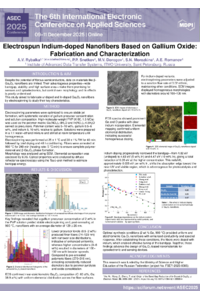
Electrospun Indium-doped Nanofibers Based on Gallium Oxide Fabrication and Characterization.pdf
Thermal and Electrical Conductivity of Modified Asphalt Mixes Reinforced with Waste Tyre Metal Fiber and Graphite
Visible Light-Induced Photocatalytic Degradation of Fast Green FCF and Orange II dye by Yb₂O₃ Nanoparticles