Event submissions
Published
This submission belongs to the session S2. Nanosciences, Chemistry and Materials Science of the event The 6th International Electronic Conference on Applied Sciences
Published date
03 Dec, 2025
Academic Editor
'%3e%3cpath%20d='M12.6657%2010.9104C12.4185%2010.325%2012.0599%209.79327%2011.6097%209.34482C11.1609%208.89508%2010.6293%208.5365%2010.0442%208.28888C10.0389%208.28626%2010.0337%208.28495%2010.0285%208.28233C10.8446%207.69279%2011.3752%206.73249%2011.3752%205.64904C11.3752%203.8542%209.92103%202.39999%208.1262%202.39999C6.33136%202.39999%204.87715%203.8542%204.87715%205.64904C4.87715%206.73249%205.40774%207.69279%206.22393%208.28364C6.21869%208.28626%206.21345%208.28757%206.20821%208.29019C5.62129%208.5378%205.09463%208.89284%204.64265%209.34613C4.1929%209.79493%203.83432%2010.3266%203.58671%2010.9117C3.34345%2011.4845%203.21226%2012.0987%203.20023%2012.7209C3.19988%2012.7349%203.20233%2012.7488%203.20744%2012.7619C3.21255%2012.7749%203.22022%2012.7867%203.22998%2012.7968C3.23975%2012.8068%203.25142%2012.8147%203.26431%2012.8202C3.2772%2012.8256%203.29105%2012.8284%203.30504%2012.8284H4.09109C4.14874%2012.8284%204.19459%2012.7825%204.1959%2012.7262C4.2221%2011.7148%204.62823%2010.7676%205.34617%2010.0497C6.08899%209.30683%207.0755%208.89808%208.1262%208.89808C9.17689%208.89808%2010.1634%209.30683%2010.9062%2010.0497C11.6242%2010.7676%2012.0303%2011.7148%2012.0565%2012.7262C12.0578%2012.7838%2012.1037%2012.8284%2012.1613%2012.8284H12.9474C12.9613%2012.8284%2012.9752%2012.8256%2012.9881%2012.8202C13.001%2012.8147%2013.0126%2012.8068%2013.0224%2012.7968C13.0322%2012.7867%2013.0398%2012.7749%2013.0449%2012.7619C13.0501%2012.7488%2013.0525%2012.7349%2013.0522%2012.7209C13.0391%2012.0947%2012.9094%2011.4855%2012.6657%2010.9104ZM8.1262%207.9024C7.52486%207.9024%206.9589%207.6679%206.53312%207.24211C6.10733%206.81633%205.87283%206.25037%205.87283%205.64904C5.87283%205.0477%206.10733%204.48174%206.53312%204.05596C6.9589%203.63018%207.52486%203.39567%208.1262%203.39567C8.72753%203.39567%209.29349%203.63018%209.71927%204.05596C10.1451%204.48174%2010.3796%205.0477%2010.3796%205.64904C10.3796%206.25037%2010.1451%206.81633%209.71927%207.24211C9.29349%207.6679%208.72753%207.9024%208.1262%207.9024Z'%20fill='%235D1EE1'/%3e%3c/g%3e%3c/svg%3e) Alberto Jiménez Suárez
Alberto Jiménez SuárezCitation
Joserie Joice Reyes, Jeremy Kyle Edson Austria, Ma. Angelica Chua, Anna Maria Parzuelo, Sean Carlo Castro, Jerry Go Olay, Rugi Vicente Rubi, Carlou Siga-an Eguico, Phytofabrication of Silver Nanoparticles from Water Hyacinth (Eichhornia crassipes) as a Pest Control Tool for Spodoptera frugiperda, in Proceedings of The 6th International Electronic Conference on Applied Sciences, 9 December–11 December 2025, MDPI: Basel, Switzerland
Share
Email
Facebook
Twitter
LinkedIn
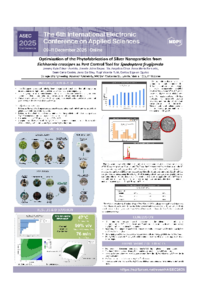
Phytofabrication of Silver Nanoparticles from Water Hyacinth (Eichhornia crassipes) as a Pest Control Tool for Spodoptera frugiperda
'%3e%3cpath%20d='M12.6647%2010.9104C12.4176%2010.325%2012.0589%209.7933%2011.6088%209.34485C11.16%208.89511%2010.6283%208.53653%2010.0432%208.28891C10.038%208.28629%2010.0327%208.28498%2010.0275%208.28236C10.8437%207.69282%2011.3743%206.73252%2011.3743%205.64907C11.3743%203.85423%209.92005%202.40002%208.12522%202.40002C6.33038%202.40002%204.87618%203.85423%204.87618%205.64907C4.87618%206.73252%205.40677%207.69282%206.22296%208.28367C6.21772%208.28629%206.21248%208.2876%206.20724%208.29022C5.62031%208.53783%205.09365%208.89287%204.64167%209.34616C4.19192%209.79496%203.83334%2010.3266%203.58573%2010.9117C3.34247%2011.4846%203.21128%2012.0987%203.19925%2012.721C3.1989%2012.735%203.20135%2012.7489%203.20646%2012.7619C3.21157%2012.7749%203.21924%2012.7868%203.22901%2012.7968C3.23877%2012.8068%203.25045%2012.8148%203.26334%2012.8202C3.27623%2012.8256%203.29007%2012.8284%203.30406%2012.8284H4.09012C4.14776%2012.8284%204.19362%2012.7825%204.19493%2012.7262C4.22113%2011.7148%204.62726%2010.7676%205.34519%2010.0497C6.08802%209.30686%207.07452%208.89811%208.12522%208.89811C9.17592%208.89811%2010.1624%209.30686%2010.9052%2010.0497C11.6232%2010.7676%2012.0293%2011.7148%2012.0555%2012.7262C12.0568%2012.7839%2012.1027%2012.8284%2012.1603%2012.8284H12.9464C12.9604%2012.8284%2012.9742%2012.8256%2012.9871%2012.8202C13%2012.8148%2013.0117%2012.8068%2013.0214%2012.7968C13.0312%2012.7868%2013.0389%2012.7749%2013.044%2012.7619C13.0491%2012.7489%2013.0515%2012.735%2013.0512%2012.721C13.0381%2012.0947%2012.9084%2011.4856%2012.6647%2010.9104ZM8.12522%207.90243C7.52388%207.90243%206.95792%207.66793%206.53214%207.24215C6.10636%206.81636%205.87185%206.2504%205.87185%205.64907C5.87185%205.04773%206.10636%204.48177%206.53214%204.05599C6.95792%203.63021%207.52388%203.3957%208.12522%203.3957C8.72655%203.3957%209.29252%203.63021%209.7183%204.05599C10.1441%204.48177%2010.3786%205.04773%2010.3786%205.64907C10.3786%206.2504%2010.1441%206.81636%209.7183%207.24215C9.29252%207.66793%208.72655%207.90243%208.12522%207.90243Z'%20fill='%235D1EE1'/%3e%3c/g%3e%3c/svg%3e)
Joserie Joice Reyes 1
Jeremy Kyle Edson Austria 1
Ma. Angelica Chua 1
Anna Maria Parzuelo 1
Sean Carlo Castro 1
Jerry Go Olay 1,2
Rugi Vicente Rubi 1,2
Carlou Siga-an Eguico 1,2
1. Chemical Engineering Department, Adamson University, Manila, National Capital Region, 1000, Philippines
2. Adamson University Laboratory of Biomass, Energy and Nanotechnology (ALBEN), Adamson University, Manila, National Capital Region, 1000, Philippines
Abstract
The Philippine agriculture sector faces a serious threat from the invasive fall armyworm (Spodoptera frugiperda), which is affecting agricultural municipalities throughout the country. Corn and sugar cane production are at high risk, requiring eco-friendly control methods to prevent potential crises. This study demonstrates the green synthesis of silver nanoparticles (AgNPs) using phytochemicals from water hyacinth (Eichhornia crassipes) as a sustainable nanopesticide against S. frugiperda. Water hyacinth leaves were washed, air-dried, and extracted using methanol (70–90%) under varying temperatures (30–50°C) and times (30–90 min). Total phenolic content (TPC) was quantified via the Folin–Ciocalteu method. AgNPs were synthesized by reacting extracts with 0.1 M AgNO₃ under dark conditions. SEM-EDX confirmed nanoscale particles (≤100 nm) with high elemental purity. Acute toxicity tests compared four AgNP concentrations (500–2000 ppm) with commercial Aztron WDG pesticide using bioassays on fall armyworm larvae fed treated corn leaves. Larval mortality was assessed after 72 h. Results showed Ec-AgNPs effectively controlled larvae, although higher doses were needed compared to Aztron WDG, which was less effective against older larval stages. Optimal extraction was achieved at 47°C, 90% methanol, and 76 min, maximizing the TPC yield. Smaller AgNPs enhanced bioavailability, indicating potential for improved pest control with minimal environmental harm. This study highlights the role of methanol concentration in phenolic extraction and notes the risks of agglomeration associated with increasing extract volumes. Future work should refine synthesis to reduce impurities and investigate FTIR-based functional group analysis to optimize nanoparticle stability. Overall, water hyacinth-derived AgNPs show promise as an eco-friendly alternative to chemical pesticides for managing S. frugiperda in the Philippines.
Keywords
Spodoptera frugiperda
water hyacinth
silver nanoparticles
green synthesis
nanopesticide
sustainable agriculture
Poster
MDPI POSTER.pdf
Numerical Simulation of Water Table Dynamics for Construction Planning in a Coastal Urban Area of Mazatlán, Mexico
Rapid green synthesis of reusable alginate-silver nanocomposite beads using Yerba mate (Ilex paraguariensis) for catalytic and antibacterial applications