Event submissions
Published
This submission belongs to the session S2. Nanosciences, Chemistry and Materials Science of the event The 6th International Electronic Conference on Applied Sciences
Published date
03 Dec, 2025
Academic Editor
'%3e%3cpath%20d='M12.6657%2010.9104C12.4185%2010.325%2012.0599%209.79327%2011.6097%209.34482C11.1609%208.89508%2010.6293%208.5365%2010.0442%208.28888C10.0389%208.28626%2010.0337%208.28495%2010.0285%208.28233C10.8446%207.69279%2011.3752%206.73249%2011.3752%205.64904C11.3752%203.8542%209.92103%202.39999%208.1262%202.39999C6.33136%202.39999%204.87715%203.8542%204.87715%205.64904C4.87715%206.73249%205.40774%207.69279%206.22393%208.28364C6.21869%208.28626%206.21345%208.28757%206.20821%208.29019C5.62129%208.5378%205.09463%208.89284%204.64265%209.34613C4.1929%209.79493%203.83432%2010.3266%203.58671%2010.9117C3.34345%2011.4845%203.21226%2012.0987%203.20023%2012.7209C3.19988%2012.7349%203.20233%2012.7488%203.20744%2012.7619C3.21255%2012.7749%203.22022%2012.7867%203.22998%2012.7968C3.23975%2012.8068%203.25142%2012.8147%203.26431%2012.8202C3.2772%2012.8256%203.29105%2012.8284%203.30504%2012.8284H4.09109C4.14874%2012.8284%204.19459%2012.7825%204.1959%2012.7262C4.2221%2011.7148%204.62823%2010.7676%205.34617%2010.0497C6.08899%209.30683%207.0755%208.89808%208.1262%208.89808C9.17689%208.89808%2010.1634%209.30683%2010.9062%2010.0497C11.6242%2010.7676%2012.0303%2011.7148%2012.0565%2012.7262C12.0578%2012.7838%2012.1037%2012.8284%2012.1613%2012.8284H12.9474C12.9613%2012.8284%2012.9752%2012.8256%2012.9881%2012.8202C13.001%2012.8147%2013.0126%2012.8068%2013.0224%2012.7968C13.0322%2012.7867%2013.0398%2012.7749%2013.0449%2012.7619C13.0501%2012.7488%2013.0525%2012.7349%2013.0522%2012.7209C13.0391%2012.0947%2012.9094%2011.4855%2012.6657%2010.9104ZM8.1262%207.9024C7.52486%207.9024%206.9589%207.6679%206.53312%207.24211C6.10733%206.81633%205.87283%206.25037%205.87283%205.64904C5.87283%205.0477%206.10733%204.48174%206.53312%204.05596C6.9589%203.63018%207.52486%203.39567%208.1262%203.39567C8.72753%203.39567%209.29349%203.63018%209.71927%204.05596C10.1451%204.48174%2010.3796%205.0477%2010.3796%205.64904C10.3796%206.25037%2010.1451%206.81633%209.71927%207.24211C9.29349%207.6679%208.72753%207.9024%208.1262%207.9024Z'%20fill='%235D1EE1'/%3e%3c/g%3e%3c/svg%3e) Alberto Jiménez Suárez
Alberto Jiménez SuárezCitation
UMAR MUDI AHMAD, HARUN IBRAHIM KHALIL, JUNAIDU NAALIYA, ZAKARIYYA UBA ZANGO, SAIDU ILIYASU MUSA, EXPLORING THE ANTIFUNGAL POTENTIAL OF Co(II) AND Mn(II) SCHIFF BASE DERIVED FROM o-AMINOPHENOL AND BENZALDEHYDE COMPLEXES, SYNTHESIS, SPECTROSCOPIC STUDIES, in Proceedings of The 6th International Electronic Conference on Applied Sciences, 9 December–11 December 2025, MDPI: Basel, Switzerland
Share
Email
Facebook
Twitter
LinkedIn
EXPLORING THE ANTIFUNGAL POTENTIAL OF Co(II) AND Mn(II) SCHIFF BASE DERIVED FROM o-AMINOPHENOL AND BENZALDEHYDE COMPLEXES, SYNTHESIS, SPECTROSCOPIC STUDIES
'%3e%3cpath%20d='M12.6647%2010.9104C12.4176%2010.325%2012.0589%209.7933%2011.6088%209.34485C11.16%208.89511%2010.6283%208.53653%2010.0432%208.28891C10.038%208.28629%2010.0327%208.28498%2010.0275%208.28236C10.8437%207.69282%2011.3743%206.73252%2011.3743%205.64907C11.3743%203.85423%209.92005%202.40002%208.12522%202.40002C6.33038%202.40002%204.87618%203.85423%204.87618%205.64907C4.87618%206.73252%205.40677%207.69282%206.22296%208.28367C6.21772%208.28629%206.21248%208.2876%206.20724%208.29022C5.62031%208.53783%205.09365%208.89287%204.64167%209.34616C4.19192%209.79496%203.83334%2010.3266%203.58573%2010.9117C3.34247%2011.4846%203.21128%2012.0987%203.19925%2012.721C3.1989%2012.735%203.20135%2012.7489%203.20646%2012.7619C3.21157%2012.7749%203.21924%2012.7868%203.22901%2012.7968C3.23877%2012.8068%203.25045%2012.8148%203.26334%2012.8202C3.27623%2012.8256%203.29007%2012.8284%203.30406%2012.8284H4.09012C4.14776%2012.8284%204.19362%2012.7825%204.19493%2012.7262C4.22113%2011.7148%204.62726%2010.7676%205.34519%2010.0497C6.08802%209.30686%207.07452%208.89811%208.12522%208.89811C9.17592%208.89811%2010.1624%209.30686%2010.9052%2010.0497C11.6232%2010.7676%2012.0293%2011.7148%2012.0555%2012.7262C12.0568%2012.7839%2012.1027%2012.8284%2012.1603%2012.8284H12.9464C12.9604%2012.8284%2012.9742%2012.8256%2012.9871%2012.8202C13%2012.8148%2013.0117%2012.8068%2013.0214%2012.7968C13.0312%2012.7868%2013.0389%2012.7749%2013.044%2012.7619C13.0491%2012.7489%2013.0515%2012.735%2013.0512%2012.721C13.0381%2012.0947%2012.9084%2011.4856%2012.6647%2010.9104ZM8.12522%207.90243C7.52388%207.90243%206.95792%207.66793%206.53214%207.24215C6.10636%206.81636%205.87185%206.2504%205.87185%205.64907C5.87185%205.04773%206.10636%204.48177%206.53214%204.05599C6.95792%203.63021%207.52388%203.3957%208.12522%203.3957C8.72655%203.3957%209.29252%203.63021%209.7183%204.05599C10.1441%204.48177%2010.3786%205.04773%2010.3786%205.64907C10.3786%206.2504%2010.1441%206.81636%209.7183%207.24215C9.29252%207.66793%208.72655%207.90243%208.12522%207.90243Z'%20fill='%235D1EE1'/%3e%3c/g%3e%3c/svg%3e)
UMAR MUDI AHMAD 1
HARUN IBRAHIM KHALIL 2
JUNAIDU NAALIYA 2

ZAKARIYYA UBA ZANGO 3
SAIDU ILIYASU MUSA 1
1. Department of Chemistry, School of Sciences, Kano State College of Education and Preliminary Studies, Kano, 234, Nigeria
2. Department of Pure and Industrial Chemistry, Faculty of Physical Sciences, Bayero University, Kano, 234, Nigeria
3. Department of Chemistry, College of Natural and Applied Sciences, Al-Qalam University, Katsina State, 234, Nigeria
Abstract
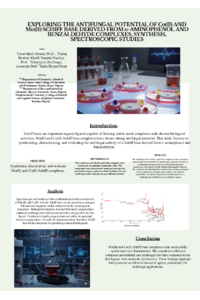
A Schiff base derived from benzaldehyde and o-aminophenol was synthesized, along with its Mn(II) and Co(II) complexes. The synthesized compounds were characterized using standard analytical and spectroscopic methods, including melting/decomposition temperature determination, solubility testing, magnetic susceptibility, infrared (IR) spectroscopy, atomic absorption spectroscopy (AAS), and elemental analysis. Formation of the azomethine bond was confirmed by an IR absorption band at 1614 cm⁻¹ for the free ligand, which shifted to 1603 cm⁻¹ and 1602 cm⁻¹ in the metal complexes, indicating coordination. The melting point of the Schiff base was 189 °C, while the metal complexes decomposed at 273 °C and 220 °C, respectively. Magnetic moment values of 5.78 and 4.81 B.M confirmed paramagnetic behavior. Low molar conductance values (18.5 and 14.1 Ω⁻¹ cm² mol⁻¹) indicated non-electrolytic nature of the complexes. AAS and elemental data suggested a 1:2 metal-to-ligand ratio, with the Schiff base functioning as a bidentate ligand. Biological evaluations revealed that the Schiff base and its metal complexes exhibited significant antibacterial activity against Staphylococcus aureus, Escherichia coli, and Salmonella typhi, and potent antifungal activity against Aspergillus niger, Aspergillus flavus, and Candida albicans. Notably, the antifungal effects were more pronounced at higher concentrations. Cytotoxicity studies showed moderate toxicity, with LC₅₀ values of 132.705 and 147.932 µg/mL for the free ligand and complexes, respectively. These findings suggest that Schiff base metal complexes of Mn(II) and Co(II) hold promise as effective bioactive agents, particularly in antifungal applications.
Keywords
Schiff base
transition metal complexes
azomethine bond
antifungal activity
antibacterial screening
Co(II) complexes
Mn(II) complexes
cytotoxicity
spectroscopic characterization.
Poster
Exploring The Antifungal Effects.pdf
Rapid green synthesis of reusable alginate-silver nanocomposite beads using Yerba mate (Ilex paraguariensis) for catalytic and antibacterial applications
Satellite Vegetation Monitoring Challenges in Oil-Polluted Niger Delta Community