Event submissions
Published
This submission belongs to the session S2. Nanosciences, Chemistry and Materials Science of the event The 6th International Electronic Conference on Applied Sciences
Published date
03 Dec, 2025
Academic Editor
'%3e%3cpath%20d='M12.6657%2010.9104C12.4185%2010.325%2012.0599%209.79327%2011.6097%209.34482C11.1609%208.89508%2010.6293%208.5365%2010.0442%208.28888C10.0389%208.28626%2010.0337%208.28495%2010.0285%208.28233C10.8446%207.69279%2011.3752%206.73249%2011.3752%205.64904C11.3752%203.8542%209.92103%202.39999%208.1262%202.39999C6.33136%202.39999%204.87715%203.8542%204.87715%205.64904C4.87715%206.73249%205.40774%207.69279%206.22393%208.28364C6.21869%208.28626%206.21345%208.28757%206.20821%208.29019C5.62129%208.5378%205.09463%208.89284%204.64265%209.34613C4.1929%209.79493%203.83432%2010.3266%203.58671%2010.9117C3.34345%2011.4845%203.21226%2012.0987%203.20023%2012.7209C3.19988%2012.7349%203.20233%2012.7488%203.20744%2012.7619C3.21255%2012.7749%203.22022%2012.7867%203.22998%2012.7968C3.23975%2012.8068%203.25142%2012.8147%203.26431%2012.8202C3.2772%2012.8256%203.29105%2012.8284%203.30504%2012.8284H4.09109C4.14874%2012.8284%204.19459%2012.7825%204.1959%2012.7262C4.2221%2011.7148%204.62823%2010.7676%205.34617%2010.0497C6.08899%209.30683%207.0755%208.89808%208.1262%208.89808C9.17689%208.89808%2010.1634%209.30683%2010.9062%2010.0497C11.6242%2010.7676%2012.0303%2011.7148%2012.0565%2012.7262C12.0578%2012.7838%2012.1037%2012.8284%2012.1613%2012.8284H12.9474C12.9613%2012.8284%2012.9752%2012.8256%2012.9881%2012.8202C13.001%2012.8147%2013.0126%2012.8068%2013.0224%2012.7968C13.0322%2012.7867%2013.0398%2012.7749%2013.0449%2012.7619C13.0501%2012.7488%2013.0525%2012.7349%2013.0522%2012.7209C13.0391%2012.0947%2012.9094%2011.4855%2012.6657%2010.9104ZM8.1262%207.9024C7.52486%207.9024%206.9589%207.6679%206.53312%207.24211C6.10733%206.81633%205.87283%206.25037%205.87283%205.64904C5.87283%205.0477%206.10733%204.48174%206.53312%204.05596C6.9589%203.63018%207.52486%203.39567%208.1262%203.39567C8.72753%203.39567%209.29349%203.63018%209.71927%204.05596C10.1451%204.48174%2010.3796%205.0477%2010.3796%205.64904C10.3796%206.25037%2010.1451%206.81633%209.71927%207.24211C9.29349%207.6679%208.72753%207.9024%208.1262%207.9024Z'%20fill='%235D1EE1'/%3e%3c/g%3e%3c/svg%3e) Mimimorena Seggio
Mimimorena SeggioCitation
Maribel Lopez, Daniel A. Heredia, Edgardo N. Durantini, MAGNETIC NANOVEHICLES FUNCTIONALIZED WITH CHLORINS FOR ANTIMICROBIAL PHOTODYNAMIC THERAPY, in Proceedings of The 6th International Electronic Conference on Applied Sciences, 9 December–11 December 2025, MDPI: Basel, Switzerland
Share
Email
Facebook
Twitter
LinkedIn
MAGNETIC NANOVEHICLES FUNCTIONALIZED WITH CHLORINS FOR ANTIMICROBIAL PHOTODYNAMIC THERAPY

Maribel Lopez 1

Daniel A. Heredia 1
'%3e%3cpath%20d='M12.6647%2010.9104C12.4176%2010.325%2012.0589%209.7933%2011.6088%209.34485C11.16%208.89511%2010.6283%208.53653%2010.0432%208.28891C10.038%208.28629%2010.0327%208.28498%2010.0275%208.28236C10.8437%207.69282%2011.3743%206.73252%2011.3743%205.64907C11.3743%203.85423%209.92005%202.40002%208.12522%202.40002C6.33038%202.40002%204.87618%203.85423%204.87618%205.64907C4.87618%206.73252%205.40677%207.69282%206.22296%208.28367C6.21772%208.28629%206.21248%208.2876%206.20724%208.29022C5.62031%208.53783%205.09365%208.89287%204.64167%209.34616C4.19192%209.79496%203.83334%2010.3266%203.58573%2010.9117C3.34247%2011.4846%203.21128%2012.0987%203.19925%2012.721C3.1989%2012.735%203.20135%2012.7489%203.20646%2012.7619C3.21157%2012.7749%203.21924%2012.7868%203.22901%2012.7968C3.23877%2012.8068%203.25045%2012.8148%203.26334%2012.8202C3.27623%2012.8256%203.29007%2012.8284%203.30406%2012.8284H4.09012C4.14776%2012.8284%204.19362%2012.7825%204.19493%2012.7262C4.22113%2011.7148%204.62726%2010.7676%205.34519%2010.0497C6.08802%209.30686%207.07452%208.89811%208.12522%208.89811C9.17592%208.89811%2010.1624%209.30686%2010.9052%2010.0497C11.6232%2010.7676%2012.0293%2011.7148%2012.0555%2012.7262C12.0568%2012.7839%2012.1027%2012.8284%2012.1603%2012.8284H12.9464C12.9604%2012.8284%2012.9742%2012.8256%2012.9871%2012.8202C13%2012.8148%2013.0117%2012.8068%2013.0214%2012.7968C13.0312%2012.7868%2013.0389%2012.7749%2013.044%2012.7619C13.0491%2012.7489%2013.0515%2012.735%2013.0512%2012.721C13.0381%2012.0947%2012.9084%2011.4856%2012.6647%2010.9104ZM8.12522%207.90243C7.52388%207.90243%206.95792%207.66793%206.53214%207.24215C6.10636%206.81636%205.87185%206.2504%205.87185%205.64907C5.87185%205.04773%206.10636%204.48177%206.53214%204.05599C6.95792%203.63021%207.52388%203.3957%208.12522%203.3957C8.72655%203.3957%209.29252%203.63021%209.7183%204.05599C10.1441%204.48177%2010.3786%205.04773%2010.3786%205.64907C10.3786%206.2504%2010.1441%206.81636%209.7183%207.24215C9.29252%207.66793%208.72655%207.90243%208.12522%207.90243Z'%20fill='%235D1EE1'/%3e%3c/g%3e%3c/svg%3e)
Edgardo N. Durantini 1
1. IDAS-CONICET, Departamento de Química, FCEFQyN, Universidad Nacional de Río Cuarto, Río Cuarto, X5804BYA, Argentina.
Abstract
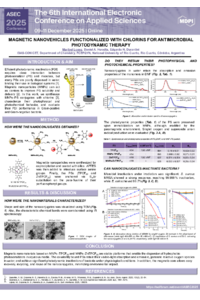
Photodynamic inactivation (PDI) has emerged as an effective and selective strategy for microbial inactivation, where close contact between microorganisms and the photosensitizer (PS) is essential to ensure its efficacy. Achieving proper dispersion of the PS in aqueous media is crucial for its performance. In this work, magnetic nanoparticles (MNPs) were designed as platforms to transport PSs in aqueous environments.
Iron oxide (Fe₃O₄) MNPs were synthesized using the conventional co-precipitation method. FeCl₂·4H₂O and FeCl₃·6H₂O were dissolved in water and reacted under mild conditions. The resulting MNPs were then coated with metasilicate, incorporating Na₂SiO₃·5H₂O, to provide colloidal stability. The obtained MNPs-SiO₂ was washed by magnetic decantation and functionalized with aminopropyltriethoxysilane (APTES) in a toluene/THF (1:1) mixture. This spacer introduced aliphatic amine groups capable of reacting through nucleophilic aromatic substitution (SNAr) with the PSs. Finally, the MNPs-SiO₂-NH₂ was suspended in DMF to react with 5,10,15,20-tetrakis(pentafluorophenyl)chlorin (TPCF20) and its Zn(II) complex (ZnTPCF20). This covalent coupling allowed for the preparation of MNPs-TPCF20 and MNPs-ZnTPCF20, which remained stable in aqueous solutions. Moreover, the magnetic nature of the MNPs-PS facilitated their removal from the medium using external magnetic fields. Spectroscopic characterizations confirmed the retention of the photophysical properties of the attached chlorins. The materials showed the ability to generate reactive oxygen species (ROS) and photodynamic efficacy against both Gram-positive and Gram-negative microorganisms. These results highlight the potential of chlorin-functionalized magnetic nanoparticles as effective antimicrobial agents for applications in aqueous environments.
Keywords
Magnetic nanoparticles
Chlorins
Photosensitizer
Poster
ML ASEC 2025.pdf
Treatment performance of agro-industrial biochar adsorption for arsenic-polluted potable water
Impact of AI technologies on the challenges of rural education in Mexico