Event submissions
Published
This submission belongs to the session S8. Applied Physical Science of the event The 6th International Electronic Conference on Applied Sciences
Published date
03 Dec, 2025
Academic Editor
'%3e%3cpath%20d='M12.6657%2010.9104C12.4185%2010.325%2012.0599%209.79327%2011.6097%209.34482C11.1609%208.89508%2010.6293%208.5365%2010.0442%208.28888C10.0389%208.28626%2010.0337%208.28495%2010.0285%208.28233C10.8446%207.69279%2011.3752%206.73249%2011.3752%205.64904C11.3752%203.8542%209.92103%202.39999%208.1262%202.39999C6.33136%202.39999%204.87715%203.8542%204.87715%205.64904C4.87715%206.73249%205.40774%207.69279%206.22393%208.28364C6.21869%208.28626%206.21345%208.28757%206.20821%208.29019C5.62129%208.5378%205.09463%208.89284%204.64265%209.34613C4.1929%209.79493%203.83432%2010.3266%203.58671%2010.9117C3.34345%2011.4845%203.21226%2012.0987%203.20023%2012.7209C3.19988%2012.7349%203.20233%2012.7488%203.20744%2012.7619C3.21255%2012.7749%203.22022%2012.7867%203.22998%2012.7968C3.23975%2012.8068%203.25142%2012.8147%203.26431%2012.8202C3.2772%2012.8256%203.29105%2012.8284%203.30504%2012.8284H4.09109C4.14874%2012.8284%204.19459%2012.7825%204.1959%2012.7262C4.2221%2011.7148%204.62823%2010.7676%205.34617%2010.0497C6.08899%209.30683%207.0755%208.89808%208.1262%208.89808C9.17689%208.89808%2010.1634%209.30683%2010.9062%2010.0497C11.6242%2010.7676%2012.0303%2011.7148%2012.0565%2012.7262C12.0578%2012.7838%2012.1037%2012.8284%2012.1613%2012.8284H12.9474C12.9613%2012.8284%2012.9752%2012.8256%2012.9881%2012.8202C13.001%2012.8147%2013.0126%2012.8068%2013.0224%2012.7968C13.0322%2012.7867%2013.0398%2012.7749%2013.0449%2012.7619C13.0501%2012.7488%2013.0525%2012.7349%2013.0522%2012.7209C13.0391%2012.0947%2012.9094%2011.4855%2012.6657%2010.9104ZM8.1262%207.9024C7.52486%207.9024%206.9589%207.6679%206.53312%207.24211C6.10733%206.81633%205.87283%206.25037%205.87283%205.64904C5.87283%205.0477%206.10733%204.48174%206.53312%204.05596C6.9589%203.63018%207.52486%203.39567%208.1262%203.39567C8.72753%203.39567%209.29349%203.63018%209.71927%204.05596C10.1451%204.48174%2010.3796%205.0477%2010.3796%205.64904C10.3796%206.25037%2010.1451%206.81633%209.71927%207.24211C9.29349%207.6679%208.72753%207.9024%208.1262%207.9024Z'%20fill='%235D1EE1'/%3e%3c/g%3e%3c/svg%3e) Nunzio Cennamo
Nunzio CennamoCitation
Mostafa Hussien Fytory Abdallah, Niccolo Marcucci, Ambra Giannetti, Francesco Baldini, Andreas Lesch, Simona Scarano, Cosmo Trono, Sara Tombelli, Long-Period Fiber Gratings coupled with Imprinted Biopolymers and Hydrogels for Advanced Biosensing Applications, in Proceedings of The 6th International Electronic Conference on Applied Sciences, 9 December–11 December 2025, MDPI: Basel, Switzerland
Share
Email
Facebook
Twitter
LinkedIn
Long-Period Fiber Gratings coupled with Imprinted Biopolymers and Hydrogels for Advanced Biosensing Applications
'%3e%3cpath%20d='M12.6647%2010.9104C12.4176%2010.325%2012.0589%209.7933%2011.6088%209.34485C11.16%208.89511%2010.6283%208.53653%2010.0432%208.28891C10.038%208.28629%2010.0327%208.28498%2010.0275%208.28236C10.8437%207.69282%2011.3743%206.73252%2011.3743%205.64907C11.3743%203.85423%209.92005%202.40002%208.12522%202.40002C6.33038%202.40002%204.87618%203.85423%204.87618%205.64907C4.87618%206.73252%205.40677%207.69282%206.22296%208.28367C6.21772%208.28629%206.21248%208.2876%206.20724%208.29022C5.62031%208.53783%205.09365%208.89287%204.64167%209.34616C4.19192%209.79496%203.83334%2010.3266%203.58573%2010.9117C3.34247%2011.4846%203.21128%2012.0987%203.19925%2012.721C3.1989%2012.735%203.20135%2012.7489%203.20646%2012.7619C3.21157%2012.7749%203.21924%2012.7868%203.22901%2012.7968C3.23877%2012.8068%203.25045%2012.8148%203.26334%2012.8202C3.27623%2012.8256%203.29007%2012.8284%203.30406%2012.8284H4.09012C4.14776%2012.8284%204.19362%2012.7825%204.19493%2012.7262C4.22113%2011.7148%204.62726%2010.7676%205.34519%2010.0497C6.08802%209.30686%207.07452%208.89811%208.12522%208.89811C9.17592%208.89811%2010.1624%209.30686%2010.9052%2010.0497C11.6232%2010.7676%2012.0293%2011.7148%2012.0555%2012.7262C12.0568%2012.7839%2012.1027%2012.8284%2012.1603%2012.8284H12.9464C12.9604%2012.8284%2012.9742%2012.8256%2012.9871%2012.8202C13%2012.8148%2013.0117%2012.8068%2013.0214%2012.7968C13.0312%2012.7868%2013.0389%2012.7749%2013.044%2012.7619C13.0491%2012.7489%2013.0515%2012.735%2013.0512%2012.721C13.0381%2012.0947%2012.9084%2011.4856%2012.6647%2010.9104ZM8.12522%207.90243C7.52388%207.90243%206.95792%207.66793%206.53214%207.24215C6.10636%206.81636%205.87185%206.2504%205.87185%205.64907C5.87185%205.04773%206.10636%204.48177%206.53214%204.05599C6.95792%203.63021%207.52388%203.3957%208.12522%203.3957C8.72655%203.3957%209.29252%203.63021%209.7183%204.05599C10.1441%204.48177%2010.3786%205.04773%2010.3786%205.64907C10.3786%206.2504%2010.1441%206.81636%209.7183%207.24215C9.29252%207.66793%208.72655%207.90243%208.12522%207.90243Z'%20fill='%235D1EE1'/%3e%3c/g%3e%3c/svg%3e)
Mostafa Hussien Fytory Abdallah 1
Niccolo Marcucci 2

Ambra Giannetti 2

Francesco Baldini 2
Andreas Lesch 3

Simona Scarano 4

Cosmo Trono 2

Sara Tombelli 2
1. Institute of applied physics "Nello Carrara" (IFAC), Sesto Fiorentino, Florence, Italy
2. Istituto di Fisica Applicata Nello Carrara – CNR, Sesto Fiorentino, Florence, Italy
3. Department of Industrial Chemistry "Toso Montanari", University of Bologna, Bologna, Italy
4. Department of Chemistry 'Ugo Schiff', University of Florence, Sesto Fiorentino, Florence, Italy
Abstract
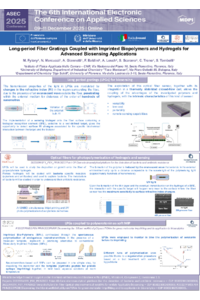
Long-period fiber gratings (LPFGs) have emerged as highly sensitive optical platforms for biosensing due to their responsiveness to refractive index changes. However, achieving the necessary sensitivity and selectivity for detecting biomolecules in complex real samples remains challenging. To overcome this, natural and biomimetic biological recognition elements (BREs) have been integrated with LPFGs, with the key step being the formation of a selective biolayer tailored to the target analyte.
This work explores imprinted biopolymers novel synthetic antibody mimics produced via the spontaneous polymerization of endogenous neurotransmitters such as dopamine or serotonin in the presence of molecular templates. Using LPFG sensors, the polymerization kinetics and growth conditions of a serotonin-based imprintable biopolymer were monitored in both templated and non-templated conditions, demonstrating their potential as functional coatings for biosensing.
Additionally, LPFGs were employed to study the coupling of various polymers and hydrogels to develop functional layers for BRE immobilization. In particular, the photopolymerization of acrylamide into polyacrylamide hydrogels was characterized. These hydrogels offer a porous and reactive matrix for the immobilization of antibodies and aptamers, enabling the capture of bacteria and the investigation of their antibiotic resistance.
Finally, the integration of LPFG sensors with thermally stabilized, custom-designed microfluidic systems enabled the combined advantages of the investigated polymers and hydrogels. This synergy enhances the performance of LPFG-based biosensors while maintaining their inherent benefits versatility, low cost, and portability, thus presenting a promising approach for developing advanced, highly specific, and sensitive biosensing platforms.
Keywords
Optical sensing
fiber grating
polymer
Poster
Poster Fytory ASEC 2025 on template_ST.pdf
From Global Noise to Local Accuracy: An Abstaining Classifier Approach for Robust Forest Mapping with Noisy Global Data
Use of Microbial Carriers in Anaerobic Digestion: Scientific and Research Aspects