Event submissions
Published
This submission belongs to the session S3. Computing and Artificial Intelligence of the event The 6th International Electronic Conference on Applied Sciences
Published date
03 Dec, 2025
Academic Editor
'%3e%3cpath%20d='M12.6657%2010.9104C12.4185%2010.325%2012.0599%209.79327%2011.6097%209.34482C11.1609%208.89508%2010.6293%208.5365%2010.0442%208.28888C10.0389%208.28626%2010.0337%208.28495%2010.0285%208.28233C10.8446%207.69279%2011.3752%206.73249%2011.3752%205.64904C11.3752%203.8542%209.92103%202.39999%208.1262%202.39999C6.33136%202.39999%204.87715%203.8542%204.87715%205.64904C4.87715%206.73249%205.40774%207.69279%206.22393%208.28364C6.21869%208.28626%206.21345%208.28757%206.20821%208.29019C5.62129%208.5378%205.09463%208.89284%204.64265%209.34613C4.1929%209.79493%203.83432%2010.3266%203.58671%2010.9117C3.34345%2011.4845%203.21226%2012.0987%203.20023%2012.7209C3.19988%2012.7349%203.20233%2012.7488%203.20744%2012.7619C3.21255%2012.7749%203.22022%2012.7867%203.22998%2012.7968C3.23975%2012.8068%203.25142%2012.8147%203.26431%2012.8202C3.2772%2012.8256%203.29105%2012.8284%203.30504%2012.8284H4.09109C4.14874%2012.8284%204.19459%2012.7825%204.1959%2012.7262C4.2221%2011.7148%204.62823%2010.7676%205.34617%2010.0497C6.08899%209.30683%207.0755%208.89808%208.1262%208.89808C9.17689%208.89808%2010.1634%209.30683%2010.9062%2010.0497C11.6242%2010.7676%2012.0303%2011.7148%2012.0565%2012.7262C12.0578%2012.7838%2012.1037%2012.8284%2012.1613%2012.8284H12.9474C12.9613%2012.8284%2012.9752%2012.8256%2012.9881%2012.8202C13.001%2012.8147%2013.0126%2012.8068%2013.0224%2012.7968C13.0322%2012.7867%2013.0398%2012.7749%2013.0449%2012.7619C13.0501%2012.7488%2013.0525%2012.7349%2013.0522%2012.7209C13.0391%2012.0947%2012.9094%2011.4855%2012.6657%2010.9104ZM8.1262%207.9024C7.52486%207.9024%206.9589%207.6679%206.53312%207.24211C6.10733%206.81633%205.87283%206.25037%205.87283%205.64904C5.87283%205.0477%206.10733%204.48174%206.53312%204.05596C6.9589%203.63018%207.52486%203.39567%208.1262%203.39567C8.72753%203.39567%209.29349%203.63018%209.71927%204.05596C10.1451%204.48174%2010.3796%205.0477%2010.3796%205.64904C10.3796%206.25037%2010.1451%206.81633%209.71927%207.24211C9.29349%207.6679%208.72753%207.9024%208.1262%207.9024Z'%20fill='%235D1EE1'/%3e%3c/g%3e%3c/svg%3e) Eugenio Vocaturo
Eugenio VocaturoCitation
Shoffan Saifullah, Rafał Dreżewski, Bayesian Optimization-Driven U-Net Architecture Tuning for Brain Tumor Segmentation, in Proceedings of The 6th International Electronic Conference on Applied Sciences, 9 December–11 December 2025, MDPI: Basel, Switzerland
Share
Email
Facebook
Twitter
LinkedIn
Bayesian Optimization-Driven U-Net Architecture Tuning for Brain Tumor Segmentation

Shoffan Saifullah 1,2

Rafał Dreżewski 1
1. Faculty of Computer Science, AGH University of Krakow, Krakow, Poland
2. Department of Informatics, Universitas Pembangunan Nasional Veteran Yogyakarta, Yogyakarta, Indonesia
Abstract
Precise brain tumor segmentation from MRI scans is critical for clinical diagnosis, surgical planning, and treatment monitoring. However, determining an optimal deep learning architecture remains a significant challenge due to the high-dimensional hyperparameter space, variability in tumor morphology, and differences across MRI modalities. This paper presents a novel approach that integrates Bayesian Optimization (BO) to systematically tune the U-Net architecture for enhanced brain tumor segmentation performance. The proposed BO-UNet framework explores various encoder, bottleneck, and decoder configurations using a Gaussian Process-based surrogate model. The optimization is guided by a composite fitness function that averages the Dice Similarity Coefficient (DSC) and Jaccard Index (JI), ensuring accurate spatial overlap between predicted and ground truth masks. Experiments were conducted on two benchmark datasets: the Figshare Brain Tumor Segmentation (FBTS) dataset and the BraTS 2021 dataset, with a focus on Whole Tumor (WT) segmentation. The best architecture discovered—[64, 64, 64, 256, 64, 128, 256]—demonstrated superior performance. On the FBTS dataset, it achieved 0.9503 DSC and 0.9054 JI, while on BraTS 2021 it reached 0.9261 DSC and 0.8631 JI, outperforming several state-of-the-art deep learning models. Convergence plots and segmentation map visualizations illustrate the effectiveness of BO in guiding architectural evolution. These findings highlight the potential of data-driven optimization strategies for automatic model design in medical image analysis, particularly in domains requiring high precision and structural sensitivity.
Keywords
Bayesian Optimization
U-Net Architecture
Brain Tumor Segmentation
Medical Image Analysis
MRI
Poster
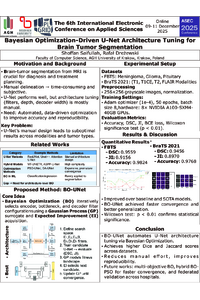
ASEC 2025 Poster.pdf
Fluid–structure interaction study of the influence of aortic valve leaflets' stiffness on hemodynamic performance
Secure and Adaptive Federated Learning with Knowledge Distillation and Hierarchical Homomorphic Encryption for Non-IID Data