Event submissions
Published
This submission belongs to the session S7. Food Science and Technology of the event The 6th International Electronic Conference on Applied Sciences
Published date
03 Dec, 2025
Academic Editor
'%3e%3cpath%20d='M12.6657%2010.9104C12.4185%2010.325%2012.0599%209.79327%2011.6097%209.34482C11.1609%208.89508%2010.6293%208.5365%2010.0442%208.28888C10.0389%208.28626%2010.0337%208.28495%2010.0285%208.28233C10.8446%207.69279%2011.3752%206.73249%2011.3752%205.64904C11.3752%203.8542%209.92103%202.39999%208.1262%202.39999C6.33136%202.39999%204.87715%203.8542%204.87715%205.64904C4.87715%206.73249%205.40774%207.69279%206.22393%208.28364C6.21869%208.28626%206.21345%208.28757%206.20821%208.29019C5.62129%208.5378%205.09463%208.89284%204.64265%209.34613C4.1929%209.79493%203.83432%2010.3266%203.58671%2010.9117C3.34345%2011.4845%203.21226%2012.0987%203.20023%2012.7209C3.19988%2012.7349%203.20233%2012.7488%203.20744%2012.7619C3.21255%2012.7749%203.22022%2012.7867%203.22998%2012.7968C3.23975%2012.8068%203.25142%2012.8147%203.26431%2012.8202C3.2772%2012.8256%203.29105%2012.8284%203.30504%2012.8284H4.09109C4.14874%2012.8284%204.19459%2012.7825%204.1959%2012.7262C4.2221%2011.7148%204.62823%2010.7676%205.34617%2010.0497C6.08899%209.30683%207.0755%208.89808%208.1262%208.89808C9.17689%208.89808%2010.1634%209.30683%2010.9062%2010.0497C11.6242%2010.7676%2012.0303%2011.7148%2012.0565%2012.7262C12.0578%2012.7838%2012.1037%2012.8284%2012.1613%2012.8284H12.9474C12.9613%2012.8284%2012.9752%2012.8256%2012.9881%2012.8202C13.001%2012.8147%2013.0126%2012.8068%2013.0224%2012.7968C13.0322%2012.7867%2013.0398%2012.7749%2013.0449%2012.7619C13.0501%2012.7488%2013.0525%2012.7349%2013.0522%2012.7209C13.0391%2012.0947%2012.9094%2011.4855%2012.6657%2010.9104ZM8.1262%207.9024C7.52486%207.9024%206.9589%207.6679%206.53312%207.24211C6.10733%206.81633%205.87283%206.25037%205.87283%205.64904C5.87283%205.0477%206.10733%204.48174%206.53312%204.05596C6.9589%203.63018%207.52486%203.39567%208.1262%203.39567C8.72753%203.39567%209.29349%203.63018%209.71927%204.05596C10.1451%204.48174%2010.3796%205.0477%2010.3796%205.64904C10.3796%206.25037%2010.1451%206.81633%209.71927%207.24211C9.29349%207.6679%208.72753%207.9024%208.1262%207.9024Z'%20fill='%235D1EE1'/%3e%3c/g%3e%3c/svg%3e) Antonios Koutelidakis
Antonios KoutelidakisCitation
Imane THAIFA, Hicham WAHNOU, Oumaima Anachad, Wafaa TAHA, Imad Fenjar, Houssam Assioui, Faiza BENNIS, Fatima CHEGDANI, Temporal Dynamics of Antioxidant Capacities in Fermentation Brines: Multi-Assay Evidence for Plant-Matrix-Driven Release of Bioactive Compounds and Prospects for Sustainable Functional Food Applications, in Proceedings of The 6th International Electronic Conference on Applied Sciences, 9 December–11 December 2025, MDPI: Basel, Switzerland
Share
Email
Facebook
Twitter
LinkedIn
Temporal Dynamics of Antioxidant Capacities in Fermentation Brines: Multi-Assay Evidence for Plant-Matrix-Driven Release of Bioactive Compounds and Prospects for Sustainable Functional Food Applications
'%3e%3cpath%20d='M12.6647%2010.9104C12.4176%2010.325%2012.0589%209.7933%2011.6088%209.34485C11.16%208.89511%2010.6283%208.53653%2010.0432%208.28891C10.038%208.28629%2010.0327%208.28498%2010.0275%208.28236C10.8437%207.69282%2011.3743%206.73252%2011.3743%205.64907C11.3743%203.85423%209.92005%202.40002%208.12522%202.40002C6.33038%202.40002%204.87618%203.85423%204.87618%205.64907C4.87618%206.73252%205.40677%207.69282%206.22296%208.28367C6.21772%208.28629%206.21248%208.2876%206.20724%208.29022C5.62031%208.53783%205.09365%208.89287%204.64167%209.34616C4.19192%209.79496%203.83334%2010.3266%203.58573%2010.9117C3.34247%2011.4846%203.21128%2012.0987%203.19925%2012.721C3.1989%2012.735%203.20135%2012.7489%203.20646%2012.7619C3.21157%2012.7749%203.21924%2012.7868%203.22901%2012.7968C3.23877%2012.8068%203.25045%2012.8148%203.26334%2012.8202C3.27623%2012.8256%203.29007%2012.8284%203.30406%2012.8284H4.09012C4.14776%2012.8284%204.19362%2012.7825%204.19493%2012.7262C4.22113%2011.7148%204.62726%2010.7676%205.34519%2010.0497C6.08802%209.30686%207.07452%208.89811%208.12522%208.89811C9.17592%208.89811%2010.1624%209.30686%2010.9052%2010.0497C11.6232%2010.7676%2012.0293%2011.7148%2012.0555%2012.7262C12.0568%2012.7839%2012.1027%2012.8284%2012.1603%2012.8284H12.9464C12.9604%2012.8284%2012.9742%2012.8256%2012.9871%2012.8202C13%2012.8148%2013.0117%2012.8068%2013.0214%2012.7968C13.0312%2012.7868%2013.0389%2012.7749%2013.044%2012.7619C13.0491%2012.7489%2013.0515%2012.735%2013.0512%2012.721C13.0381%2012.0947%2012.9084%2011.4856%2012.6647%2010.9104ZM8.12522%207.90243C7.52388%207.90243%206.95792%207.66793%206.53214%207.24215C6.10636%206.81636%205.87185%206.2504%205.87185%205.64907C5.87185%205.04773%206.10636%204.48177%206.53214%204.05599C6.95792%203.63021%207.52388%203.3957%208.12522%203.3957C8.72655%203.3957%209.29252%203.63021%209.7183%204.05599C10.1441%204.48177%2010.3786%205.04773%2010.3786%205.64907C10.3786%206.2504%2010.1441%206.81636%209.7183%207.24215C9.29252%207.66793%208.72655%207.90243%208.12522%207.90243Z'%20fill='%235D1EE1'/%3e%3c/g%3e%3c/svg%3e)
Imane THAIFA 1
Hicham WAHNOU 1
Oumaima Anachad 1
Wafaa TAHA 1
Imad Fenjar 1
Houssam Assioui 1,2
Faiza BENNIS 1
Fatima CHEGDANI 1
1. Laboratory of Integrative Biology, Faculty of Sciences Aïn Chock, Hassan II University of Casablanca, Morocco
2. Aix-Marseille Université - Campus Santé Timone - Faculté de Médecine
27, Bd Jean Moulin, 13005 Marseille
Abstract
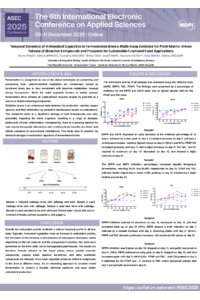
Fermentation is recognized as one of the oldest techniques for preserving and processing food. Lacto-fermented vegetables are increasingly valued as functional foods due to their enrichment with bioactive metabolites released during fermentation. While the solid vegetable fraction is widely studied, fermentation brine remains an underutilized resource despite its potential as a source of health-enhancing compounds. This study aims to examine the temporal changes in antioxidant capacities of fermentation brines.
The antioxidant potential of brines from fermented vegetables samples prepared from different combinations of cabbage, beetroot, carrot, cucumber, and bell pepper was evaluated during fermentation. Antioxidant activity was measured at different time points (0, 12, 24, 72, 120, 240, 360, and 504 hours) using four in vitro tests: ABTS, DPPH, FRAP, and TAC.
All brine samples showed antioxidant activity, which varied significantly over time. ABTS showed a strong radical scavenging activity, reaching up to 96% on day 21, while DPPH activity was moderate, with a maximum of 54% the same sampling time. The FRAP activity highest absorbance value reached 2.071 on day 21, while TAC peaked at an absorbance value of 1.788 on the same day, confirming the antioxidant potential of brines. These variations can be explained by the plant matrix and the gradual diffusion of bioactive compounds during fermentation. Overall, this study highlights fermentation brines as a promising and lasting source of natural antioxidants. Rather than being perceived as waste, these products could be used as useful ingredients for nutritional and food applications, contributing to sustainable and circular food systems.
Keywords
fermentation
antioxydants
bioactive compounds
food
Poster
poster IMANE (2).pdf
Secure and Adaptive Federated Learning with Knowledge Distillation and Hierarchical Homomorphic Encryption for Non-IID Data
Loquat Leaf Extract as a Natural Antioxidant for Food Applications: Phytochemical Profiling and Bioactivity Assessment