Event submissions
Published
This submission belongs to the session S7. Food Science and Technology of the event The 6th International Electronic Conference on Applied Sciences
Published date
03 Dec, 2025
Academic Editor
'%3e%3cpath%20d='M12.6657%2010.9104C12.4185%2010.325%2012.0599%209.79327%2011.6097%209.34482C11.1609%208.89508%2010.6293%208.5365%2010.0442%208.28888C10.0389%208.28626%2010.0337%208.28495%2010.0285%208.28233C10.8446%207.69279%2011.3752%206.73249%2011.3752%205.64904C11.3752%203.8542%209.92103%202.39999%208.1262%202.39999C6.33136%202.39999%204.87715%203.8542%204.87715%205.64904C4.87715%206.73249%205.40774%207.69279%206.22393%208.28364C6.21869%208.28626%206.21345%208.28757%206.20821%208.29019C5.62129%208.5378%205.09463%208.89284%204.64265%209.34613C4.1929%209.79493%203.83432%2010.3266%203.58671%2010.9117C3.34345%2011.4845%203.21226%2012.0987%203.20023%2012.7209C3.19988%2012.7349%203.20233%2012.7488%203.20744%2012.7619C3.21255%2012.7749%203.22022%2012.7867%203.22998%2012.7968C3.23975%2012.8068%203.25142%2012.8147%203.26431%2012.8202C3.2772%2012.8256%203.29105%2012.8284%203.30504%2012.8284H4.09109C4.14874%2012.8284%204.19459%2012.7825%204.1959%2012.7262C4.2221%2011.7148%204.62823%2010.7676%205.34617%2010.0497C6.08899%209.30683%207.0755%208.89808%208.1262%208.89808C9.17689%208.89808%2010.1634%209.30683%2010.9062%2010.0497C11.6242%2010.7676%2012.0303%2011.7148%2012.0565%2012.7262C12.0578%2012.7838%2012.1037%2012.8284%2012.1613%2012.8284H12.9474C12.9613%2012.8284%2012.9752%2012.8256%2012.9881%2012.8202C13.001%2012.8147%2013.0126%2012.8068%2013.0224%2012.7968C13.0322%2012.7867%2013.0398%2012.7749%2013.0449%2012.7619C13.0501%2012.7488%2013.0525%2012.7349%2013.0522%2012.7209C13.0391%2012.0947%2012.9094%2011.4855%2012.6657%2010.9104ZM8.1262%207.9024C7.52486%207.9024%206.9589%207.6679%206.53312%207.24211C6.10733%206.81633%205.87283%206.25037%205.87283%205.64904C5.87283%205.0477%206.10733%204.48174%206.53312%204.05596C6.9589%203.63018%207.52486%203.39567%208.1262%203.39567C8.72753%203.39567%209.29349%203.63018%209.71927%204.05596C10.1451%204.48174%2010.3796%205.0477%2010.3796%205.64904C10.3796%206.25037%2010.1451%206.81633%209.71927%207.24211C9.29349%207.6679%208.72753%207.9024%208.1262%207.9024Z'%20fill='%235D1EE1'/%3e%3c/g%3e%3c/svg%3e) Antonios Koutelidakis
Antonios KoutelidakisCitation
Yasmine Abdelouahed, Souad Djellali, Rachid Sahraoui, Youssra Mihoune, Loquat Leaf Extract as a Natural Antioxidant for Food Applications: Phytochemical Profiling and Bioactivity Assessment, in Proceedings of The 6th International Electronic Conference on Applied Sciences, 9 December–11 December 2025, MDPI: Basel, Switzerland
Share
Email
Facebook
Twitter
LinkedIn
Loquat Leaf Extract as a Natural Antioxidant for Food Applications: Phytochemical Profiling and Bioactivity Assessment
'%3e%3cpath%20d='M12.6647%2010.9104C12.4176%2010.325%2012.0589%209.7933%2011.6088%209.34485C11.16%208.89511%2010.6283%208.53653%2010.0432%208.28891C10.038%208.28629%2010.0327%208.28498%2010.0275%208.28236C10.8437%207.69282%2011.3743%206.73252%2011.3743%205.64907C11.3743%203.85423%209.92005%202.40002%208.12522%202.40002C6.33038%202.40002%204.87618%203.85423%204.87618%205.64907C4.87618%206.73252%205.40677%207.69282%206.22296%208.28367C6.21772%208.28629%206.21248%208.2876%206.20724%208.29022C5.62031%208.53783%205.09365%208.89287%204.64167%209.34616C4.19192%209.79496%203.83334%2010.3266%203.58573%2010.9117C3.34247%2011.4846%203.21128%2012.0987%203.19925%2012.721C3.1989%2012.735%203.20135%2012.7489%203.20646%2012.7619C3.21157%2012.7749%203.21924%2012.7868%203.22901%2012.7968C3.23877%2012.8068%203.25045%2012.8148%203.26334%2012.8202C3.27623%2012.8256%203.29007%2012.8284%203.30406%2012.8284H4.09012C4.14776%2012.8284%204.19362%2012.7825%204.19493%2012.7262C4.22113%2011.7148%204.62726%2010.7676%205.34519%2010.0497C6.08802%209.30686%207.07452%208.89811%208.12522%208.89811C9.17592%208.89811%2010.1624%209.30686%2010.9052%2010.0497C11.6232%2010.7676%2012.0293%2011.7148%2012.0555%2012.7262C12.0568%2012.7839%2012.1027%2012.8284%2012.1603%2012.8284H12.9464C12.9604%2012.8284%2012.9742%2012.8256%2012.9871%2012.8202C13%2012.8148%2013.0117%2012.8068%2013.0214%2012.7968C13.0312%2012.7868%2013.0389%2012.7749%2013.044%2012.7619C13.0491%2012.7489%2013.0515%2012.735%2013.0512%2012.721C13.0381%2012.0947%2012.9084%2011.4856%2012.6647%2010.9104ZM8.12522%207.90243C7.52388%207.90243%206.95792%207.66793%206.53214%207.24215C6.10636%206.81636%205.87185%206.2504%205.87185%205.64907C5.87185%205.04773%206.10636%204.48177%206.53214%204.05599C6.95792%203.63021%207.52388%203.3957%208.12522%203.3957C8.72655%203.3957%209.29252%203.63021%209.7183%204.05599C10.1441%204.48177%2010.3786%205.04773%2010.3786%205.64907C10.3786%206.2504%2010.1441%206.81636%209.7183%207.24215C9.29252%207.66793%208.72655%207.90243%208.12522%207.90243Z'%20fill='%235D1EE1'/%3e%3c/g%3e%3c/svg%3e)
Yasmine Abdelouahed 1,2
Souad Djellali 1,2
Rachid Sahraoui 3
Youssra Mihoune 1,2
1. Department of Chemistry, Faculty of Sciences, University Ferhat Abbas Setif 1, 19000, Setif, Algeria
2. Laboratory of Physical Chemistry of High Polymers, University Ferhat Abbas Setif 1, 19000, Setif, Algeria
3. Laboratory of Valorisation of Natural Biological Resources, University Ferhat Abbas Setif 1, 19000, Setif, Algeria
Abstract
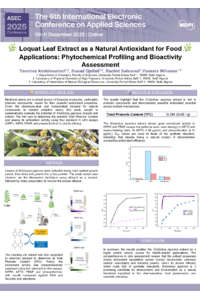
Medicinal plants are precious reservoirs of bioactive molecules; they are able to produce diverse natural substances. Currently, research is focused on creating new applications and taking advantage of the qualities of these resources in many industries, including the food, cosmetics, and pharmaceutical industries [1]. In line with this global interest in medicinal plants In this work we explore the antimicrobial properties of the Eriobotrya japonica, the extract has been obtained after plant leaves were meticulously collected during their optimal growth period, followed by a careful process of drying and grinding. Employing the Maceration technique, we utilized ethanol as the solvent for extraction, with subsequent defatting accomplished using hexane. The total phenolic content in the Eriobotrya japonica extract was determined to be 384.19 µg/mL gallic acid equivalents, indicating that the plant is rich in phenolic compounds. The antioxidant activity also was evaluated by various antioxidant methods, including 2,2-diphenyl-1-picrylhydrazyl (DPPH), 2,2-Azinobis (3-ethylbenzothiazolin) -6-sulphonic acid (ABTS), Ferric Reducing Antioxidant Power (FRAP), and phenanthroline. Those various antioxidant activities were compared to standard antioxidants such as butylated hydroxyanisole (BHA) and butylated hydroxytoluene (BHT). The extract demonstrated strong antioxidant activity across all methods, with low IC₅₀ values 253.6 , 1.68 , 32.68 and 4.11 µg/mL respectively, Overall, the results suggest that Eriobotrya japonica is a valuable plant with strong antioxidant properties, making it a potential candidate for various health-related applications.
Keywords
Eriobotrya japonica
Phenolic compounds
Antioxidant activity
Traditional medicine
Plant extract.
Poster
Poster_ASEC_2015_ABDELOUAHED.pdf
Temporal Dynamics of Antioxidant Capacities in Fermentation Brines: Multi-Assay Evidence for Plant-Matrix-Driven Release of Bioactive Compounds and Prospects for Sustainable Functional Food Applications
Adaptive Marine Predators Algorithm for Optimizing CNNs in Malaria Detection