Event submissions
Published
This submission belongs to the session S1. Applied Biosciences and Bioengineering of the event The 6th International Electronic Conference on Applied Sciences
Published date
03 Dec, 2025
Academic Editor
'%3e%3cpath%20d='M12.6657%2010.9104C12.4185%2010.325%2012.0599%209.79327%2011.6097%209.34482C11.1609%208.89508%2010.6293%208.5365%2010.0442%208.28888C10.0389%208.28626%2010.0337%208.28495%2010.0285%208.28233C10.8446%207.69279%2011.3752%206.73249%2011.3752%205.64904C11.3752%203.8542%209.92103%202.39999%208.1262%202.39999C6.33136%202.39999%204.87715%203.8542%204.87715%205.64904C4.87715%206.73249%205.40774%207.69279%206.22393%208.28364C6.21869%208.28626%206.21345%208.28757%206.20821%208.29019C5.62129%208.5378%205.09463%208.89284%204.64265%209.34613C4.1929%209.79493%203.83432%2010.3266%203.58671%2010.9117C3.34345%2011.4845%203.21226%2012.0987%203.20023%2012.7209C3.19988%2012.7349%203.20233%2012.7488%203.20744%2012.7619C3.21255%2012.7749%203.22022%2012.7867%203.22998%2012.7968C3.23975%2012.8068%203.25142%2012.8147%203.26431%2012.8202C3.2772%2012.8256%203.29105%2012.8284%203.30504%2012.8284H4.09109C4.14874%2012.8284%204.19459%2012.7825%204.1959%2012.7262C4.2221%2011.7148%204.62823%2010.7676%205.34617%2010.0497C6.08899%209.30683%207.0755%208.89808%208.1262%208.89808C9.17689%208.89808%2010.1634%209.30683%2010.9062%2010.0497C11.6242%2010.7676%2012.0303%2011.7148%2012.0565%2012.7262C12.0578%2012.7838%2012.1037%2012.8284%2012.1613%2012.8284H12.9474C12.9613%2012.8284%2012.9752%2012.8256%2012.9881%2012.8202C13.001%2012.8147%2013.0126%2012.8068%2013.0224%2012.7968C13.0322%2012.7867%2013.0398%2012.7749%2013.0449%2012.7619C13.0501%2012.7488%2013.0525%2012.7349%2013.0522%2012.7209C13.0391%2012.0947%2012.9094%2011.4855%2012.6657%2010.9104ZM8.1262%207.9024C7.52486%207.9024%206.9589%207.6679%206.53312%207.24211C6.10733%206.81633%205.87283%206.25037%205.87283%205.64904C5.87283%205.0477%206.10733%204.48174%206.53312%204.05596C6.9589%203.63018%207.52486%203.39567%208.1262%203.39567C8.72753%203.39567%209.29349%203.63018%209.71927%204.05596C10.1451%204.48174%2010.3796%205.0477%2010.3796%205.64904C10.3796%206.25037%2010.1451%206.81633%209.71927%207.24211C9.29349%207.6679%208.72753%207.9024%208.1262%207.9024Z'%20fill='%235D1EE1'/%3e%3c/g%3e%3c/svg%3e) Roger Narayan
Roger NarayanCitation
Natalia Trufanova, Galyna Bozhok, Daria Cherkashina, Oleh Trufanov, Olena Revenko, Oleksandr Pakhomov, Oleksandr Petrenko, Ambient storage of bioengineered MSC-based 3D constructs, in Proceedings of The 6th International Electronic Conference on Applied Sciences, 9 December–11 December 2025, MDPI: Basel, Switzerland
Share
Email
Facebook
Twitter
LinkedIn
Ambient storage of bioengineered MSC-based 3D constructs
'%3e%3cpath%20d='M12.6647%2010.9104C12.4176%2010.325%2012.0589%209.7933%2011.6088%209.34485C11.16%208.89511%2010.6283%208.53653%2010.0432%208.28891C10.038%208.28629%2010.0327%208.28498%2010.0275%208.28236C10.8437%207.69282%2011.3743%206.73252%2011.3743%205.64907C11.3743%203.85423%209.92005%202.40002%208.12522%202.40002C6.33038%202.40002%204.87618%203.85423%204.87618%205.64907C4.87618%206.73252%205.40677%207.69282%206.22296%208.28367C6.21772%208.28629%206.21248%208.2876%206.20724%208.29022C5.62031%208.53783%205.09365%208.89287%204.64167%209.34616C4.19192%209.79496%203.83334%2010.3266%203.58573%2010.9117C3.34247%2011.4846%203.21128%2012.0987%203.19925%2012.721C3.1989%2012.735%203.20135%2012.7489%203.20646%2012.7619C3.21157%2012.7749%203.21924%2012.7868%203.22901%2012.7968C3.23877%2012.8068%203.25045%2012.8148%203.26334%2012.8202C3.27623%2012.8256%203.29007%2012.8284%203.30406%2012.8284H4.09012C4.14776%2012.8284%204.19362%2012.7825%204.19493%2012.7262C4.22113%2011.7148%204.62726%2010.7676%205.34519%2010.0497C6.08802%209.30686%207.07452%208.89811%208.12522%208.89811C9.17592%208.89811%2010.1624%209.30686%2010.9052%2010.0497C11.6232%2010.7676%2012.0293%2011.7148%2012.0555%2012.7262C12.0568%2012.7839%2012.1027%2012.8284%2012.1603%2012.8284H12.9464C12.9604%2012.8284%2012.9742%2012.8256%2012.9871%2012.8202C13%2012.8148%2013.0117%2012.8068%2013.0214%2012.7968C13.0312%2012.7868%2013.0389%2012.7749%2013.044%2012.7619C13.0491%2012.7489%2013.0515%2012.735%2013.0512%2012.721C13.0381%2012.0947%2012.9084%2011.4856%2012.6647%2010.9104ZM8.12522%207.90243C7.52388%207.90243%206.95792%207.66793%206.53214%207.24215C6.10636%206.81636%205.87185%206.2504%205.87185%205.64907C5.87185%205.04773%206.10636%204.48177%206.53214%204.05599C6.95792%203.63021%207.52388%203.3957%208.12522%203.3957C8.72655%203.3957%209.29252%203.63021%209.7183%204.05599C10.1441%204.48177%2010.3786%205.04773%2010.3786%205.64907C10.3786%206.2504%2010.1441%206.81636%209.7183%207.24215C9.29252%207.66793%208.72655%207.90243%208.12522%207.90243Z'%20fill='%235D1EE1'/%3e%3c/g%3e%3c/svg%3e)
Natalia Trufanova 1
Galyna Bozhok 2
Daria Cherkashina 1
Oleh Trufanov 3
Olena Revenko 1
Oleksandr Pakhomov 2
Oleksandr Petrenko 1
1. Cryobiochemistry department, Institute for Problems of Cryobiology and Cryomedicine of National Academy of Sciences of Ukraine, Kharkiv 61015, Ukraine
2. Cryoendocrinology department, Institute for Problems of Cryobiology and Cryomedicine of National Academy of Sciences of Ukraine, Kharkiv 61015, Ukraine
3. Cryomicrobiology department, Institute for Problems of Cryobiology and Cryomedicine of National Academy of Sciences of Ukraine, Kharkiv 61015, Ukraine
Abstract
Introduction:
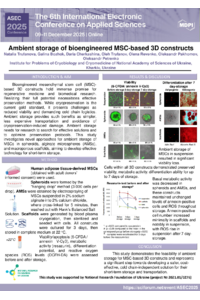
Bioengineered mesenchymal stem cell (MSC)-based 3D constructs hold immense promise for regenerative medicine and biomedical research. Realizing their full potential necessitates effective preservation methods. While cryopreservation is the current gold standard, it presents challenges such as reduced viability and demanding cold chain logistics. This study investigates novel approaches for ambient storage of MSCs in spheroids, alginate microspheres (AMSs), and macroporous scaffolds, aiming to develop effective technology for short-term storage.
Methods:
Human adipose tissue-derived MSCs were used. Spheroids were formed using the "hanging drop" method, AMSs via electrospraying, and scaffolds by means of plasma cryogelation before cell seeding. Constructs were cultured for 3 days and then stored in complete medium at 22 °C. Viability/apoptosis (6-CFDA/annexin V-Cy3), metabolic activity (resazurin), differentiation potential, and reactive oxygen species (ROS) levels (DCFH-DA) were assessed before and after storage.
Results and Discussion:
Ambient storage of MSCs in suspension resulted in significant viability loss. Cells within all 3D constructs demonstrated preserved viability, metabolic activity, and differentiation ability for up to 7 days of storage. Basal metabolic activity was decreased in spheroids and AMSs, and these constructs maintained unchanged levels of annexin-positive cells and ROS throughout storage. Annexin-positive cell number increased minimally in scaffolds and notably in suspension, with ROS rise in suspension after 7-day storage.
Conclusions:
This study demonstrates the feasibility of ambient storage for MSC-based 3D constructs and represents a significant step towards developing a safer, cost-effective, cold chain-independent solution for their short-term storage and transportation.
This study was supported by the National Research Foundation of Ukraine (project № 2021.01/0276).
Keywords
MSC-based 3D constructs
ambient storage
viability
metabolic activity
apoptosis
ROS metabolism
Poster
Trufanova.pdf
A Bio-Inspired Hybrid Optimization Framework for Precision Agriculture Using PSO–ACO and Neural Networks
A machine learning algorithm for urban vegetation classification based on radar and multispectral imagery from sentinel satellites data